
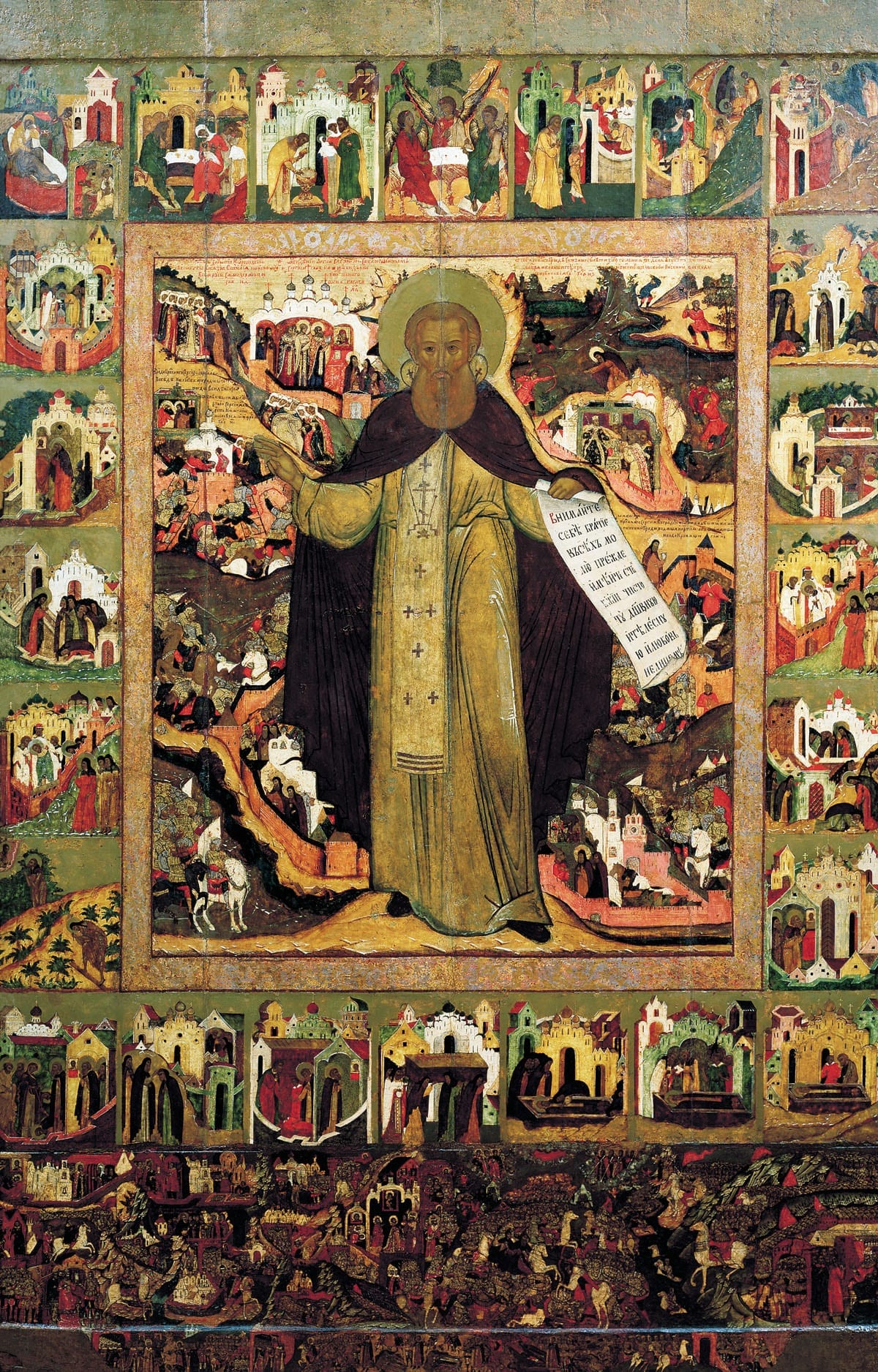
Bartholomew (the future Sergius) was born to a noble family of Rostov during the dark second century of the Mongol Yoke that had broken Kievan Rus' in 1240. His family was reduced by Mongol taxation, lost its estates, and moved to the village of Radonezh north of Moscow. As an adolescent he had famous difficulty learning to read until, by his own account, an old man encountered in the forest gave him a piece of consecrated bread and his understanding opened.
After his parents' death, around 1337, he and his brother Stephen withdrew to a wilderness in the deep forest north of Moscow to live as hermits. They built a small chapel dedicated to the Holy Trinity. Stephen could not endure the privations and left; Bartholomew remained alone for several years and took monastic vows under the name Sergius. Other monks began joining him, and the community grew into the Holy Trinity Lavra — restoring Russian monasticism after a century in which it had been all but obliterated by the Mongol invasions.
He refused the Metropolitan throne of Moscow when it was offered him in 1378. The following year he was visited by Grand Prince Dmitry of Moscow on the eve of his campaign against the Tatar khan Mamai. Sergius blessed the prince and sent two of his monks (the former boyar-warriors Peresvet and Oslyabya) to fight in the army. The Russian victory at Kulikovo on September 8, 1380 — the first major military defeat of the Mongol Yoke — was understood in Russian historical memory as Sergius's miracle, and he became the principal heavenly patron of the Russian polity. The Trinity Lavra has remained the spiritual heart of Russian Christianity for seven centuries, including under Soviet anti-religious campaigns when the relics survived all attempts at destruction.