
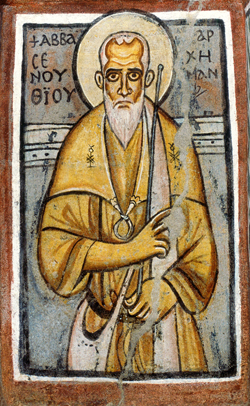
Shenoute (Coptic Šenūte; Greek Senuthios; Arabic Anba Shenuda) was — per the unanimous Coptic tradition — born to a small Coptic peasant family in Upper Egypt around 348 AD. He entered the White Monastery (Coptic Deir Anba Shenouda, named for the distinctive white limestone of its surrounding cliffs) as a child at about 13 years of age, under the abbacy of his uncle Pgol — the foundational abbot of the White Monastery, which had been founded around 340 AD as a Coptic-language reform of the Greek-language Pachomian cenobitic monastic tradition.
Shenoute became abbot of the White Monastery around 385 AD, succeeding his uncle, and governed the monastery for 81 years — the longest abbatial tenure in early Christian history. Under his governance the White Monastery grew to become the largest single Christian monastic community in the entire late-antique world: contemporary sources record at its peak (around 420 AD) approximately 2,200 male monks and 1,800 female nuns in the White Monastery system, organized in multiple specialized monastic-conventual communities across the southern Egyptian Nile Valley.
His historical importance is twofold. First, Shenoute is the foundational author of Sahidic Coptic literature — the literary form of the Sahidic dialect of Coptic that became the standard literary register of the entire post-patristic Coptic Christian tradition. His extensive surviving writings (over 100 substantial works, in nine large volumes) are the principal foundational corpus of Coptic-language Christian literature.
Second, Shenoute was a leading early-Catholic theological figure of the great Christological controversies of the 5th century. He accompanied Cyril of Alexandria (see Cyril's entry already in the catalogue) to the Council of Ephesus of 431 as one of Cyril's principal advisors, and was a vigorous defender of the Theotokos definition. After the catastrophic Council of Chalcedon of 451 (which the Coptic tradition rejected as compromising the Cyrillic Christological line — the foundational moment of the divergence between the Coptic Orthodox and the Catholic Latin/Byzantine traditions), Shenoute became one of the principal post-Chalcedonian Coptic-tradition defenders of the Miaphysite Cyrillic Christological line.
He died at the White Monastery around 466 AD at approximately 118 years of age (the extreme longevity may be partly hagiographic embellishment but is solidly attested in the contemporary Coptic sources). His tomb at the White Monastery has been a continuous Coptic pilgrimage site for over 1,560 years.