
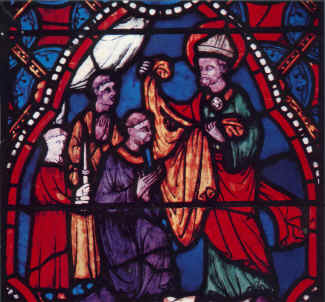
Gaius Sollius Modestus Apollinaris Sidonius (Latin Sidonius Apollinaris) was born on November 5, 430 AD at Lyon — the foundational birth-date for late-Roman Gallic patrician identity — to a family of the very highest-ranking Roman Gallic senatorial nobility. His father had been Praetorian Prefect of Gaul under Valentinian III; his maternal grandfather Apollinaris had been Praetorian Prefect of Gaul under the Emperor Constantine III in 408. Sidonius was educated in the most extensive Roman-rhetorical-classical tradition available in 5th-century Gaul.
He married Papianilla, daughter of the Emperor Avitus, around 452. When his father-in-law Avitus was made Western Emperor in 455 (the brief 455–456 reign), Sidonius accompanied him to Rome as senior personal courtier. After Avitus's deposition and Sidonius's own brief period of imperial-political ambition (he served as Praefectus Urbi of Rome in 468 under the Emperor Anthemius), Sidonius withdrew from political life and returned to his great Gallic estates in Auvergne.
Around 470 AD, by what amounts to acclamation of the Auvergne Catholic community, Sidonius — a layman who had never been ordained even deacon — was elected Bishop of Clermont (the Roman provincial capital of Auvergne in the Massif Central of central France). He was rapidly ordained and consecrated bishop. He governed the Clermont see for nineteen years through the catastrophic final collapse of Roman Gallic governance: the Visigothic conquest of Aquitaine and Auvergne by King Euric (the foundational episode of Western Gallic post-Roman governance).
Sidonius led the substantial Auvergne Roman-Catholic resistance to the Visigothic conquest — fortifying Clermont, organizing the defence, and personally leading the small surviving Roman patrician aristocracy of the Auvergne region. After the formal Visigothic capture of Clermont in 475 (the Treaty of 475 ceded Auvergne to the Visigoths), Sidonius was briefly imprisoned by Euric at Bordeaux and then permitted to return to his see. He continued to govern Clermont under Visigothic rule until his death on August 21, 489.
His historical importance is foundational. His extensive surviving literary corpus — nine books of Letters, twenty-four major Carmina (formal Latin poems) — is the principal Latin literary record of the late-Roman-to-medieval transition in Gaul. His Letters describe in extensive personal detail the daily life of the late-Roman Gallic patrician class, the gradual collapse of Roman urban-civic institutions, the Visigothic occupation of southern Gaul, the relationships between the surviving Roman population and the new Germanic governance, and the gradual emergence of the new post-Roman Catholic-Christian civic identity. He is the foundational Latin literary witness of the end of the Roman Empire in Gaul.