
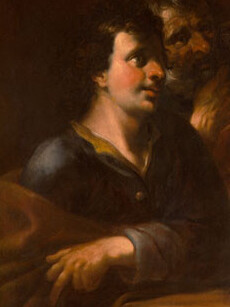
Silas (Greek Silas, perhaps from Hebrew Sha'ul/Saul, or perhaps an Aramaic Greek transliteration; also called Silvanus in Latin) was a prominent member of the Jerusalem Christian community, identified by Luke as 'a leading man among the brethren' and 'a prophet' (Acts 15:22, 32). He was chosen by the Jerusalem Council of AD 49 to accompany Paul and Barnabas back to Antioch with the foundational decree on the inclusion of the Gentiles.
When Paul and Barnabas separated after the dispute over John Mark (Acts 15:39), Paul chose Silas as his new partner for what became the celebrated Second Missionary Journey (c. AD 50–53). The two travelled through Asia Minor and crossed into Europe at Troas (the famous Macedonian Vision of Acts 16:9). At Philippi they were arrested, severely beaten, and imprisoned; they were singing hymns of praise to God at midnight when an earthquake opened the prison and converted the jailer (the foundational New Testament episode of Christian witness under imprisonment). The two continued through Thessalonica, Berea, Athens, and finally Corinth.
Silas is named as joint co-author of both 1 and 2 Thessalonians (the earliest of the surviving Pauline letters, c. AD 51 from Corinth) and is identified by Peter as the bearer of his first epistle ('By Silvanus, a faithful brother as I count him, I have briefly written' — 1 Peter 5:12). The Greek prose style of 1 Peter has long been associated with Silas. He was the first Bishop of Corinth in the Byzantine tradition.