
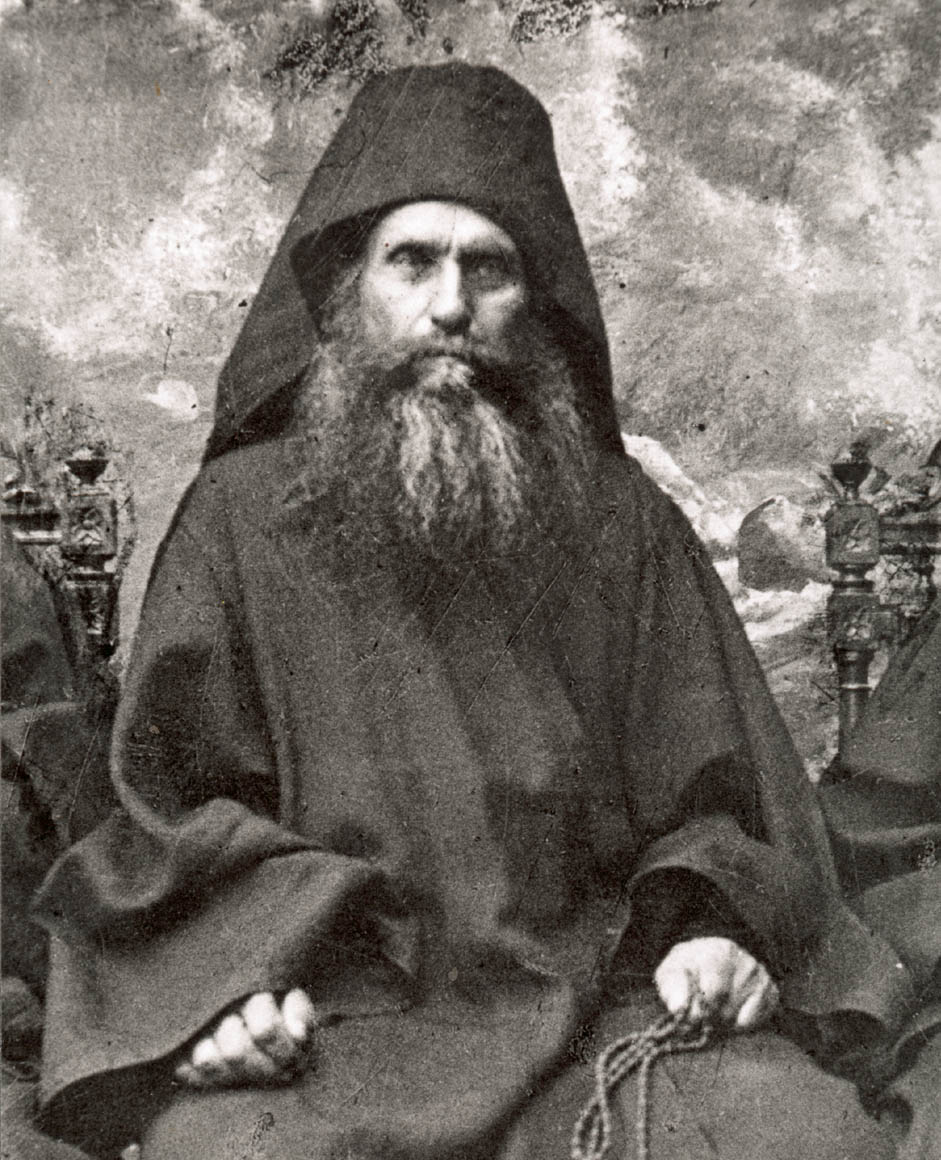
Semyon Antonov was born to a Russian peasant family in the Tambov Governorate, served briefly in the Imperial Russian Army Engineer corps in St. Petersburg, and at twenty-six in 1892 set out for Mount Athos to enter the Russian monastery of St. Panteleimon (the Russikon) — at that time, the great Russian-Athonite community housing over 2,000 monks, the principal channel of Russian Orthodox spirituality. He took monastic vows in 1896 with the religious name Silouan and lived as a simple monastic labourer at the Russikon for the remaining 42 years of his life — never holding any office in the community, never ordained priest, working successively as flour-mill keeper, storehouse keeper, and finally as keeper of the metochion (the small outlying chapel of Old Russikon).
His hidden mystical life centered on a single foundational experience early in his Athonite years: in 1896, in a long period of profound demonic temptation and interior despair, Christ appeared to him in his cell and spoke a brief teaching that became the central message of his life: 'Keep thy mind in hell, and despair not' (Russian: Derzhi um tvoy vo ade i ne otchayvaisya). The paradoxical command — that the soul should hold itself in the truth of its sinfulness without losing hope in the unconditional mercy of God — became the foundational principle of his subsequent contemplative theology.
His writings — the Notes that he kept secretly under religious obedience to his Russikon confessor, the future Elder Sophrony (Sergei Sakharov, 1896–1993) — were assembled and published by Sophrony after Silouan's death as Silouan the Athonite (1948, Russian; 1958, English: Wisdom from Mount Athos). The book became, through the 1960s and 1970s, one of the principal 20th-century introductions of Eastern Orthodox mystical theology to Western Christian audiences. Canonized by the Ecumenical Patriarchate in 1987.