
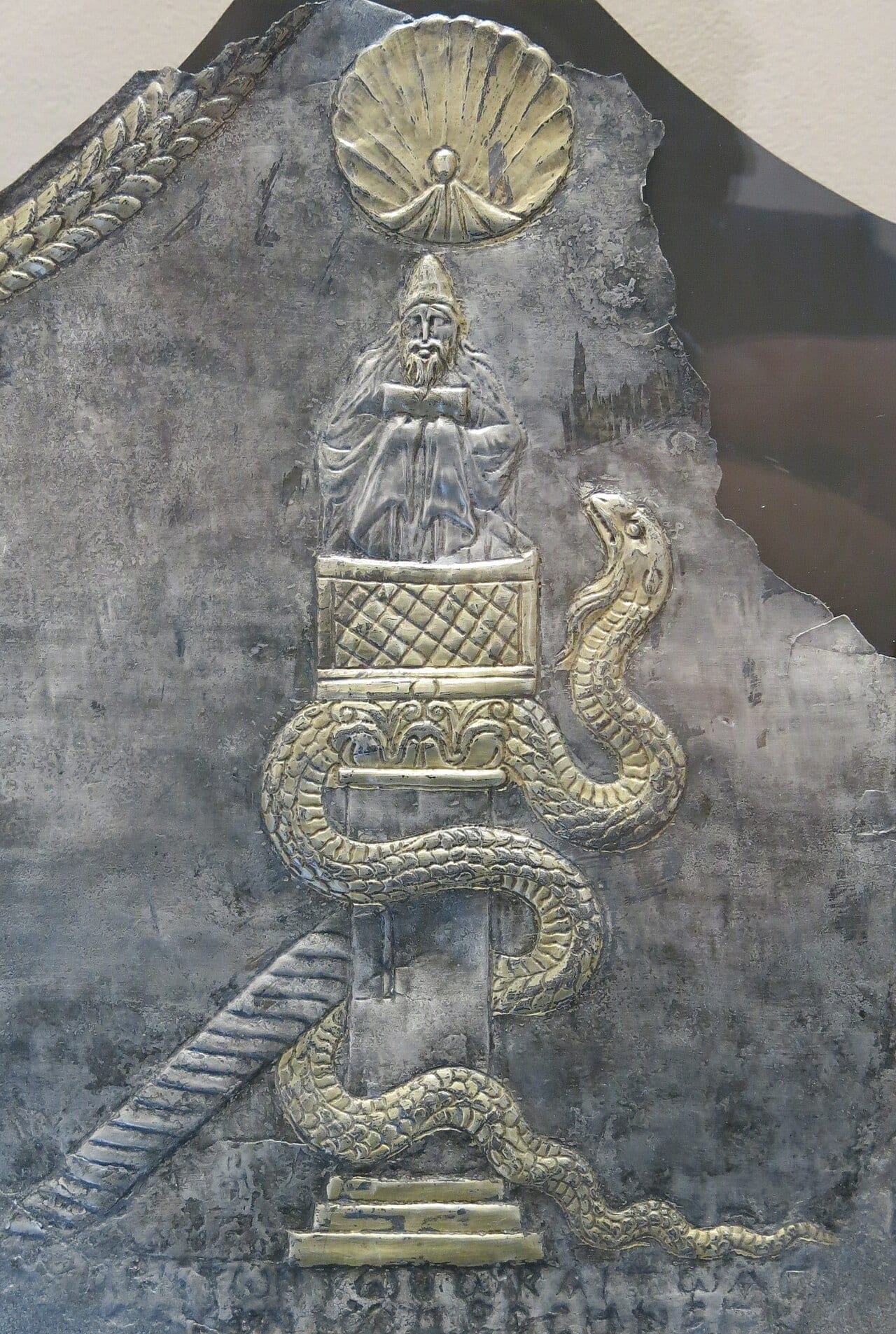
Simeon was the son of a Cilician shepherd. Converted at thirteen by a Beatitudes sermon, he entered a monastery at Eusebona, then withdrew to a hermit's cell in the Syrian desert. His extreme penances drew crowds; to escape them he climbed a small pillar of nine feet, then a higher one, then a still higher one — finally settling, around 423, on a pillar fifty feet tall on the hill of Telanissos.
There he stood, prayed, fasted, and preached for thirty-six years. Pilgrims came from Persia, Armenia, Britain, Gaul, Egypt, and Ethiopia to consult him; emperors wrote to him; he settled disputes by letters carried up to him in a basket. He died on his pillar at sixty-nine, in 459.
After his death the Emperor Zeno built around the stump of his pillar one of the great architectural masterpieces of late antiquity — the Church of Saint Simeon Stylites at Qal'at Sim'an, the largest church in the world for some sixty years until Hagia Sophia. The stone stump of his pillar still stood in the center of the ruined church at the time of the 21st-century Syrian civil war; partially damaged by air strikes in 2016, but still standing.
His example launched the long Syrian tradition of pillar-saints (stylitai), which lasted nearly nine centuries. Simeon the Younger (521–597), Daniel the Stylite at Constantinople (c. 409–493), and many others followed his path.