
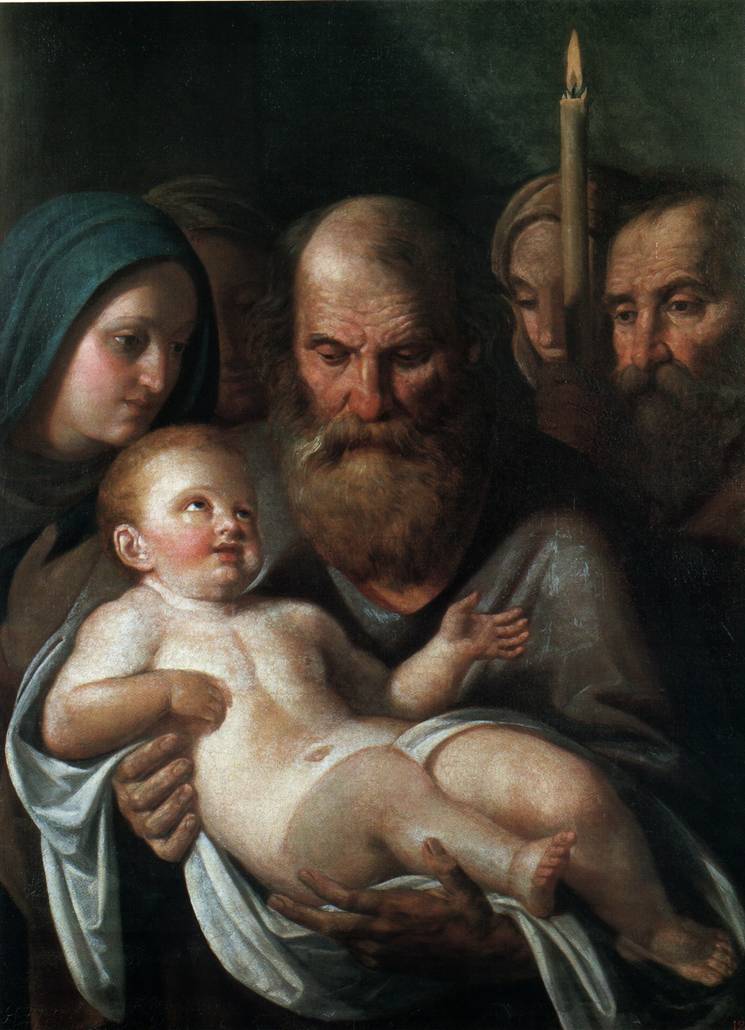
Simeon (Hebrew Shimon, 'he has heard') was 'a man in Jerusalem, just and devout, awaiting the consolation of Israel, and the Holy Spirit was upon him' (Luke 2:25). He had received in the Holy Spirit the promise that he would not die until he had seen the Christ of the Lord.
On the day of the Presentation of the Christ Child in the Temple (forty days after the Nativity, per the law of Leviticus 12), Simeon — moved by the Spirit — came to the Temple at the moment Mary and Joseph brought in the Infant Jesus to be presented. He took the Christ Child in his arms and pronounced the Nunc Dimittis (Luke 2:29–32): 'Now thou dost dismiss thy servant, O Lord, according to thy word in peace; because mine eyes have seen thy salvation, which thou hast prepared before the face of all peoples — a light to the revelation of the Gentiles, and the glory of thy people Israel.' He then turned to Mary and prophesied: 'Behold, this child is set for the fall and the resurrection of many in Israel, and for a sign which shall be contradicted; and thy own soul a sword shall pierce' (Luke 2:34–35) — the foundational prophecy of the Seven Sorrows of Mary.
He is venerated as 'Simeon the God-Receiver' (Greek Theodochos) in the Byzantine tradition. The Nunc Dimittis is sung daily at Compline (Night Prayer) of the universal Liturgy of the Hours.