
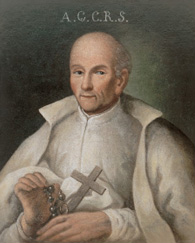
Jan Papczyński was born to a small Polish peasant family at Podegrodzie, struggled through years of difficult schooling — he was famously a slow learner who excelled in nothing until late adolescence — and entered the Piarists at Warsaw in 1654. He was ordained priest in 1661 and rose rapidly to become a famous Warsaw preacher and confessor (he served as confessor to the future King John III Sobieski, who would credit Stanislaus's prayer with the victory at Khotyn 1673).
He left the Piarists in 1670 — with their permission, after years of growing tension between his ascetic vision and the order's looser observance — and on December 8, 1673, took the white habit of the Immaculate Conception in a small clearing on the Mazovian frontier east of Warsaw, founding the new Congregation of Marian Clerics of the Immaculate Conception of the Blessed Virgin Mary — the first Polish-founded religious order. The Marians were specifically dedicated to the Marian Immaculate Conception devotion (not yet defined as dogma — that would come in 1854), to praying for the souls in purgatory (especially Polish soldiers fallen in the Cossack and Turkish wars), and to assisting parish priests in poor and frontier areas.
He governed the small new order for twenty-eight years from the central foundation at Góra Kalwaria south of Warsaw. The Marians struggled through Stanislaus's lifetime — eight friars by his death in 1701 — but the order survived, was confirmed in 1723 by Pope Innocent XIII, and grew slowly across Poland and Ukraine through the 18th and 19th centuries. Beatified 2007, canonized 2016 by Pope Francis.