
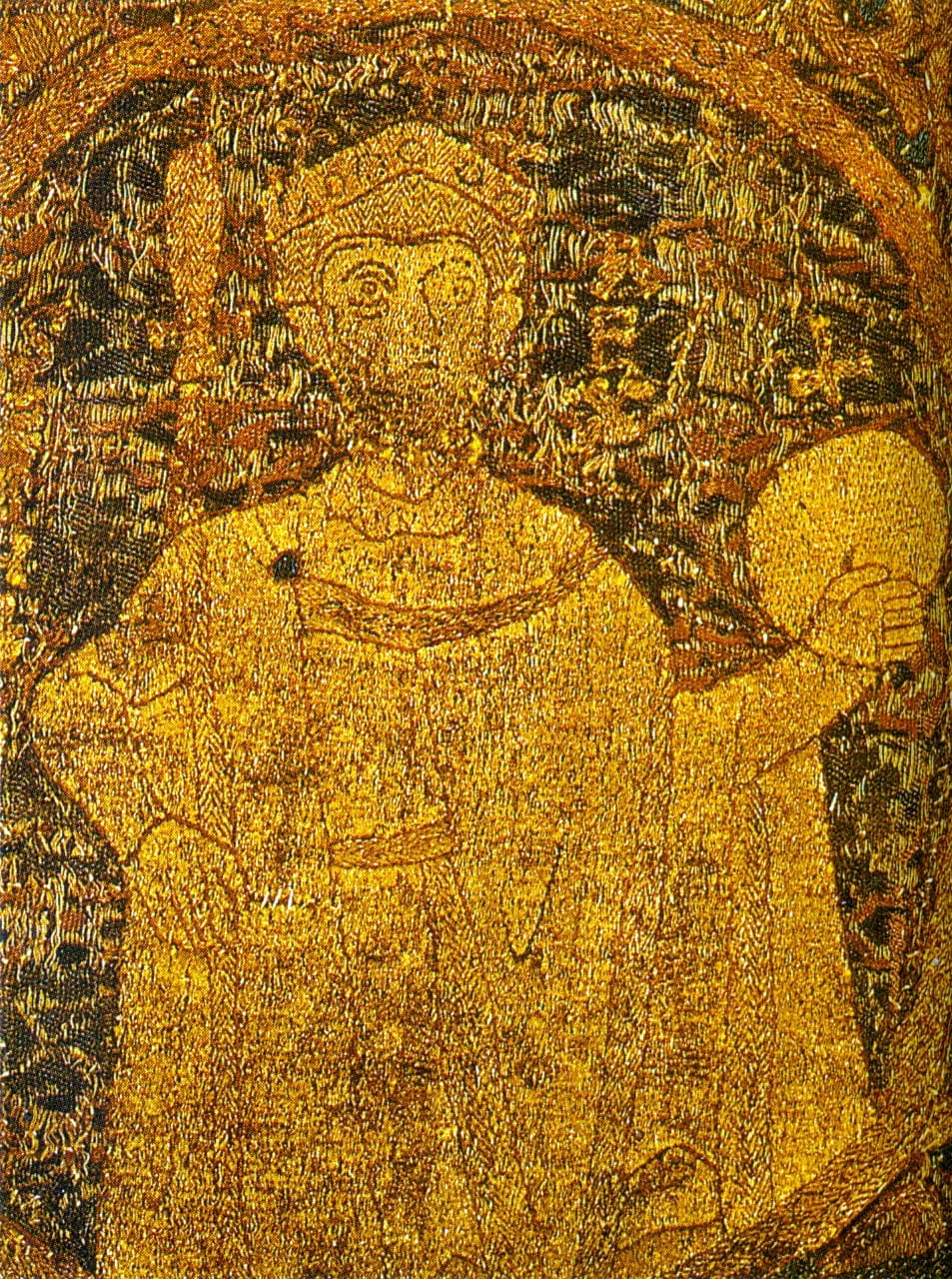
Vajk was the son of Géza, Grand Prince of the Magyars. The Magyar peoples had ridden into the Carpathian basin a century earlier; under his pagan ancestors they had raided as far as France and Italy. Géza, anticipating that the future of the Magyars lay with Christian Europe, embraced Catholicism and had his son baptised by St. Adalbert of Prague around 985 — taking the name Stephen, after the Protomartyr.
Stephen succeeded his father in 997, suppressed a pagan revolt led by his cousin Koppány, and in the year 1000 received from Pope Sylvester II both a royal crown and the title 'apostolic king' — the right to organise the Hungarian Church himself. On Christmas Day 1000 (or January 1, 1001), he was crowned King of Hungary at Esztergom. He founded ten dioceses, built monasteries (most famously Pannonhalma), brought in Italian, German, and French missionaries, and gave the Magyars a Christian legal code.
His only son and heir, Imre (Emeric), died young in a hunting accident in 1031, devastating the king and leaving the succession to disputed cousins. Stephen died on the feast of the Assumption, August 15, 1038, having consecrated his kingdom to the Virgin Mary — Hungary remains uniquely titled Regnum Marianum, 'the Kingdom of Mary.' He was canonised by Gregory VII in 1083 in a joint canonisation with his son Imre.