
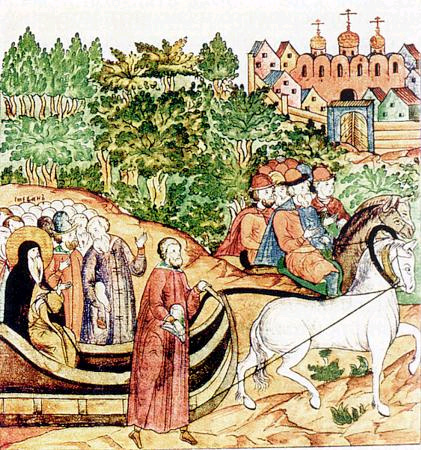
Stephen was born to a clergyman's family at Veliky Ustyug in the northern Russian forests, where he encountered the Komi (Zyrian) people — Finno-Ugric speakers of the great Vychegda-Pechora-Vym river systems north of the Volga, then almost entirely outside the reach of either Russian state or Russian Christianity. He entered monastic life at the Rostov monastery of St. Gregory the Theologian and made a meticulous study of the Komi language while researching their pagan religion.
Around 1372 he composed an alphabet specifically for Old Komi — the so-called Old Permic script, based loosely on Cyrillic and Greek shapes but designed to fit Komi phonetics — and translated into it the major liturgical texts and portions of the Bible. He returned north as a missionary in 1379, was consecrated first Bishop of Perm in 1383, and spent the remaining thirteen years of his life as the apostle of the Komi people: baptizing, founding parishes, writing in Komi, and engaging in public theological debates with the Komi shaman Pam — the climax of which, according to his hagiographer Epiphanius the Wise, was a proposed ordeal-by-fire that Pam refused at the last minute.
He died in Moscow during a visit to the Metropolitan and was buried at the Church of the Saviour at the Kremlin (later moved). Canonized in 1547, he is the proto-apostle of Russia's indigenous peoples and the foundation figure of all subsequent Russian missionary translation work into Siberian and Far Eastern indigenous languages. The Old Permic alphabet was used until the 17th century before being supplanted by Cyrillic.