
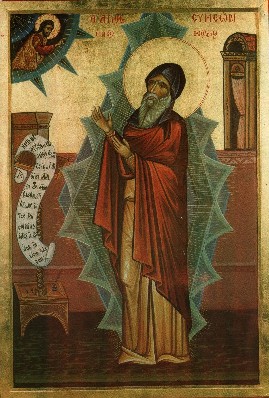
Symeon entered the Stoudios monastery in Constantinople at twenty-seven, formed under the spiritual father Symeon the Studite (Symeon Eulabes). Transferred to the small monastery of St. Mamas, he was elected its abbot in 980 and held the office for twenty-five years, rebuilding the community and writing the Hymns of Divine Love, the Catechetical Discourses, and the Theological and Ethical Discourses.
His unwavering insistence — against the imperial church establishment — that every Christian could and must experience God directly as Uncreated Light, that real mystical experience is normative not exceptional, and that a true spiritual father is the necessary mediator of grace, brought him into open conflict with Patriarch Sergius II. He was exiled across the Bosphorus to Chrysopolis in 1009 but continued teaching there until his death.
He is one of only three figures in the Eastern Orthodox tradition formally given the title 'Theologian' — alongside St. John the Evangelist and St. Gregory of Nazianzus. Through the Hesychast revival of the 14th century and Gregory Palamas, his theology of the divine light became the lived spirituality of Mount Athos and the entire Orthodox East.