
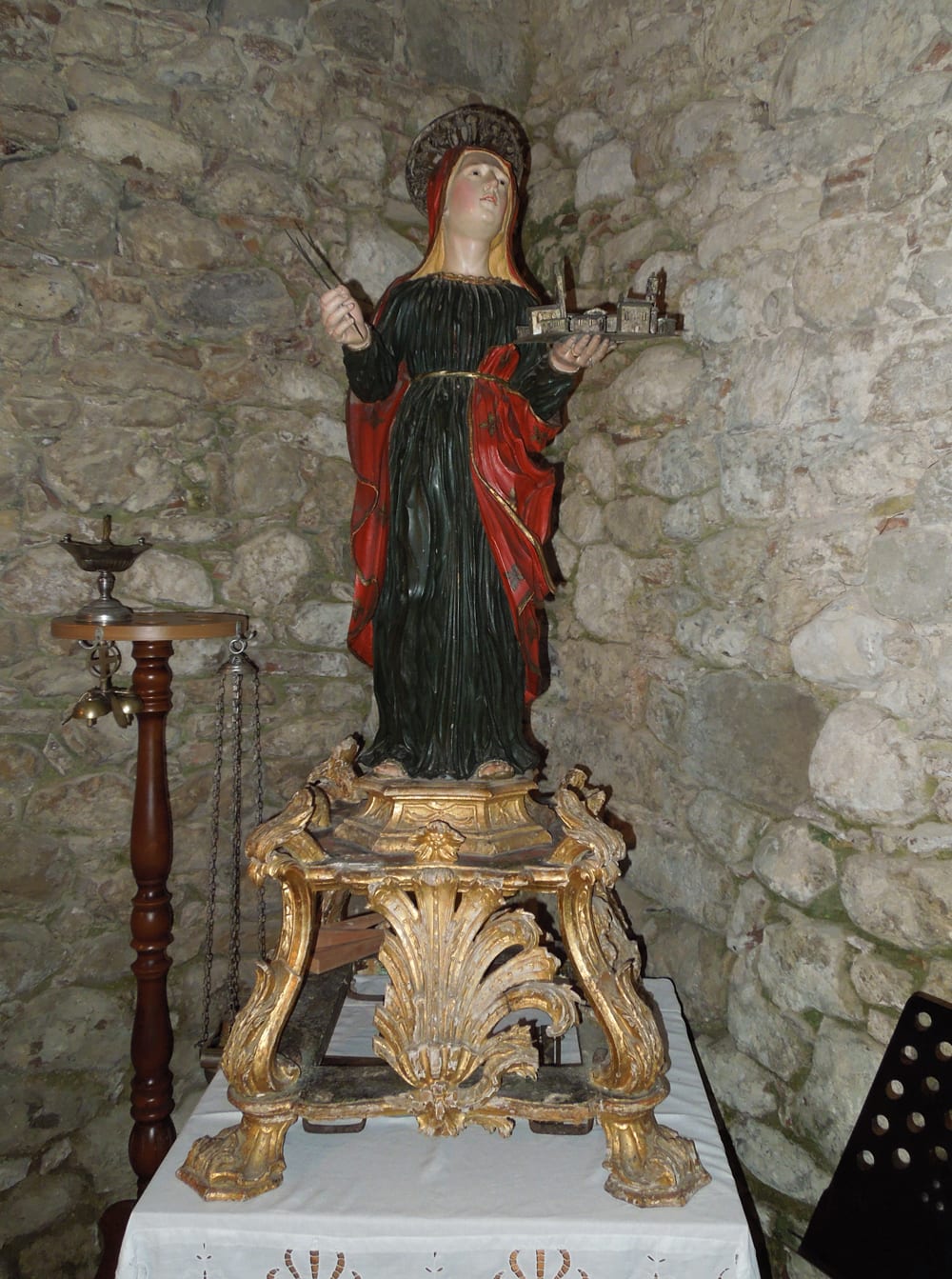
Symphorosa (Greek Symphora, 'fortunate') was a Christian widow of Tivoli, the small Roman provincial town in the Sabine Hills about 20 miles east of Rome. Her husband Getulius had been killed for the Christian faith some years earlier (around AD 120, under Hadrian), and Symphorosa had raised their seven sons in the Christian faith.
Around AD 138 — at the very end of Hadrian's reign — the emperor, who had been suffering from a long illness, was advised by his pagan priests that the Tiburtine gods were withholding his cure because of the presence of the prominent Christian widow's family in the city. He summoned Symphorosa and her sons to the imperial villa at Tivoli and demanded that they sacrifice to the pagan gods. Symphorosa publicly refused. According to the contemporary Passion of St. Symphorosa (one of the relatively well-attested early 2nd-century Roman martyrologies), Hadrian had Symphorosa beaten and then drowned in the Anio River; the next day her seven sons (Crescens, Julian, Nemesius, Primitivus, Justin, Stacteus, and Eugene) were tied to seven stakes and killed by seven different methods of execution.
She is one of the foundational Roman matron-martyrs, parallel to the slightly later St. Felicitas of Rome with her seven sons (see her entry in the 2nd-c. catalogue). The Tivoli cult was substantial through the early medieval period; the cathedral of San Lorenzo at Tivoli has been the centre of her cult since the medieval period.