
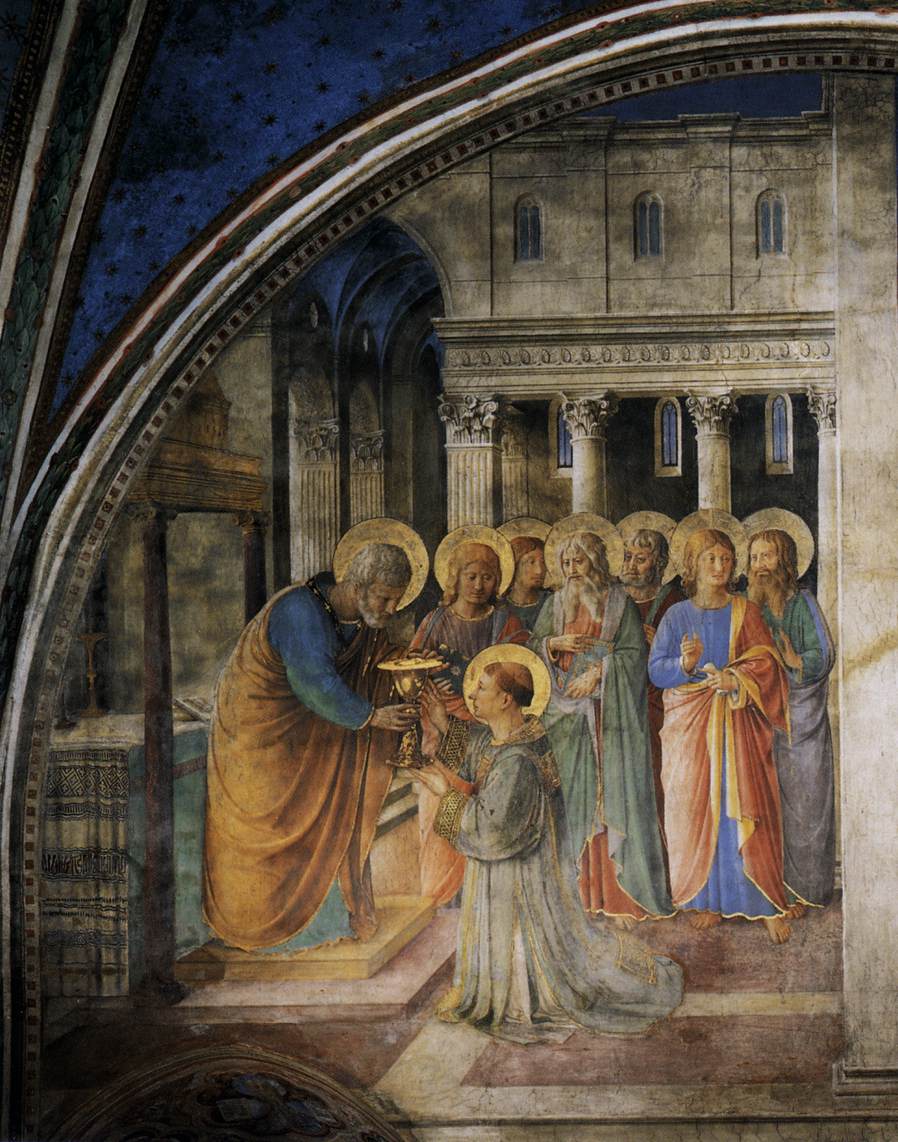
When the early Jerusalem Christian community had grown so large that the daily food distribution to the widows of the Greek-speaking Jewish Christian group (the 'Hellenists') had become disorganized — and the Hellenist widows were being neglected in comparison with the Hebrew-speaking Jewish Christian widows (Acts 6:1) — the apostles convened the community and proposed the formal selection of 'seven men of good reputation, full of the Spirit and of wisdom' (Acts 6:3) for the new ministry. The seven were chosen by the community, presented to the apostles, who 'praying, imposed hands upon them' (Acts 6:6) — the foundational New Testament establishment of the diaconal ministry.
The seven were: Stephen (the protomartyr, see his entry); Philip (the evangelist of Samaria and Caesarea, see his entry); Prochorus (Greek tradition makes him a nephew of Stephen, later a companion of John the Evangelist on Patmos, where he is traditionally identified as the author of the Apocalypse in the John tradition — he is the small figure beside John in the standard icon of the Apocalypse — and finally bishop of Nicomedia, where he was martyred); Nicanor (one tradition makes him a martyr at Jerusalem in the same persecution that killed Stephen); Timon (tradition makes him bishop of Bostra in Arabia, martyred by burning); Parmenas (tradition makes him bishop of Soli in Cyprus, martyred under Trajan around AD 98); and Nicolaus of Antioch (a Gentile-convert proselyte from Antioch — the Asia Minor tradition associates him with the later Nicolaitan heresy condemned in Apocalypse 2:6, 15, though the historical accuracy of this association is disputed).
Stephen and Philip are venerated individually (see their entries). The remaining five — particularly Prochorus, Nicanor, Timon, and Parmenas — are venerated jointly and individually in the Byzantine and Latin Synaxaria as foundational martyrs of the diaconal ministry. The 1972 restoration of the permanent diaconate by Paul VI placed them as the patrons of the new permanent diaconate.