
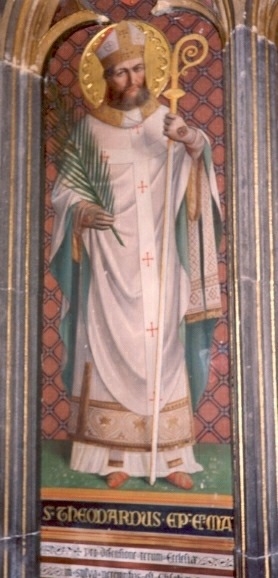
Theodard (Latin Theodardus) was the predecessor of the much-more-famous St. Lambert of Maastricht (see Lambert's entry in the 8th-c. supplemental catalogue when we do the 8th-c. supplement). He succeeded the great Belgic-Frankish Catholic bishop St. Remaclus as Bishop of Maastricht around 663 AD and governed the Belgic-Frankish episcopal see for some seven years.
His brief seven-year pontificate was substantially devoted to the defence of the Catholic property holdings of the Maastricht diocese against the substantial political-aristocratic encroachments of the Merovingian-period Frankish royal court and the substantial regional Belgic-Frankish noble families. The substantial Catholic ecclesiastical-property struggle of the late 7th-century Belgic-Frankish territories was the political-religious crisis of the period.
In 670 AD, Theodard travelled to the Frankish royal court at Speyer to make a personal substantial appeal to King Childeric II on behalf of the substantial Maastricht diocesan-property claims. En route — at a small Rhineland-frontier forest near the Speyer royal court — Theodard was murdered by substantial Belgic-Frankish noble retainers acting on behalf of the substantial regional noble interests that opposed his episcopal-property campaign. He died on September 10, 670 AD.
His successor as Bishop of Maastricht was the celebrated St. Lambert of Maastricht — who would continue Theodard's substantial episcopal-property defence struggle and would himself be martyred substantially under parallel circumstances some 35 years later (around 705 AD). The Belgic-Frankish episcopal-martyr pair of Theodard-and-Lambert is the continuous Catholic-civic identification of the modern Belgian city of Liège.