
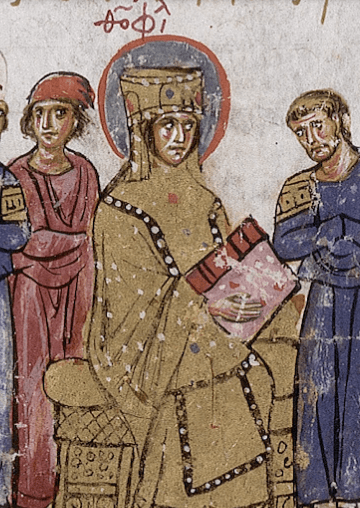
Theodora was born around 815 in Paphlagonia (northern Anatolia) to an iconodule Byzantine aristocratic family that had suffered under the second iconoclast crisis. In 830, at about age 15, she was selected as bride for the young iconoclast emperor Theophilos (829–842) through the bride-show held at the imperial palace of Constantinople.
Although her husband Theophilos was the most fervent of the second-period iconoclast emperors, Theodora and her mother Theoktiste maintained icon veneration privately — secretly hiding icons in their chambers and venerating them out of the emperor's sight.
On Theophilos's death in January 842, Theodora became regent for her two-year-old son Michael III (the future Michael the Drunkard, 842–867). Within months, she moved to end the second iconoclast crisis: a palace council was convened in early 843; the iconoclast Patriarch John VII Grammaticus was deposed; the iconodule monk St. Methodius (see his entry) was elevated to the Patriarchal throne; and the restoration of icons was decreed.
On the First Sunday of Lent of 843 (March 11, 843), the Triumph of Orthodoxy was proclaimed at the Hagia Sophia: a solemn procession with icons through the streets of Constantinople, led by Empress Theodora, the young Emperor Michael III, the new Patriarch Methodius I, and the entire iconodule episcopate and monastic-leadership of the Byzantine world. The date became the eastern-Catholic and Orthodox Sunday of Orthodoxy — the first Sunday of Great Lent, observed annually to the present day across the entire Byzantine-rite Catholic and Orthodox world.
Theodora ruled as regent until 856, when her son Michael III seized personal authority and exiled her to the Convent of Gastria in Constantinople. She lived there in monastic retirement until her death on February 11, 867 — outliving her son's assassination by Basil the Macedonian by just months.