
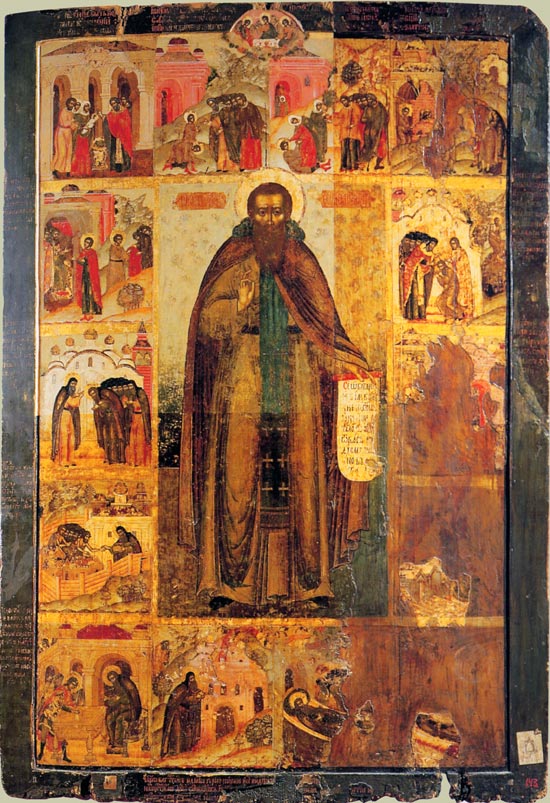
Theodosius was born to a noble family at Vasylkiv near Kiev. From childhood he refused fine clothes and the games of his peers, and as a youth he secretly bound himself with iron chains beneath his garments and worked at baking liturgical bread for the local churches. He repeatedly tried to leave home to embrace monastic life; his mother dragged him back twice and beat him. On the third attempt he reached the cave of Anthony above the Dnieper and was received into the community.
Around 1062 Anthony made him superior of the small group of cave-dwellers, and Theodosius transformed the loose collection of hermits into a true cenobitic monastery on the model of the Studite Rule he obtained from Constantinople. He built the first wooden church and the first surface buildings of what became the Kiev Pechersk Lavra, and made cenobitic communal life — not eremitic isolation — the foundation of Russian monasticism.
He died in 1074, less than a year after Anthony. Together they are venerated as the founding fathers of all Eastern Slavic monasticism. His Life, written by the monk Nestor (the same Nestor who composed the Primary Chronicle), is the earliest substantial saint's life in the Slavic literary tradition.