
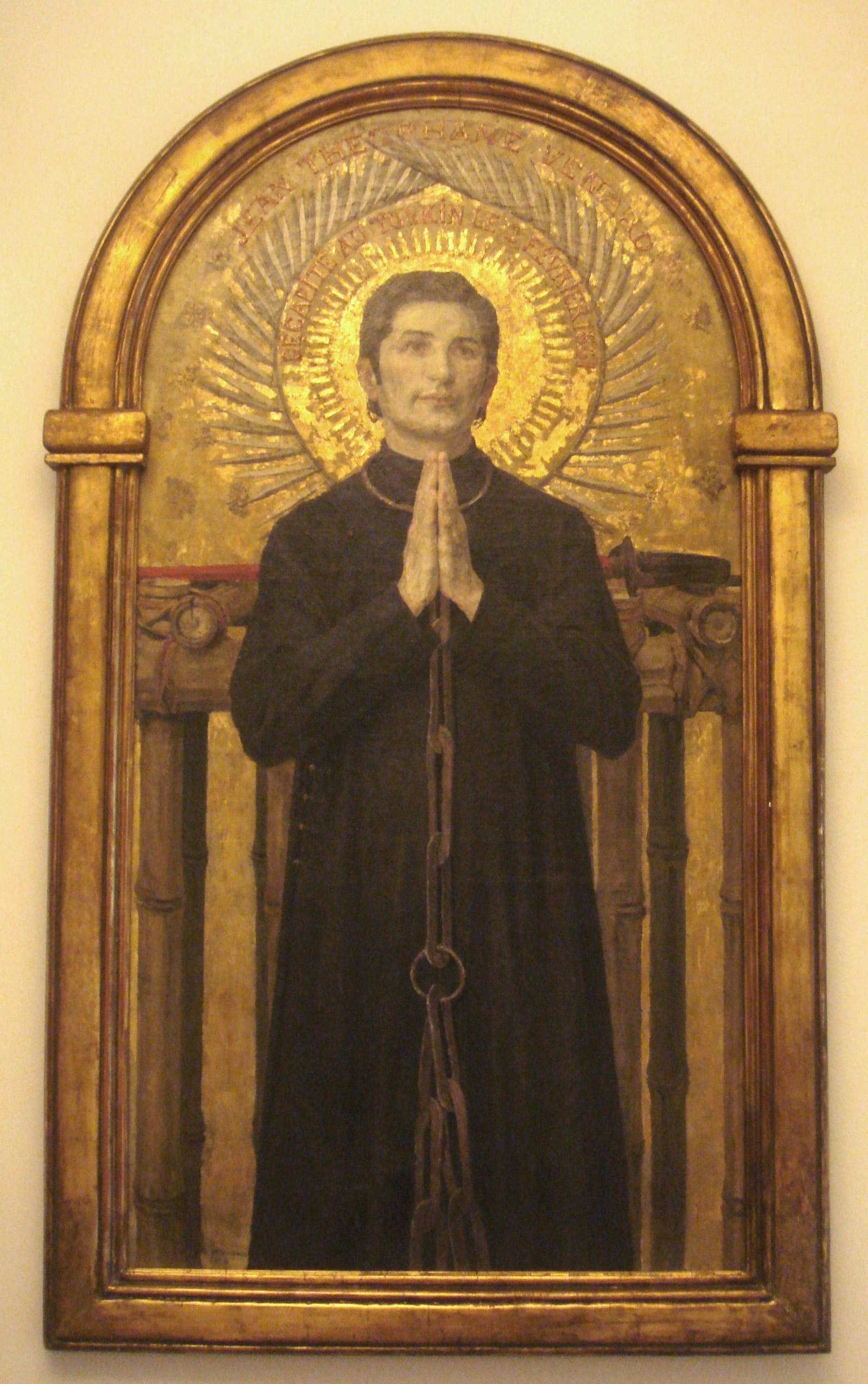
Théophane Vénard was a Poitou farmboy who at nine read the life of the recently-martyred French missionary Charles Cornay (executed at Sơn Tây 1837) and from that moment vowed to become a missionary martyr in the Tonkinese mission. He entered the Société des Missions Étrangères de Paris (MEP) at Paris in 1851 at twenty-two, was ordained in 1852, and sailed for Tonkin in 1852, arriving in clandestine entry to the Tonkinese mission of Bishop Jean-Charles Cornay-Retord in 1854.
He served the Tonkinese mission for seven years (1854–61) — through the catastrophic intensification of Emperor Tự Đức's anti-Catholic persecution from 1857 onward. He lived in hiding in the Catholic villages of the Tonkin delta, moving frequently, ministering to a substantial Catholic community of perhaps 30,000 in his area. He was finally betrayed and captured on November 30, 1860. He was kept in a small bamboo cage in the open square of the Tonkinese provincial capital for two months — the standard regime for clerical prisoners awaiting execution. From his cage he wrote a series of remarkable letters to his family in Poitou — letters that, smuggled out and published in France after his death, became one of the most influential French Catholic devotional texts of the late 19th century.
He was beheaded at Ô Cầu Giấy west of Hanoi on February 2, 1861 at thirty-one. The young Carmelite novice Thérèse Martin of Lisieux read his letters as a teenager in the 1880s and named him her great spiritual inspiration; she asked at her own death in 1897 to be united in heaven 'with my dear Théophane Vénard.' He is one of the principal influences on the great late 19th-century French Catholic missionary movement. Canonized 1988 in the 117 Vietnamese Martyrs group.