
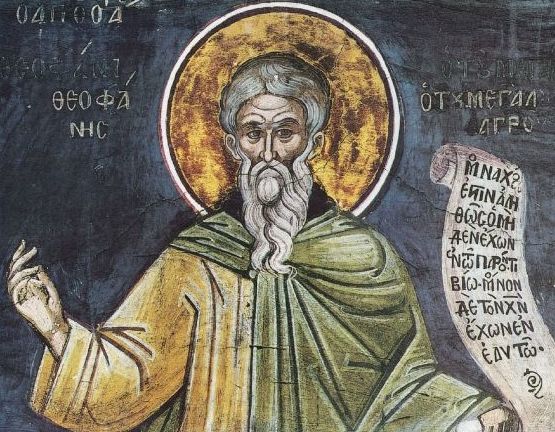
Theophanes was born around 778 in Kerak, Transjordan (modern Jordan), to a Palestinian-Arab Christian family of Mar Saba monastic tradition. With his elder brother Theodore (Theodore Graptos), he entered the Mar Saba Monastery in the Judean Desert as a child, in the late-8th-century Palestinian monastic-Catholic tradition.
The brothers travelled to Constantinople around 813 as ambassadors of the Patriarch of Jerusalem to the iconodule Patriarch Nicephorus, defending the iconodule cause against the second wave of Byzantine iconoclasm.
Under the iconoclast emperor Leo V the Armenian (813–820), Theodore II the Amorian (829–842), and Theophilos (829–842), the brothers were repeatedly imprisoned, tortured, and exiled for their iconodule confession. Most infamously, under Emperor Theophilos in 836, twelve iambic verses (composed by Theophilos himself, mocking their faith) were branded with hot iron into the foreheads of both brothers — earning the brothers their permanent epithet Graptoi (Greek 'the Inscribed/Branded'), the eastern-Catholic memorial of the second iconoclast cruelty.
Theodore Graptos died in iconoclast prison in 841. Theophanes survived to see the iconodule restoration under Empress Theodora and Patriarch Methodius I in March 843 (the 'Feast of Orthodoxy'); the restored patriarch appointed Theophanes Metropolitan of Nicaea — the city of the First Ecumenical Council (325) and the Seventh Ecumenical Council on icons (787).
As Metropolitan of Nicaea, Theophanes composed Byzantine liturgical hymnography — over 145 surviving kanon-hymns — that remain in continuous liturgical use in the eastern-Catholic and Orthodox calendars to this day. He died around 845 with the branded verses still legible on his forehead.