
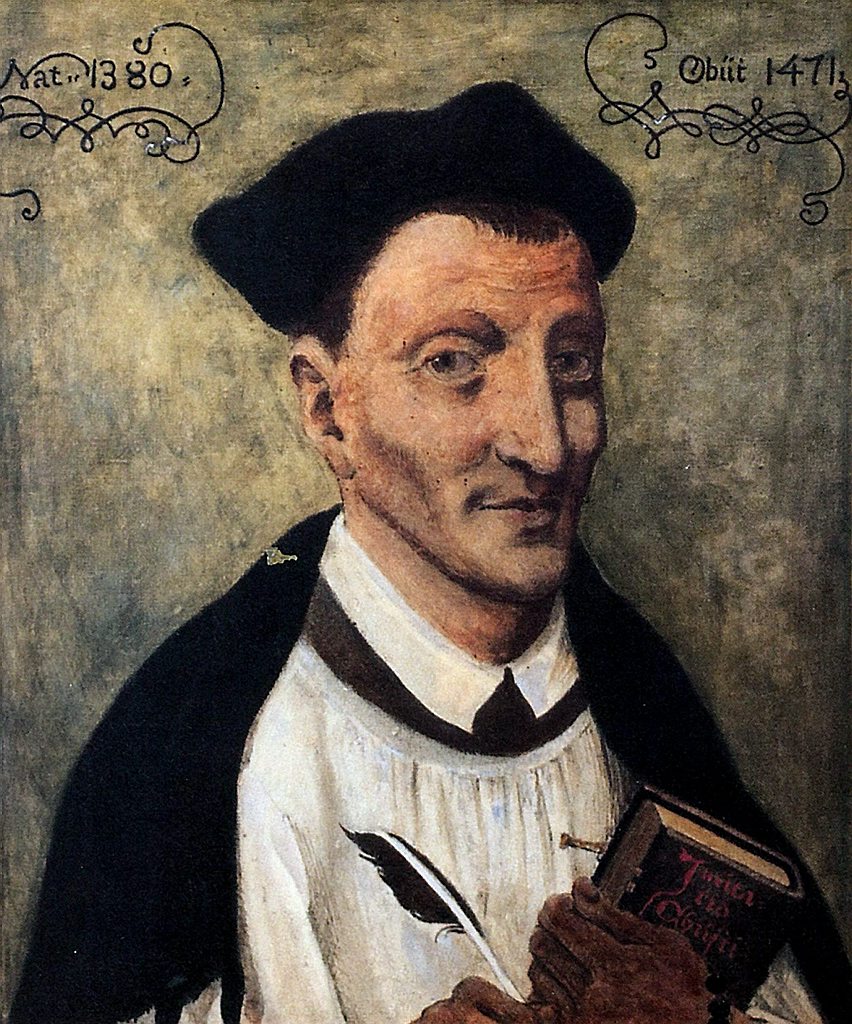
Thomas Hemerken was born at Kempen in the Lower Rhine and at thirteen sent to Deventer to be educated by the Brethren of the Common Life — the lay-religious community founded by Geert Groote that was the heart of the Devotio Moderna movement of the late medieval Low Countries. Under the rector Florent Radewijns Thomas was formed in the school's distinctive combination of practical lay piety, Christ-centered interior life, and resolute distrust of academic theological speculation.
At twenty he entered the Canons Regular of St. Augustine at the new monastery of Mount St. Agnes near Zwolle, where his brother John was prior. He was ordained in 1413 and remained at Mount St. Agnes for over fifty years — copying manuscripts (he made several complete copies of the entire Bible by hand), instructing novices, and writing.
His vast literary output is dominated by one book. The Imitation of Christ (De Imitatione Christi) — completed around 1418–27 — is, after the Bible, the single most widely-circulated devotional book in the entire history of Christianity. It exists in over 750 medieval Latin manuscripts and has been translated into virtually every written language; over 3,000 distinct printed editions have appeared. Its four books treat the spiritual life as the progressive interior union of the soul with Christ through humility, detachment from creatures, devout reception of the Eucharist, and patient endurance of suffering. The work's authorship was contested in the 15th–17th centuries (Jean Gerson and others were proposed), but the modern scholarly consensus restored it firmly to Thomas. He died at Mount St. Agnes in 1471. The cause for formal canonization was opened in 1672 but has not been advanced; his cult remains a local one despite the universal reach of his book.