
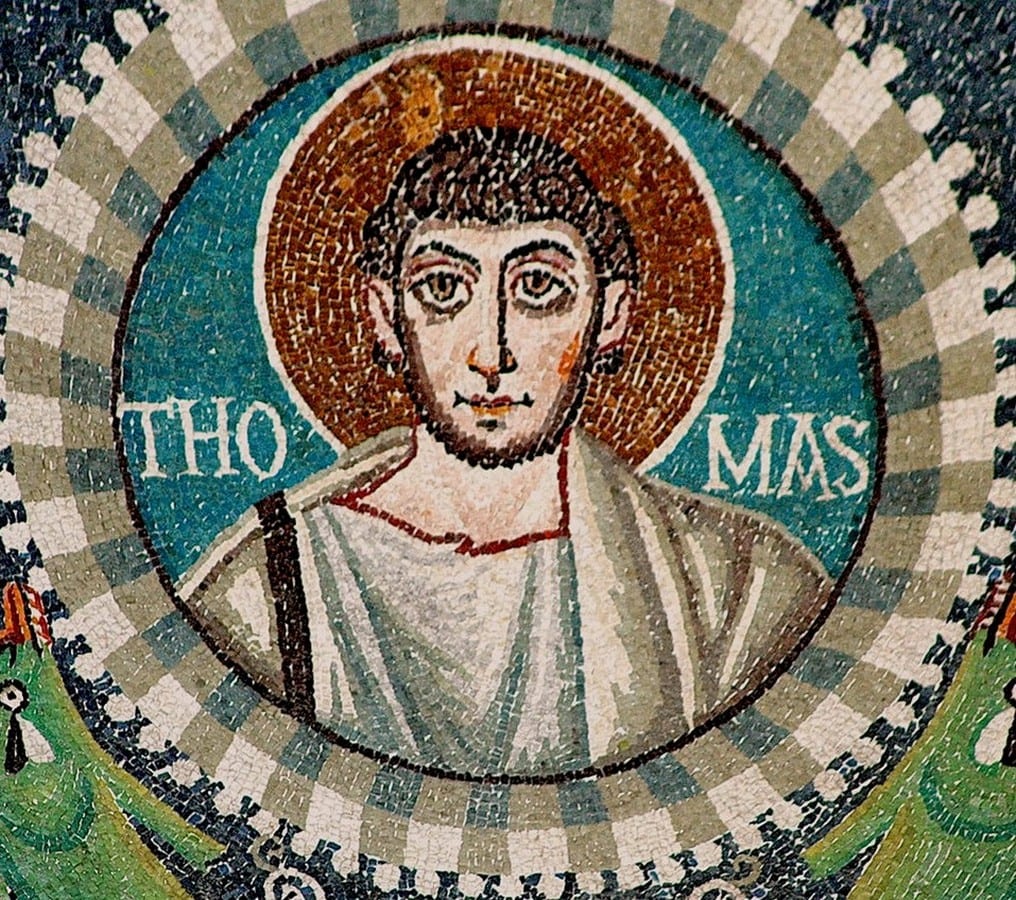
Thomas, called Didymus ('the Twin'), is best remembered for the moment of doubt that became one of the great confessions of faith. Not present at Christ's first appearance to the disciples after the Resurrection, he declared: 'Unless I see in his hands the print of the nails, and place my finger in the mark of the nails, and place my hand in his side, I will not believe.'
Eight days later Christ appeared again, told Thomas: 'Put your finger here, and see my hands; and put out your hand, and place it in my side; do not be faithless, but believing.' Thomas answered: 'My Lord and my God!' — the first and clearest confession of Christ's divinity by an apostle (John 20:24–28).
Eusebius, Origen, and Ephrem the Syrian all attest that Thomas evangelised the East — Persia first, and then India. The ancient Christian community of the Malabar Coast (Kerala), the Saint Thomas Christians, traces its origin to his arrival at Muziris (Cranganore) in AD 52. Tradition, supported by the living memory of that community and by an 8th-century inscription, holds that he was martyred at Mylapore (modern Chennai) in AD 72, pierced with a lance while at prayer.