
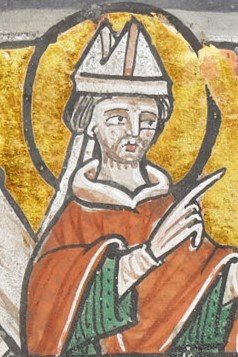
Thomas of London, son of a Norman-French merchant, rose through ecclesiastical patronage to become chancellor of England under Henry II in 1155 — the closest friend of the king, his hunting and drinking companion, the architect of the royal administration. In 1162, against his own protests and his fears, Henry forced his election as Archbishop of Canterbury, expecting to use him as the pliant instrument of royal control over the English Church.
Becket transformed on the day of his consecration. Setting aside the chancellor's robes and habits, he embraced monastic austerity — hair shirt, daily washing of the feet of thirteen poor men, ceaseless penance — and immediately resisted the king's claims over clerical jurisdiction. The conflict came to a head at the Council of Clarendon (1164) and the Constitutions of Clarendon, which sought to bring the clergy under royal courts. Becket fled to France and spent six years in exile at Pontigny and Sens.
Returning to England in December 1170 after a strained reconciliation with Henry, he excommunicated the bishops who had crowned the king's son in his absence. Henry, in a rage at his Christmas court at Bures in Normandy, uttered the famous words 'Will no one rid me of this turbulent priest?' Four knights — Reginald FitzUrse, William de Tracy, Hugh de Morville, and Richard le Breton — rode to Canterbury and on December 29, 1170 hacked him to death in the north-west transept of the cathedral during Vespers. The crown of his head was sliced off; the brain was scattered on the pavement.
Within hours pilgrims were collecting the blood from the floor. Miracles were reported within days. He was canonized by Alexander III in February 1173 — twenty-six months after his death, almost the fastest canonization in church history. Henry II did public penance at the tomb in 1174 and the cult exploded: the shrine at Canterbury became the second-greatest pilgrimage destination in Latin Christendom after Compostela, and the immediate setting of the Canterbury Tales. The shrine was destroyed by Henry VIII in 1538.