
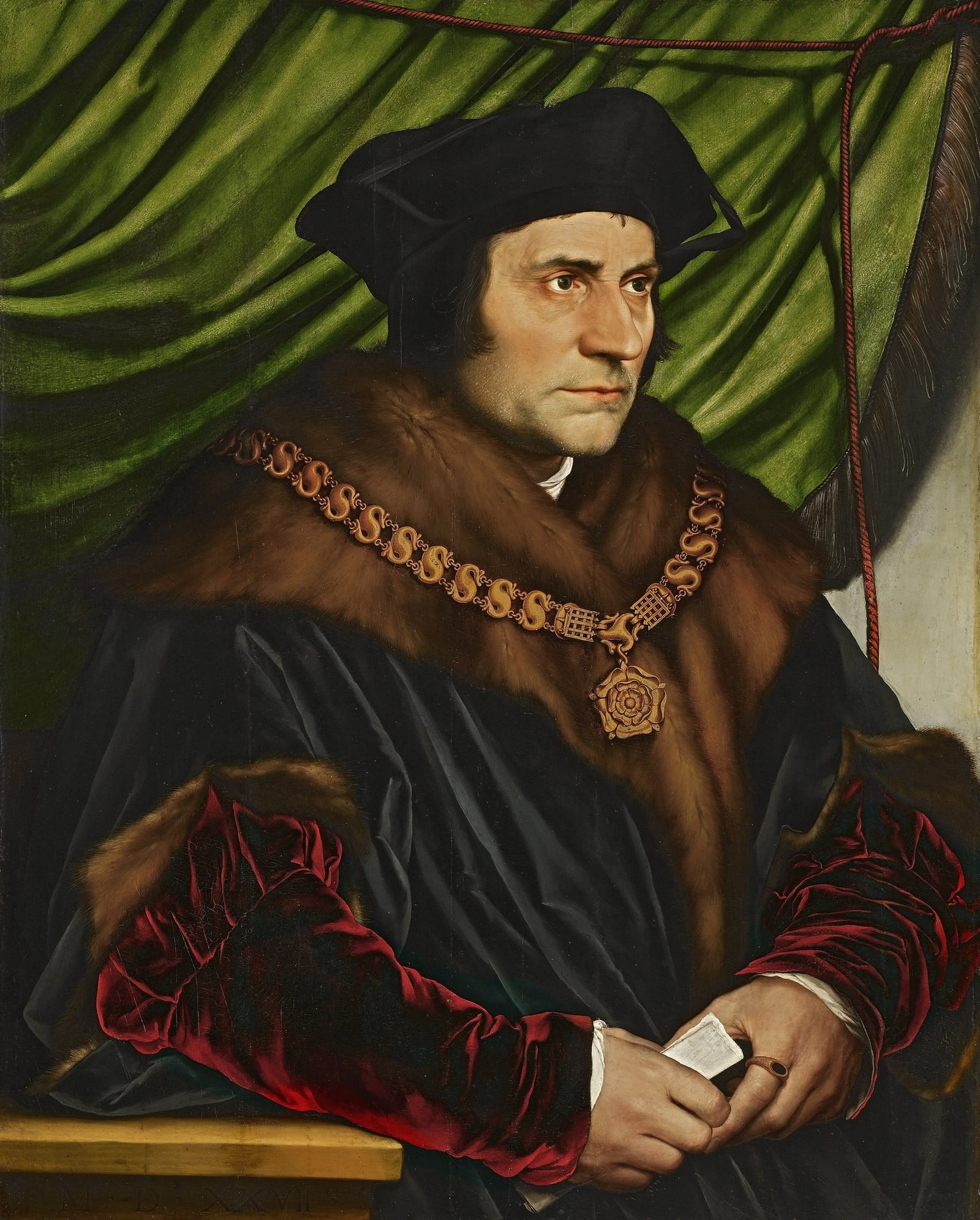
Thomas More was born to a London lawyer-family, educated at St. Anthony's school in Threadneedle Street, as a page in the household of Cardinal Morton, then at Oxford (Canterbury College), and finally at the Inns of Court. He spent four years as a young man considering monastic vocation at the London Charterhouse, ultimately deciding for marriage. He married Jane Colt in 1505, fathered four children, and after Jane's death in 1511 married Alice Middleton.
His career combined law, public service, and literary distinction unprecedented in any age. He served as Under-Sheriff of London, MP, Master of Requests, Speaker of the House of Commons (1523), and from October 1529 — succeeding the fallen Cardinal Wolsey — Lord Chancellor of England, the highest legal office in the realm. He resigned in May 1532 immediately upon Henry VIII's effective declaration of royal supremacy over the English Church. His literary work — Utopia (1516), the controversy-treatises against Luther and Tyndale, the Dialogue Concerning Heresies — made him the principal English humanist of his generation and Erasmus's closest correspondent.
He refused the Oath of Succession and was imprisoned in the Tower in April 1534. Through fifteen months of imprisonment he composed the Dialogue of Comfort against Tribulation, the Treatise upon the Passion, and many letters and prayers — works of supreme spiritual depth. He was tried for treason in Westminster Hall on July 1, 1535, convicted on perjured evidence from Richard Rich, condemned, and beheaded on Tower Hill on July 6 declaring himself 'the King's good servant, but God's first.' Canonized 1935.