
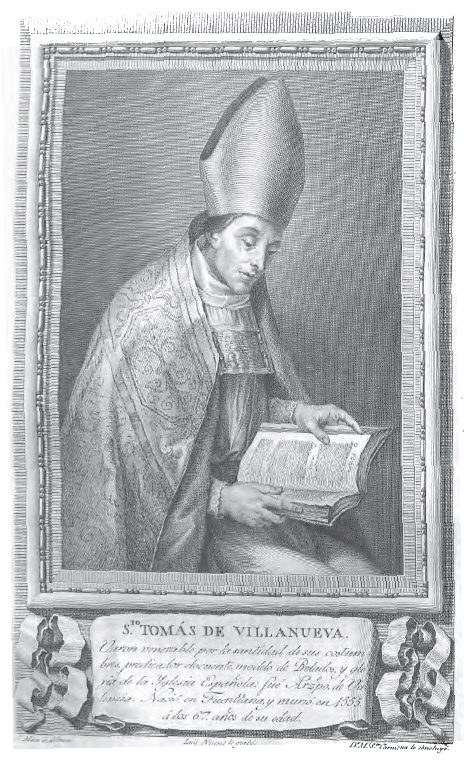
Tomás García y Martínez was raised in the small Castilian town of Villanueva de los Infantes (from which he took his religious name), studied at the new University of Alcalá de Henares founded by Cardinal Cisneros, and at twenty-six was offered the chair of natural philosophy at the rival University of Salamanca. He held it briefly before entering the Augustinian Hermits at Salamanca in 1516 and being ordained priest in 1518.
He held every important office of the Spanish Augustinian province across the 1520s, 1530s, and 1540s — provincial, Spanish provincial-general, court preacher and confessor to Charles V — and refused the archbishopric of Granada offered him by the Emperor. In 1544 Charles named him to the archbishopric of Valencia and submitted the nomination to Rome before Thomas could refuse; Paul III confirmed it. He arrived in Valencia in 1545, in the magnificent archiepiscopal palace, walking barefoot from the cathedral steps. He kept the bed and habit he had brought from his Augustinian cell for the rest of his life.
His eleven years at Valencia (1545–55) made him one of the most influential bishops of the Spanish Reformation. His direct precedence was Charles V's request that he set the model for the Spanish Tridentine bishop. He gave away virtually his entire archiepiscopal income to the poor each year — Valencia's organized response to mass poverty in the city included his model orphanage (the Casa de la Misericordia), his daily distribution of bread to thousands at the palace gate (the basis of the iconographic emblem), and his college of theology for poor students (the Colegio Real de la Presentación, founded 1550 — still active as part of the University of Valencia). He died in Valencia on September 8, 1555. Canonized 1658.