
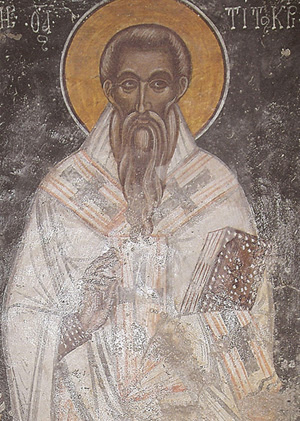
Titus (Greek Titos) was a Greek convert of Paul's, possibly of Antioch — Paul calls him 'a Greek' (Galatians 2:3) and emphasizes that he was 'not compelled to be circumcised,' making him the test case for Paul's argument at the Jerusalem Council (Acts 15) that Gentile converts to Christianity should not be required to observe the Mosaic ritual law.
Titus served as Paul's principal envoy to the difficult Corinthian community during the period of the bitter Corinthian-Pauline correspondence (the period of 1 Corinthians and especially 2 Corinthians, which is largely an extended response to a Titus mission). He was sent by Paul also to the Dalmatian mission (2 Timothy 4:10) and finally established as Bishop of Crete with apostolic authority to ordain elders 'in every city' of the island (Titus 1:5).
The Epistle of Paul to Titus — the second of the three 'Pastoral Epistles' (with the two letters to Timothy) and one of the principal New Testament documents on the qualifications of Christian bishops and presbyters — was addressed to him during this Cretan period (c. AD 63–65). He governed the Cretan Church for some thirty years and died at Gortyna (the Roman provincial capital of Crete) around 96 AD. His head is preserved at Heraklion Cathedral, which is dedicated to him.