
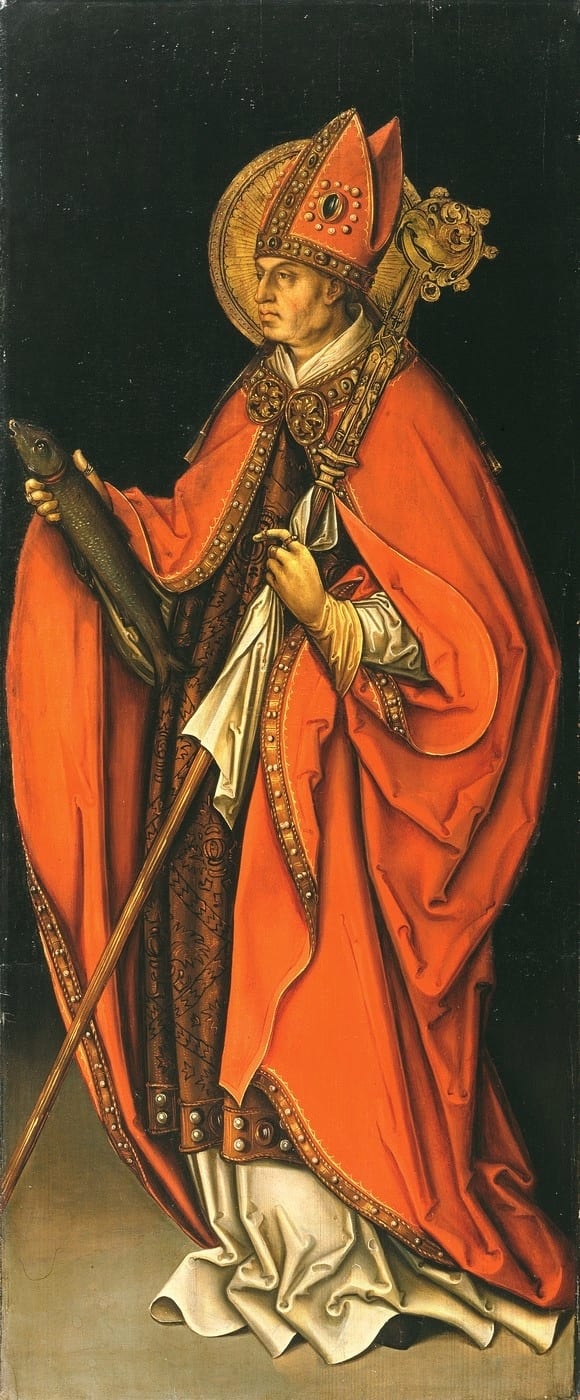
Ulrich (Ulricus, Udalricus) was born around 890 to a noble Alemannian-Swabian family of Augsburg. Educated at the Abbey of St. Gall under the Notker Balbulus tradition, he served as cathedral provost of Augsburg before being consecrated Bishop of Augsburg in 923 by King Henry the Fowler.
His fifty-year episcopate (923–973) — among the longest in early-medieval Catholic history — spans the entire consolidation of the Ottonian Holy Roman Empire under Henry the Fowler, Otto I the Great, and Otto II.
He is most renowned for the defence of Augsburg during the decisive Battle of Lechfeld (August 10, 955) — when the Hungarian Magyar pagan invasion of the German lands was definitively defeated by Emperor Otto I in the battle that ended the forty-year Magyar threat to Catholic central Europe. Ulrich led the defence of the walls of Augsburg from August 8 until Otto's arrival on August 10 — appearing on the walls in episcopal vestments with the pectoral cross and pastoral staff (without armour), encouraging the defenders during the Magyar siege. The victory at Lechfeld produced the Christianization of the Hungarian Magyars under King St. Stephen of Hungary (997–1038).
Ulrich reformed the German clerical discipline of his vast Augsburg diocese, established the scriptorium and episcopal school, and undertook pilgrimage to Rome and to the tomb of St. Martin at Tours.
He died on July 4, 973 — having served the Catholic Church for fifty years. Twenty years after his death, on January 31, 993, Pope John XV canonized him at a Roman synod — the first formal papal canonization in Catholic history, the institutional inauguration of the distinctively Catholic canonization-process that would develop through the 12th–13th centuries into the current Vatican canonization-procedure.