
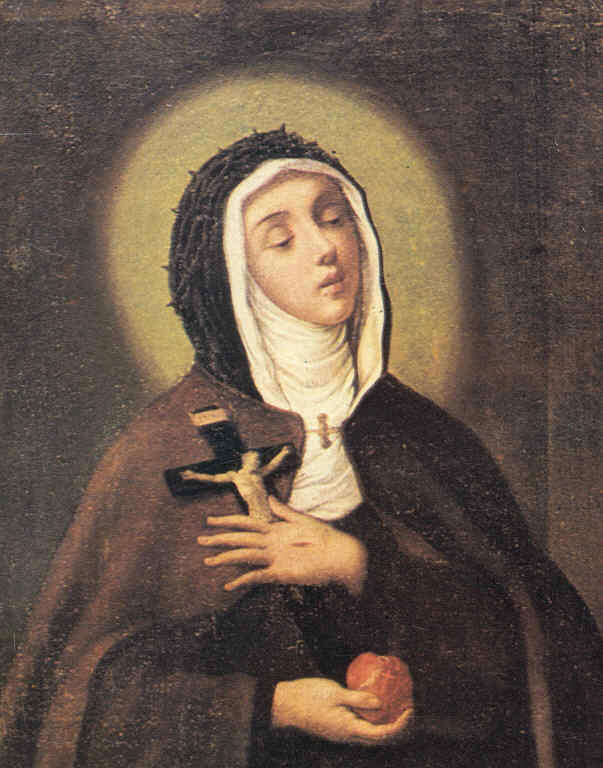
Orsola Giuliani entered the Capuchin Poor Clares of Città di Castello at seventeen in 1677 — taking the religious name Veronica, after the Veronica of the Way of the Cross. Her hidden interior life began almost immediately; the external phenomena emerged in 1693 when, on Good Friday, she received the visible stigmata in a sequence of subsequent ecstasies: first the crown of thorns (Holy Week 1694), then the wounds of the side and hands and feet (April 5, 1697 — Good Friday).
Her superiors and the local diocesan authorities reacted with extreme caution — placing her under a sustained four-year regime of medical and theological examination, fasting tests, and humiliating manual labour (she was demoted from the choir and restricted to the kitchen and gatehouse for years). The phenomena withstood the scrutiny; her superiors gradually came to accept the supernatural nature, and finally in 1716 — at fifty-five — she was elected abbess of the small Capuchin Poor Clare community, serving as such until her death.
Her vast spiritual diary — 22,000 pages of mystical autobiography composed under religious obedience over twenty-eight years (1693–1721) — is one of the most extensive personal mystical-theological texts in the Western Catholic tradition. She died at the Capuchin convent of Città di Castello on July 9, 1727. Canonized 1839 by Gregory XVI — the same canonization decree that included Pacific of San Severino.