
MIRACULOUS MIRACLES™

Saint — Bl. Villana de' Botti

Bl. Villana de' Botti
1332 AD, Florence, Republic of Florence (noble Florentine Botti family) — January 29, 1361 AD, Florence — Black Death epidemic
Florentine Dominican Third Order laywoman; Florentine married-lay Dominican-Tertiary mystic
Basilica of Santa Maria Novella, Florence, Italy — her shrine at the Rucellai Chapel (containing her tomb and the famous Villana-de-Botti sarcophagus by Bernardo Rossellino, c. 1451), Italy
Feast
January 29
Canonized
Beatified March 27, 1824 by Pope Leo XII
Life

Villana was born in 1332 to the noble Florentine Botti family. Raised in conventional Florentine bourgeois-aristocratic devotion, Villana was married at the age of 13 (1345) to the Florentine merchant Rosso di Piero Benintendi.

In her young married life, Villana undertook the conventional Florentine bourgeois-aristocratic worldly life — fashion, balls, courtly amusements — in deliberate rejection of her earlier childhood piety.

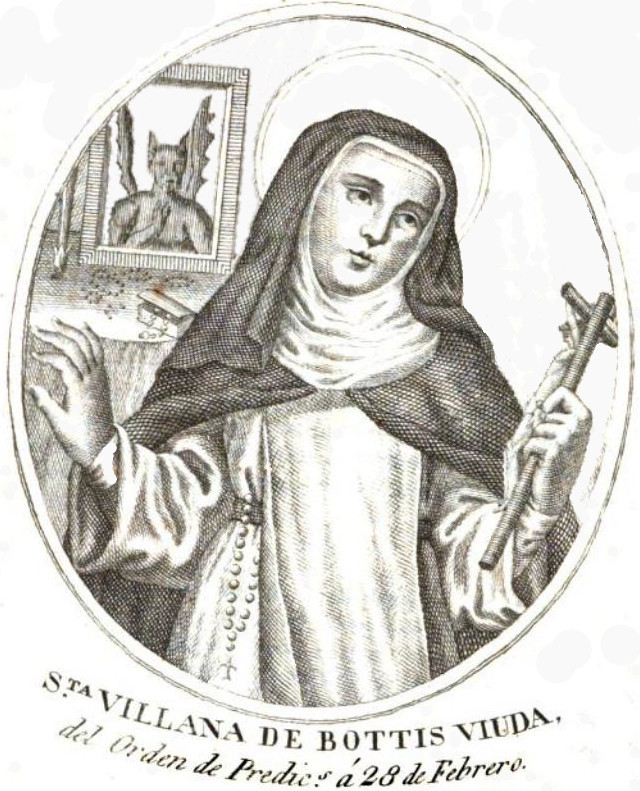
The classic Villana-de-Botti conversion narrative: examining herself in a mirror adorned with her Florentine bourgeois-aristocratic jewellery and fashions, Villana saw not her human face in the mirror but the face of a monstrous demon — the vision-mirror producing her immediate conversion.

Villana undertook the Dominican Third Order (Tertiary) vows and spent the remaining 15 years of her life (1346–1361) at the Botti palace in strict Dominican-Tertiary discipline — simultaneously fulfilling her marital duties to Rosso Benintendi.

She became famous during her final years for her mystical-ecstatic experiences and her pastoral ministry to the Florentine poor. She died at Florence on January 29, 1361 in the continuing Black Death epidemic (the second wave of the plague, 1360–1362).

Miracles & Phenomena
  • The mirror-conversion narrative

    Bl. Villana de' Botti's mirror-conversion narrative — seeing the monstrous demonic face in the mirror in place of her human face — is one of the classic 14th-century Catholic conversion narratives, establishing the late-medieval Catholic 'mirror-of-vanity-and-death' spiritual literature that would extend through the memento-mori tradition.

Relics
  • Body
    Tomb of Bl. Villana de' Botti
    Basilica of Santa Maria Novella, Florence, Italy — her shrine at the Rucellai Chapel; the famous Villana-de-Botti sarcophagus by Bernardo Rossellino, c. 1451

    Her tomb at the Basilica of Santa Maria Novella in Florence — in the Rucellai Chapel — features the famous Villana-de-Botti sarcophagus sculpted by Bernardo Rossellino around 1451, one of the principal early Florentine Renaissance funerary monuments.

Iconography
  • Villana receiving the mirror-vision

    The mid-14th-century Florentine bourgeois-aristocratic young woman examining herself in a hand-mirror adorned with the Florentine bourgeois-aristocratic jewellery and fashion, seeing not her human face in the mirror but the face of a monstrous demon — the classic Florentine Catholic iconography of the Villana-de-Botti conversion narrative.

Patronages
Florence (Republic of Florence) and the Florentine Catholic traditionOrder of Preachers (Dominican Third Order/Tertiary)Catholic married-lay-Dominican-Tertiary tradition (with contemporary Sts. Catherine of Siena and others)