
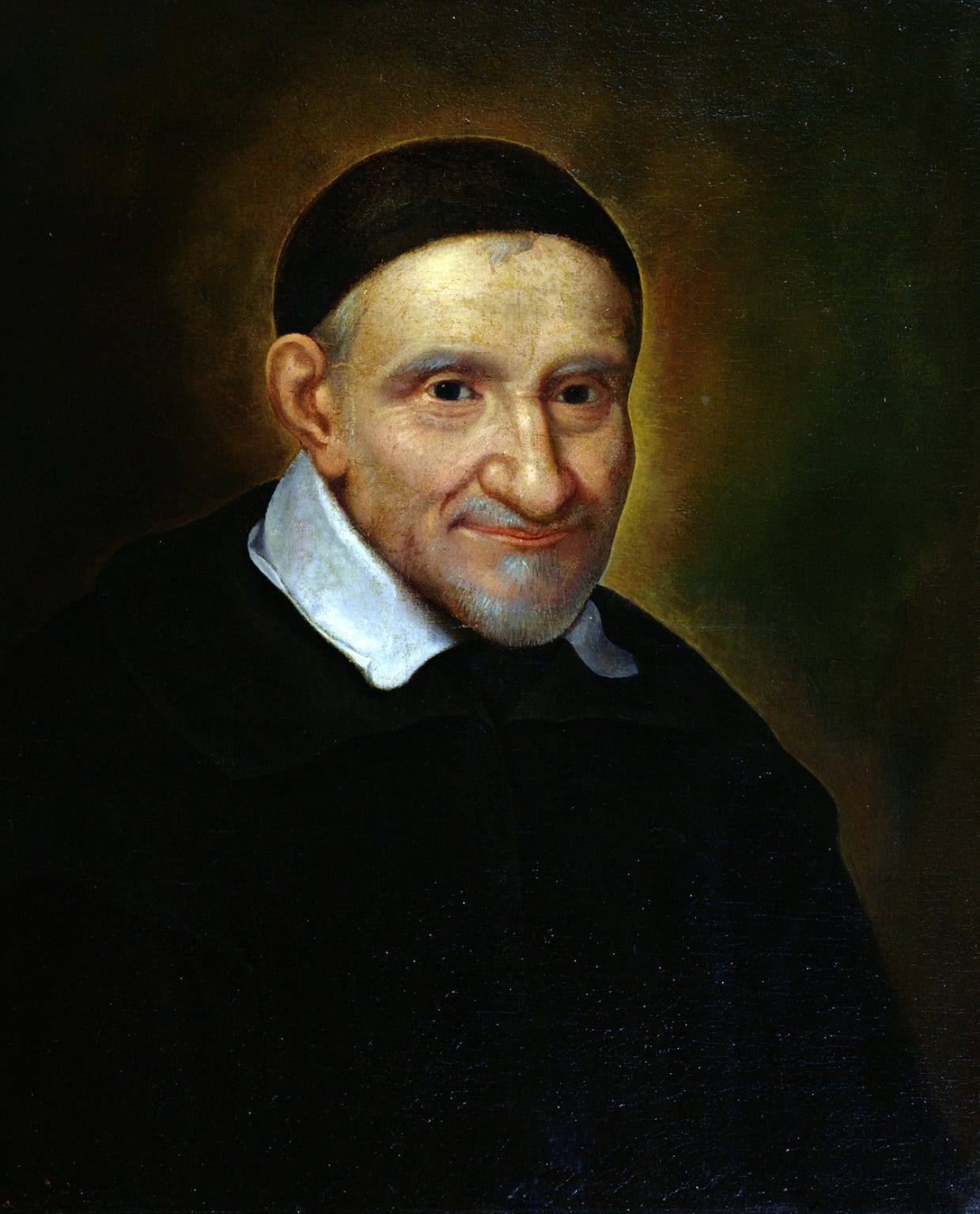
Vincent de Paul was born to a peasant family in Gascony, ordained priest at twenty (uncanonically early — he was below the canonical age), and pursued for his first twenty years as a priest the standard career of a French abbé seeking a comfortable benefice. The decisive turn came in 1617: as a parish priest in the village of Folleville (Picardy), then chaplain to the great noble Gondi family of Paris, he encountered the spiritual desolation of the rural French peasantry, mostly catechized only in the most rudimentary way and frequently without confession or sacraments for years. He began organizing missions to the rural parishes.
From 1625 onward he organized his work into permanent institutions. The Congregation of the Mission (the Lazarists or Vincentians) was founded for the missionizing of rural French Catholics; the Confraternities of Charity for organized lay charitable work in the parishes; the Daughters of Charity in 1633 (jointly with Louise de Marillac) for unenclosed women's hospital and charitable work — a complete revolution in women's religious life since the Daughters specifically rejected the canonical enclosure (cloister) that bound every previous Catholic women's order, allowing them to serve directly in the slums, hospitals, prisons, and shipyards. The Daughters of Charity grew from twelve at foundation to over five thousand by the time of the French Revolution and remain today the largest single Catholic women's religious institute in the world.
He was the principal architect of the Catholic charitable response to the catastrophes of mid-17th-century France: the Thirty Years' War (1618–48) and its effects on Lorraine, the Fronde civil wars (1648–53), the long Parisian winter famines, the systematic ransom of Christian slaves from the Barbary states (the Vincentians ransomed about 1,200 from Algiers, Tunis, and Salé), and the foundling-orphan crisis of mid-17th-century Paris (the Daughters opened the first systematic urban foundling-hospitals in modern Europe). He died at Saint-Lazare in Paris on September 27, 1660. Canonized 1737. Declared by Leo XIII in 1885 the universal patron of all Catholic charitable institutions.