
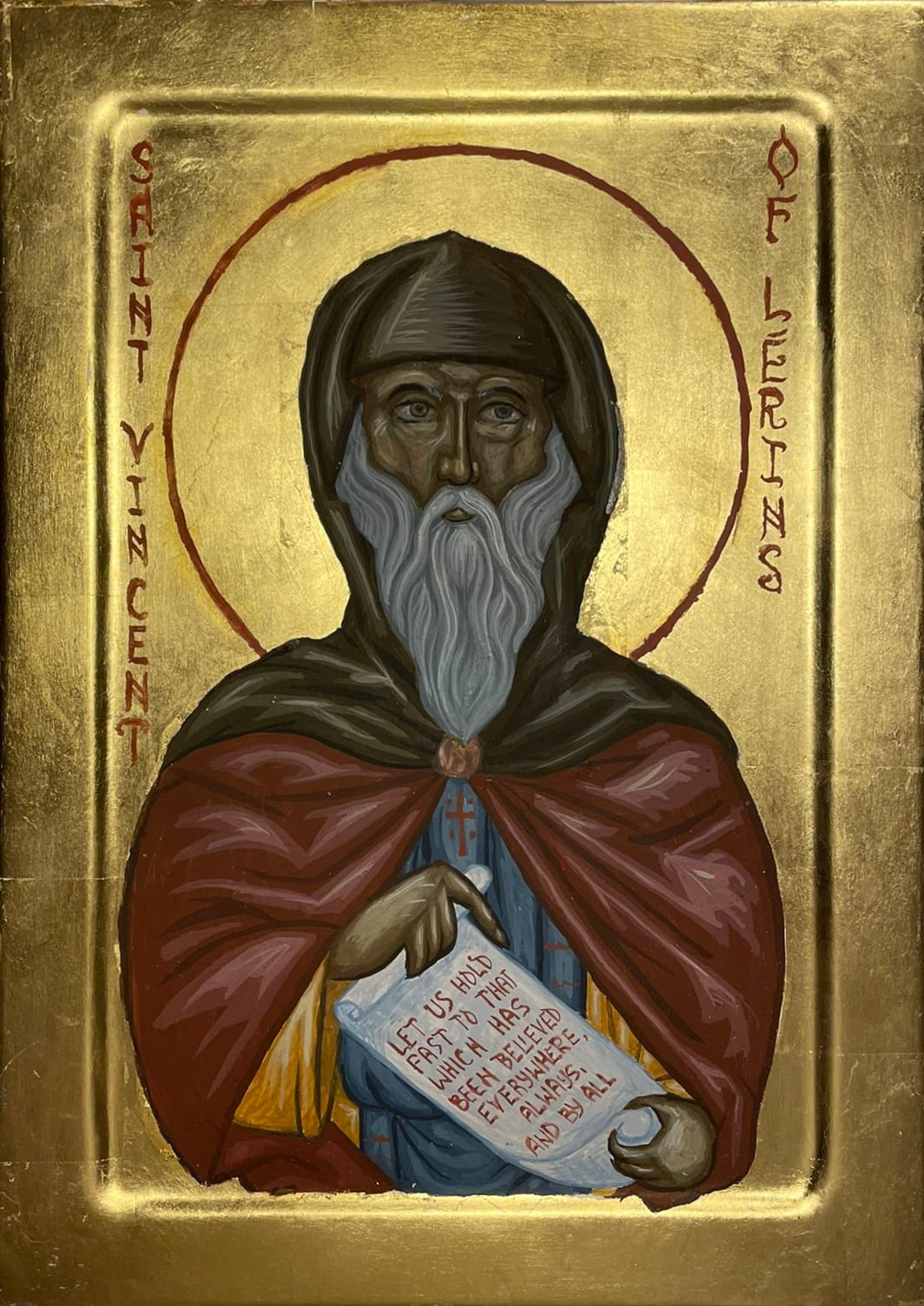
Vincent was a soldier of the late Roman army who, weary of military life, retreated to the great island monastery of Lérins off the southern Gallic coast around 425. There, under the abbacy of St. Honoratus, he became a leading theological writer of the early 5th-century Provençal monastic milieu.
His Commonitorium ('Aide-Mémoire'), written around 434, contains the famous formulation now called the Vincentian Canon — the criterion that authentic Catholic teaching is 'what has been believed everywhere, always, and by all' (quod ubique, quod semper, quod ab omnibus creditum est). This three-fold test — universality, antiquity, and consent — has been one of the foundational principles of Catholic doctrinal reasoning ever since, cited from Trent through Vatican II.
He died at Lérins around 445. His theology was suspected during his lifetime of semi-Pelagianism — sympathetic to Cassian and skeptical of the strict Augustinian doctrine of predestination — but his Commonitorium prevailed as canonical and his memory was honored as a saint.