
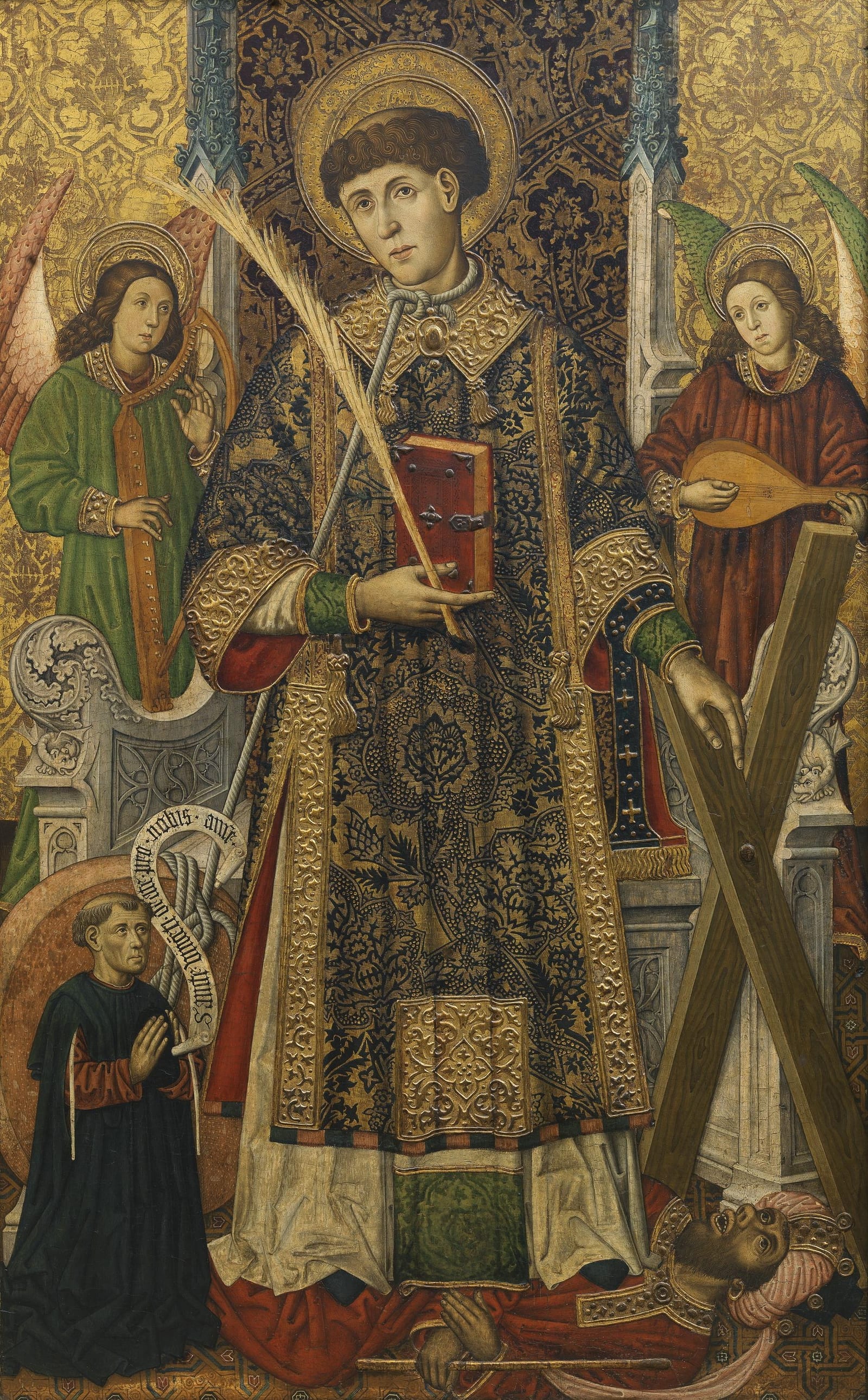
Vincent (Latin Vincentius, 'conquering') was a young deacon of Bishop Valerius of Saragossa in the early 4th century. Bishop Valerius — who had a speech impediment — relied on the young deacon for all public preaching at the Saragossan cathedral. When the Roman governor Dacian arrived to enforce the Diocletianic edicts of 303, he summoned both bishop and deacon to Valencia for trial.
Bishop Valerius — for his speech impediment — was condemned to exile rather than death. Vincent, however, was subjected by Dacian to one of the most prolonged and explicit Roman torture-records in the entire late-antique martyrologial tradition. The Acts of Vincent (composed in the late 4th century, drawing on direct Spanish liturgical tradition and famously celebrated in a passionate sermon by Augustine on his feast day) describe a sequence: scourging, the rack, iron combs of red-hot iron drawn through his flesh, being burnt on a gridiron with shards of pottery beneath, and finally being imprisoned in a pitch-dark cell strewn with broken pottery shards.
Throughout the tortures Vincent maintained his composure and continued to confess Christ. In the cell — per the Acts — he was visited and consoled by angels; the broken pottery shards became flowers; the cell was filled with light. Dacian finally ordered him moved to a bed with linen sheets in the hope of breaking him with kindness; Vincent died on the bed on January 22, 304. His body was first thrown to dogs and ravens (which did not touch it), then thrown into the sea (which returned it intact to shore at the modern Algarve). The remains were eventually buried at Saint Vincent's Cape (Cabo de São Vicente) — the southwestern tip of the Iberian Peninsula, named for him — and finally translated to Lisbon in 1173. He is the protomartyr of the Spanish Catholic Church and the most extensively-celebrated single Iberian martyr of the patristic period.