
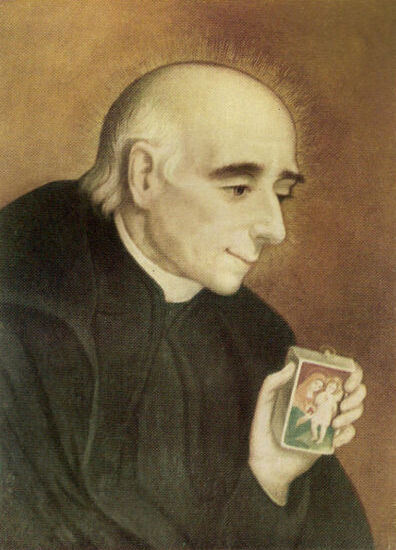
Vincenzo Pallotti was born to a Roman merchant family in the Trastevere district and was ordained priest in 1818 at twenty-three. He served as a confessor and parish priest in Rome through forty intense years of pastoral work — at a dozen Roman parishes and confraternities, with a constant focus on the rejected categories of the city: the prisoners of the Carceri Nuove, the abandoned women of Trastevere, the migrant Italian poor flooding into the city through the early 19th-century rural collapse, and the small surviving community of Roman Jewish converts to Catholicism.
In January 1835 — on the feast of the Epiphany — Pallotti received in prayer the foundational insight of what he called the Society of the Catholic Apostolate (Società dell'Apostolato Cattolico, the Pallottines): the conviction that the apostolate of the Church is not the exclusive responsibility of ordained clergy but the common responsibility of all baptized Catholics, in their actual lay states of life. Pope Gregory XVI confirmed the Society in 1835. Pallotti's foundational text on Catholic lay apostolate — the Memoria Pia of 1839 — became one of the most influential 19th-century texts on lay Catholic apostolic mission, and effectively pre-empted by a hundred years the great Catholic Action movement of the 20th century and the Second Vatican Council's reflection on lay apostolate.
He founded the Pallottine Sisters in 1843 and ran a network of free schools, hostels for indigent migrants, evening catechetical classes for working men, and the celebrated Roman Octave of the Epiphany — the eight-day liturgical celebration of the Eastern Catholic rites in Rome each January, the precursor of the modern ecumenical movement. He died at Rome on January 22, 1850 at fifty-four. Canonized by John XXIII in 1963 — the Pope who two years earlier had convoked the Second Vatican Council.