
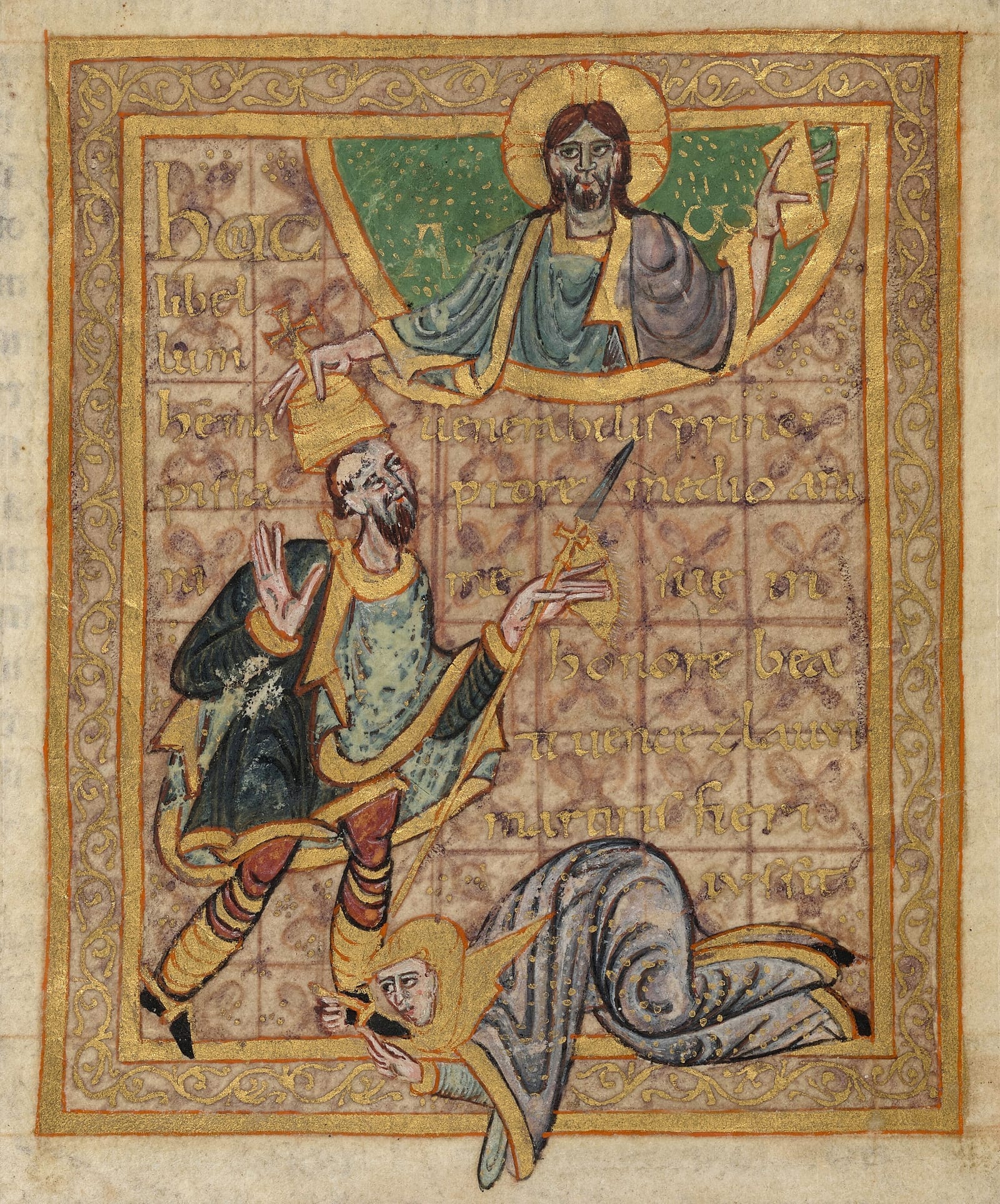
Wenceslas was born to Duke Vratislaus I of Bohemia and Drahomíra of the Hevelli. Raised by his Christian grandmother Ludmilla, he was given a Christian education at Budeč while his pagan mother held the regency after his father's death. When he came of age around 925 he ruled as a model Christian prince — building churches (including the rotunda of St. Vitus at Prague Castle that would become the great cathedral), ransoming Christian slaves, and dispensing personal charity to the poor.
His brother Boleslav, jealous and resentful of the Christian-friendly direction of Wenceslas's reign, invited him to celebrate the feast of Sts. Cosmas and Damian at Stará Boleslav on September 28, 935. As Wenceslas walked alone to early Mass before dawn, Boleslav and his retainers attacked and killed him at the church door. His blood was reportedly visible on the door for years.
He is the principal patron saint of the Czech Republic. The English carol 'Good King Wenceslas' by John Mason Neale (1853) — set to the tune of a 13th-century spring carol — preserves his memory in the English-speaking world. The historical Wenceslas was a Duke, not a King — but he was named King posthumously by Emperor Otto I.