
MIRACULOUS MIRACLES™

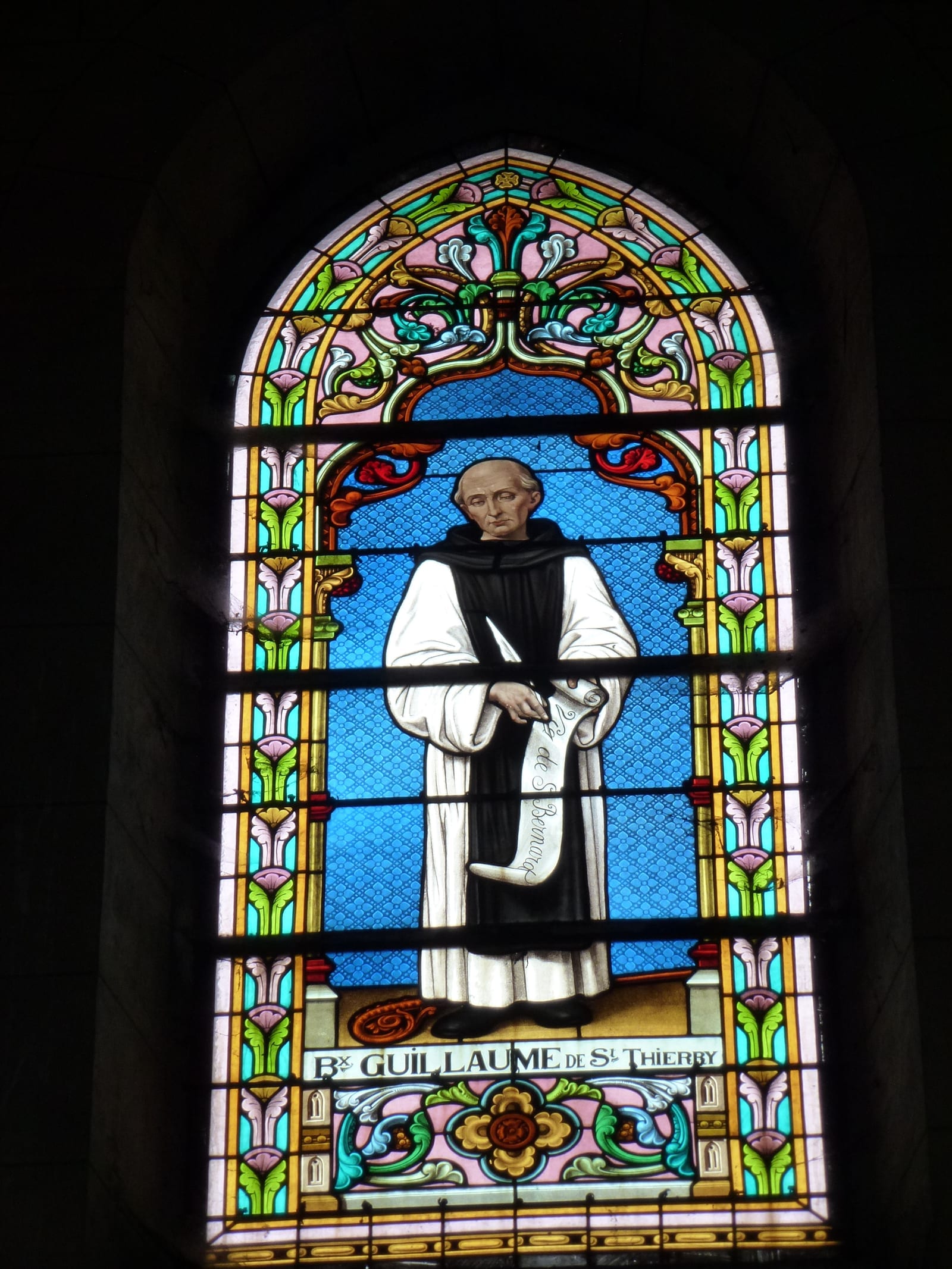
Saint — Bl. William of Saint-Thierry

Bl. William of Saint-Thierry
c. 1085 AD, Liège, Lotharingia (noble Lotharingian family) — September 8, 1148 AD, Abbey of Signy, Ardennes, France
Cistercian abbot-theologian; mystical-spiritual writer; intimate friend of St. Bernard of Clairvaux
Abbey of Saint-Thierry (Abbaye Saint-Thierry), near Reims, Champagne, France — his Benedictine abbacy 1119–1135; the abbey was destroyed in the French Revolution, the site preserved, France
Feast
September 8
Canonized
Beatified locally; venerated as 'Blessed William of Saint-Thierry' in the Cistercian calendar
Life

William was born around 1085 in Liège, Lotharingia, to a noble Lotharingian family. Educated at the cathedral school of Reims and at the Benedictine Abbey of Saint-Nicaise at Reims, he became a Benedictine monk around 1113.

In 1119 he was elected Abbot of the Benedictine Abbey of Saint-Thierry near Reims — taking up the governance of the important medieval Champenois monastic community.

Around 1118 he first met St. Bernard of Clairvaux — and the intense personal friendship and theological-spiritual collaboration between the two Catholic spiritual masters became one of the principal friendships of the High Medieval Catholic spiritual tradition. William desired to enter Bernard's Cistercian community at Clairvaux, but Bernard insisted he should remain in the Benedictine abbacy of Saint-Thierry — to be a reforming voice for the broader Benedictine tradition.

In 1135, after sixteen years of Benedictine abbacy and repeated personal desire, William finally laid down the Saint-Thierry abbacy and entered the Cistercian Abbey of Signy in the Ardennes as a simple Cistercian monk — one of the few cases in medieval Western Catholic history of a sitting abbot voluntarily resigning to enter a stricter monastic community as a simple monk.

He spent the last thirteen years of his life (1135–1148) at Signy in Cistercian-monastic simplicity, composing his principal theological-mystical works. He died at Signy on September 8, 1148.

His principal theological-mystical works include: the Epistola Aurea (Golden Epistle / Letter to the Brothers of Mont-Dieu) — addressed to the Carthusian community of Mont-Dieu, one of the principal medieval Catholic spiritual-mystical treatises and the classic Western articulation of the three-stages spiritual ascent (animal, rational, spiritual); the De Natura et Dignitate Amoris (On the Nature and Dignity of Love), one of the principal medieval Western Catholic treatises on love; the De Contemplando Deo (On Contemplating God) and the Speculum Fidei (Mirror of Faith); Latin translations of the Greek Fathers (he translated portions of St. Gregory of Nyssa's De Hominis Opificio into Latin, one of the rare Greek-Patristic translation efforts of the High Medieval Latin West).

He also composed the disputation Contra Petrum Abaelardum (Against Peter Abelard) — his principal contribution to the famous Bernard-Abelard theological controversy of the 1140s.

Miracles & Phenomena
  • The Epistola Aurea (Golden Epistle)

    William of Saint-Thierry's Epistola Aurea (Golden Epistle / Letter to the Brothers of Mont-Dieu, c. 1144) — addressed to the Carthusian community of Mont-Dieu — is one of the principal medieval Catholic spiritual-mystical treatises and the classic Western articulation of the three-stages spiritual ascent (animal, rational, spiritual). The Epistola Aurea was widely copied throughout the medieval centuries (over 200 surviving medieval manuscripts), extensively quoted in the High Medieval and early-modern Catholic spiritual-theological tradition (the text circulated under the mistaken attribution to St. Bernard of Clairvaux for centuries), and a principal source of the Catholic mystical-theological tradition.

  • The Latin translation of Greek Patristic texts

    William of Saint-Thierry's Latin translation of portions of St. Gregory of Nyssa's De Hominis Opificio (On the Creation of Man) into Latin — one of the rare Greek-Patristic translation efforts of the High Medieval Latin West — institutionally pre-figured the 13th- and 14th-century Latin-Greek Catholic theological-translation tradition that would produce the High Medieval ecumenical Catholic-Orthodox theological dialogue (the Catholic Latin translations of Pseudo-Dionysius, Gregory Nazianzen, John of Damascus that would underpin the scholastic-theological synthesis).

Relics
  • Body
    Tomb of Bl. William of Saint-Thierry
    Abbey of Signy, Ardennes, France — destroyed in the French Revolution (1789–1799); the principal relics lost; memorial veneration at the ruins of the Abbey and at the current Catholic Cistercian houses preserving the William-spiritual-tradition

    His tomb at the Abbey of Signy was destroyed in the French Revolutionary dissolution; the principal relics lost; memorial veneration is maintained in the Cistercian tradition.

Iconography
  • William of Saint-Thierry composing the Golden Epistle

    The mid-12th-century Cistercian monk in Cistercian habit at the scriptorium-desk of the Abbey of Signy in the Ardennes composing the Epistola Aurea, the addressed Carthusian community of Mont-Dieu pictured in the distance, the text of the three-stages spiritual ascent unfolding on the parchment — the iconography of Catholic Cistercian-Carthusian spiritual-mystical tradition.

Patronages
Catholic Cistercian theological-mystical traditionCatholic Latin spiritual-theological writersThe Champagne and Ardennes regions of FranceCatholic ecumenical Catholic-Orthodox theological dialogue (his interest in the Greek Patristic tradition)