
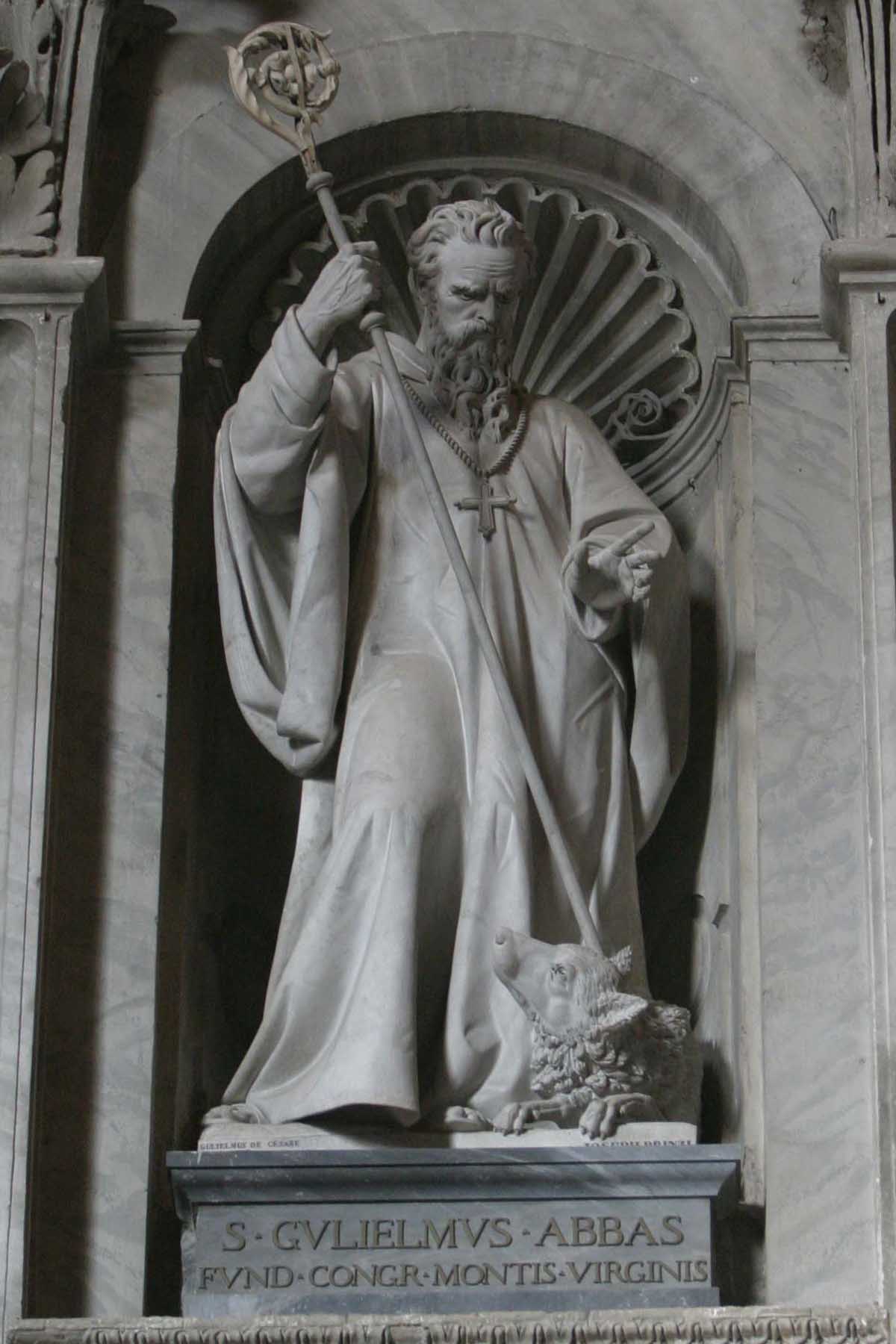
William (Italian Guglielmo) was born in 1085 in Vercelli, Lombardy, to a noble Lombard family — orphaned in infancy. Raised by kinsmen, he undertook the youthful pilgrimage to Santiago de Compostela around 1100 (an extraordinary youthful pilgrimage from northern Italy to Galicia, one of the principal early medieval Italian Catholic pilgrim-itineraries).
After return to Italy, William undertook hermit-life on Monte Solicchio (in the Apulian Gargano peninsula) around 1106. He subsequently undertook the hermit-life on Monte Vergiliano (a holy mountain of the Hirpini Apennine region, named for the Virgil-poet and later for the Catholic 'Vergine' Madonna of the mountain-shrine) in Campania around 1118.
In 1124 he founded the Sanctuary of Montevergine on the summit of Monte Vergiliano (modern Mercogliano, near Avellino in Campania) — one of the principal Catholic Marian pilgrim destinations of southern Italy. The Sanctuary of Montevergine has been one of the principal pilgrim-destinations of the Hirpini-Campanian-Catholic tradition for the nine centuries, housing the famous Madonna di Montevergine (the Black Madonna of Montevergine, an ancient Marian icon).
William established the Williamite Congregation (Italian Congregazione Verginiana, the Order of Monte Vergine) — a Benedictine reform congregation affiliated to multiple daughter houses across southern Italy. He subsequently founded multiple additional monastic communities, most including the Abbey of Goleto at Sant'Angelo dei Lombardi — a distinctive double-monastery (with separate but simultaneous men's and women's communities, one of the rare double-monastic foundations of medieval Western Catholicism).
He died at Goleto on June 25, 1142, and was buried at his Goleto foundation. His principal relics were subsequently translated to the Sanctuary of Montevergine, where they remain to the present day.