
MIRACULOUS MIRACLES™

Saint — Wolfgang of Regensburg

St. Wolfgang of Regensburg
c. 934 AD, Pfullingen, Swabia (noble Alemannian-Swabian family) — October 31, 994 AD, Pupping, Upper Austria
Bishop of Regensburg 972–994; Bavarian Catholic reformer; one of the three holy bishops of Germany
Abbey of St. Emmeram, Regensburg, Bavaria — his shrine; the Bavarian pilgrim destination of St. Wolfgang im Salzkammergut (Upper Austria), Austria — the lake-town named for his hermitage, Germany
Feast
October 31
Canonized
Canonized 1052 by Pope Leo IX (confirmed by papal canonization)
Life

Wolfgang was born around 934 to a noble Alemannian-Swabian family at Pfullingen in Swabia. Educated at the Abbey of Reichenau on Lake Constance and at the cathedral school of Würzburg, he became a teacher and later monk at the Abbey of Einsiedeln in Switzerland under St. Gregory of Einsiedeln.

Around 972, the new Holy Roman Emperor Otto II summoned Wolfgang to be consecrated Bishop of Regensburg — the principal Bavarian Catholic see — succeeding the deposed Michael. For the next twenty-two years (972–994), Wolfgang undertook the major Catholic reform of Bavaria.

His most consequential institutional act was the 975 separation of the Bohemian diocese of Prague from the over-large Bavarian Diocese of Regensburg — creating the autonomous Bohemian (Czech) Catholic ecclesiastical structure that would become the Catholic Czech national-church identity (St. Adalbert of Prague, consecrated 982, was the second Bishop of the new Prague see).

He undertook missionary work among the Hungarian Magyars (in parallel to St. Adalbert's mission), and served as tutor of the young Emperor St. Henry II — placing him in the central Ottonian Catholic episcopal-imperial circle.

He established the Abbey of St. Emmeram at Regensburg as a reform-centre and undertook ascetic retreats to a hermitage on the shore of Lake Abersee in the Salzkammergut of Upper Austria — the lake and the town that grew up at the hermitage are named for him today as Wolfgangsee and St. Wolfgang im Salzkammergut, one of the principal pilgrim destinations of Austrian Catholicism.

He died at Pupping near Linz on October 31, 994, on a pastoral visitation journey; his body was returned to Regensburg and buried at the Abbey of St. Emmeram, where his shrine remains in active Catholic veneration to the present day.

Miracles & Phenomena
  • The creation of the Diocese of Prague (975)

    Wolfgang's consent and episcopal cooperation in the 975 separation of the autonomous Diocese of Prague from the over-large Diocese of Regensburg — at the request of the Bohemian Duke Boleslaus II and with the confirmation of Pope Benedict VII — produced the autonomous Bohemian (Czech) Catholic ecclesiastical structure that became the principal Catholic identity of the Bohemian and Czech national tradition. St. Adalbert of Prague, consecrated as the second Bishop of the new Prague see in 982, would become the Apostle of the Czechs, Slovaks, Hungarians, and Poles.

  • The hermitage at Wolfgangsee

    Wolfgang's hermitage on the shore of Lake Abersee in the Salzkammergut of Upper Austria — where he retreated for ascetic prayer during his Regensburg episcopate — produced the pilgrim town of St. Wolfgang im Salzkammergut, one of the principal pilgrim destinations of Austrian Catholicism. The lake (Wolfgangsee) and the town bear the saint's name to the present day, and the late-Gothic pilgrim church of St. Wolfgang (1430–1481, with famous Michael Pacher altarpiece of 1471–1481) remains in active Catholic liturgical use.

Relics
  • Body
    Tomb of St. Wolfgang
    Abbey of St. Emmeram, Regensburg, Bavaria, Germany — in continuous Catholic veneration since 994; Bavarian Catholic pilgrim destination

    His tomb at the Abbey of St. Emmeram in Regensburg has been the principal Bavarian Catholic pilgrim destination for eleven centuries. The basilica (rebuilt in baroque style 1731–1733 by the Asam brothers) survives in active Catholic liturgical use.

Iconography
  • Wolfgang building his hermitage at Wolfgangsee

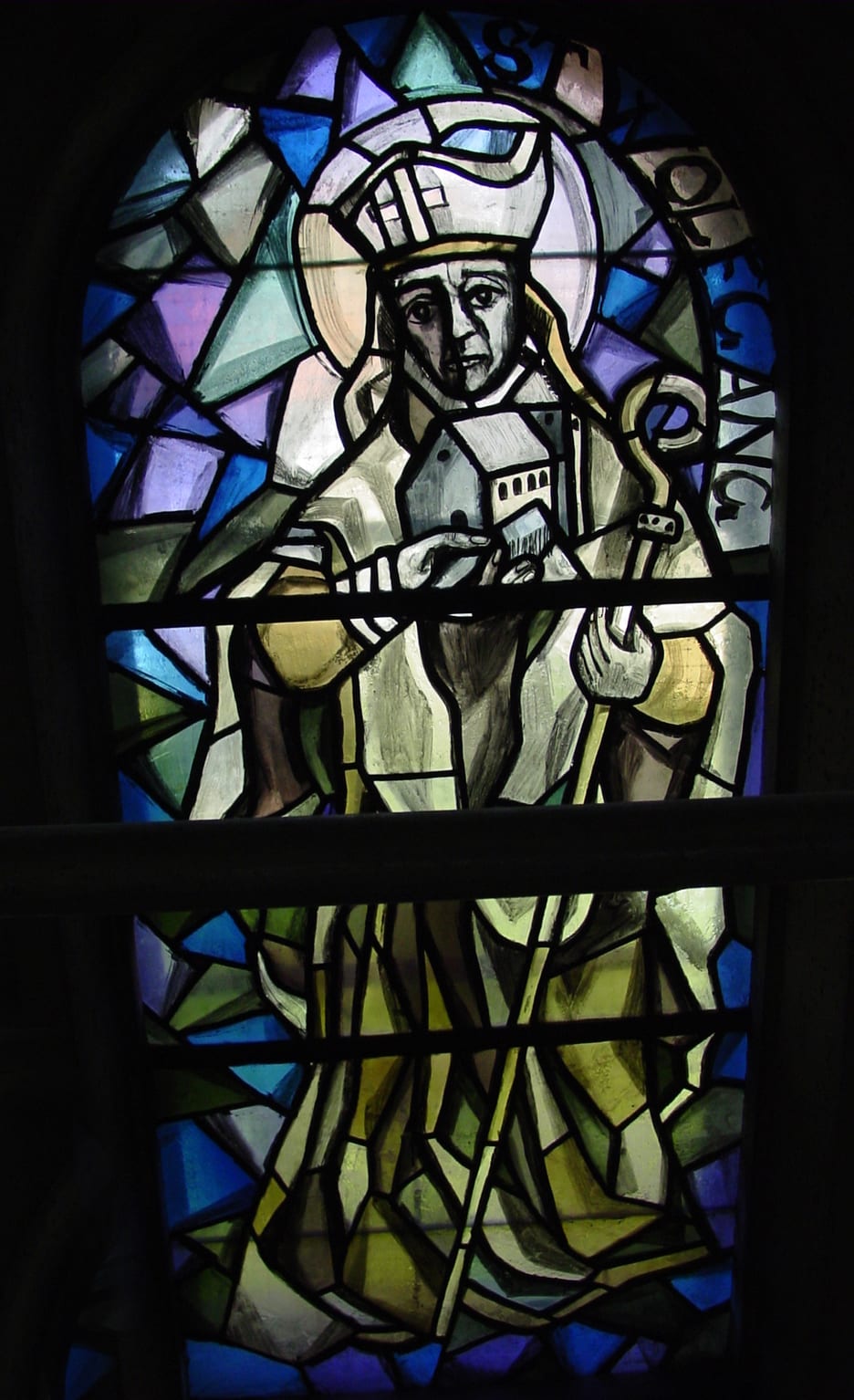
    The mid-10th-century Bishop of Regensburg in simple Benedictine habit (without episcopal vestments) on the shore of Lake Abersee in the Salzkammergut striking with an axe at the tree-trunk that would become the beam of his hermitage chapel, his episcopal mitre and pastoral staff laid on the ground beside him — the standard iconography of the Bavarian and Austrian Catholic tradition.

Patronages
Diocese of RegensburgBavaria, Upper Austria, and the SalzkammergutCatholic carpenters, woodcutters, and stonemasons (his hermit-building tradition)Catholic German episcopal reformers (with Sts. Ulrich of Augsburg and Conrad of Constance, the 'Three Holy Bishops')