
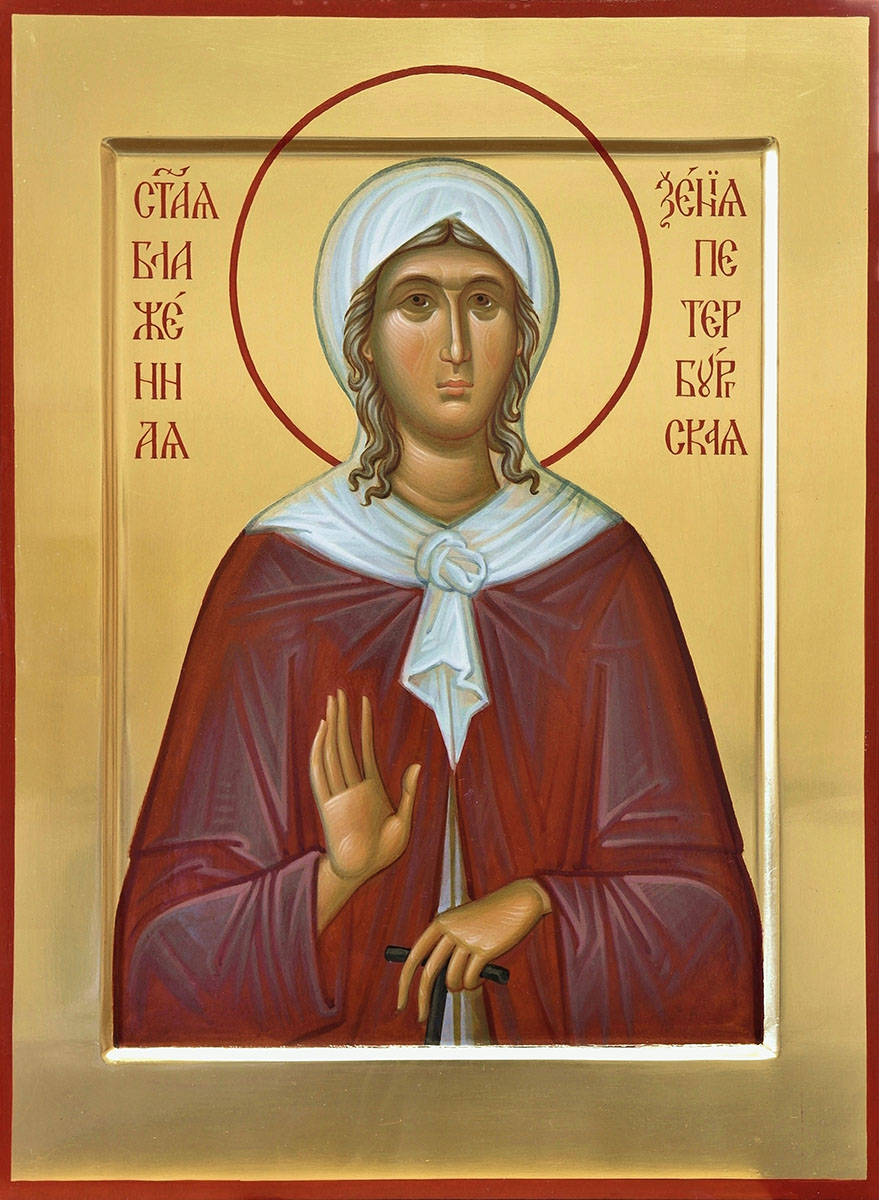
Xenia Petrova was the wife of an imperial Russian Army colonel, Andrei Petrov, in the court of Empress Elizabeth Petrovna. She was widowed suddenly at twenty-six when her husband died without sacramental preparation. The shock of his unconfessed death drove her to a radical decision: she would give her remaining years to praying his repentance for him before God.
She gave away the entire family inheritance to the poor of St. Petersburg, donated the house itself to a homeless woman she found in the street, and put on her dead husband's military uniform — wearing it without ever changing it for the rest of her life and answering only to his name 'Andrei Fyodorovich.' For the next forty-five years she lived as a 'yurodivaya' — a holy fool — homeless in the streets of St. Petersburg, sleeping in open fields, eating only what she was given, and accepting only such alms as she could immediately redistribute to others.
She became one of the most beloved figures of pre-Soviet St. Petersburg religious culture — credited with extensive intercessory miracles in her own lifetime (she would predict deaths, births, marriages, and political events with attested accuracy), and venerated continuously after her death around 1803. Her grave in the Smolensk Cemetery was the focus of an extraordinary continuous popular devotion through the entire Tsarist period and into the Soviet period (the small chapel built over her grave was closed by the Soviets but the cult never died). She is the most-venerated lay saint of the Russian Orthodox tradition. Formally canonized by the Russian Orthodox Church in 1988 at the millennium of the Baptism of Rus'.