
MIRACULOUS MIRACLES™

Blessed — Yolanda of Poland (Jolenta)

Bl. Yolanda of Poland (Jolenta)
1235 AD, Esztergom, Kingdom of Hungary (royal Árpád family — younger sister of St. Kinga of Poland) — June 17, 1298 AD, Poor Clare Monastery of Gniezno, Kingdom of Poland
Duchess-consort of Kalisz (1256–1279); Poor Clare abbess of Gniezno; third Polish royal-Poor-Clare saint
Poor Clare Monastery of Gniezno, Kingdom of Poland — her personal foundation; largely destroyed in the 19th-century Prussian dissolutions but memorial preserved, Poland
Feast
June 15
Canonized
Beatified September 26, 1827 by Pope Leo XII
Life

Yolanda (Hungarian Jolán, Polish Jolenta) was born in 1235 at Esztergom to King Béla IV of Hungary and Queen Maria Laskarina — the younger sister of St. Kinga of Poland (1234–1292).

In 1256, at the age of 21, Yolanda was married to Bolesław the Pious of Kalisz (1224–1279) — Piast prince of Greater Poland (Wielkopolska).

Yolanda and Bolesław established the royal court at Gniezno-Kalisz and produced three daughters (Hedwig, Elisabeth, and Anna). During the period, they undertook extensive Catholic charitable and monastic patronage — patrons of the Franciscan Order in Greater Poland, founders of multiple Franciscan churches and convents.

After Bolesław's death in 1279, Yolanda undertook the Poor Clare vocation — in institutional parallel with her older sister Kinga (also widowed in 1279 and taking the Poor Clare habit that same year) and her sister-in-law-once-removed Bl. Salomea (Poor Clare from 1245).

Yolanda entered the Poor Clare Monastery of Stary Sącz (with her sister St. Kinga) around 1280, then moved to found her own Poor Clare Monastery at Gniezno — the primatial see of Poland — serving as abbess of Gniezno until her death on June 17, 1298.

The three Polish royal Poor Clare saints — Bl. Salomea (1211–1268), St. Kinga (1234–1292), and Bl. Yolanda (1235–1298) — institutionally established the Polish royal-Piast-dynasty Poor Clare tradition of the royal-lay-becoming-monastic culture that would extend through the medieval Polish Catholic centuries.

Miracles & Phenomena
  • The three Polish royal Poor Clare saints (Salomea, Kinga, Yolanda)

    Bl. Yolanda of Poland — the third of the three Polish royal Poor Clare saints (with Bl. Salomea and St. Kinga) — institutionally completed the Polish royal-Piast-dynasty Poor Clare tradition of the royal-lay-becoming-monastic culture. The three saints shared the pattern of royal marriage, widowhood, Poor Clare vocation, and abbatial ministry — producing the distinctive Polish Catholic-women's-monastic culture that would extend through the medieval Polish Catholic centuries and underpins the continuing Polish Catholic identity.

Relics
  • Body
    Tomb of Bl. Yolanda of Poland
    Originally Poor Clare Monastery of Gniezno (1298 burial); the monastery largely destroyed in the 19th-century Prussian dissolutions; relics translated to the Franciscan Cathedral of Gniezno

    Her principal relics rest at the Franciscan Cathedral of Gniezno — translated from the destroyed Poor Clare Monastery in the 19th-century Prussian dissolutions.

Iconography
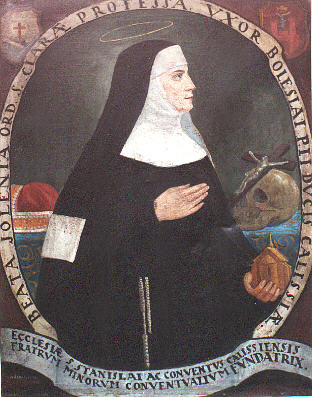
  • Yolanda as Poor Clare abbess of Gniezno

    The late-13th-century Hungarian-Polish royal princess in Poor Clare habit at the Poor Clare Monastery of Gniezno, holding the Rule of St. Clare and the royal Piast crown of Greater Poland (sign of her royal renunciation), the Franciscan mother-cathedral of Gniezno visible behind — the iconography of Catholic Polish royal-Poor-Clare tradition.

Patronages
Poland (principal Polish royal-Piast-Árpád saint alongside St. Hedwig, Bl. Salomea, and St. Kinga)Catholic Polish Poor Clare tradition (with Bl. Salomea and St. Kinga)Gniezno (primatial see of Poland — the Gniezno-Poznań archdiocesan tradition)The Diocese of Kalisz (Poland)