
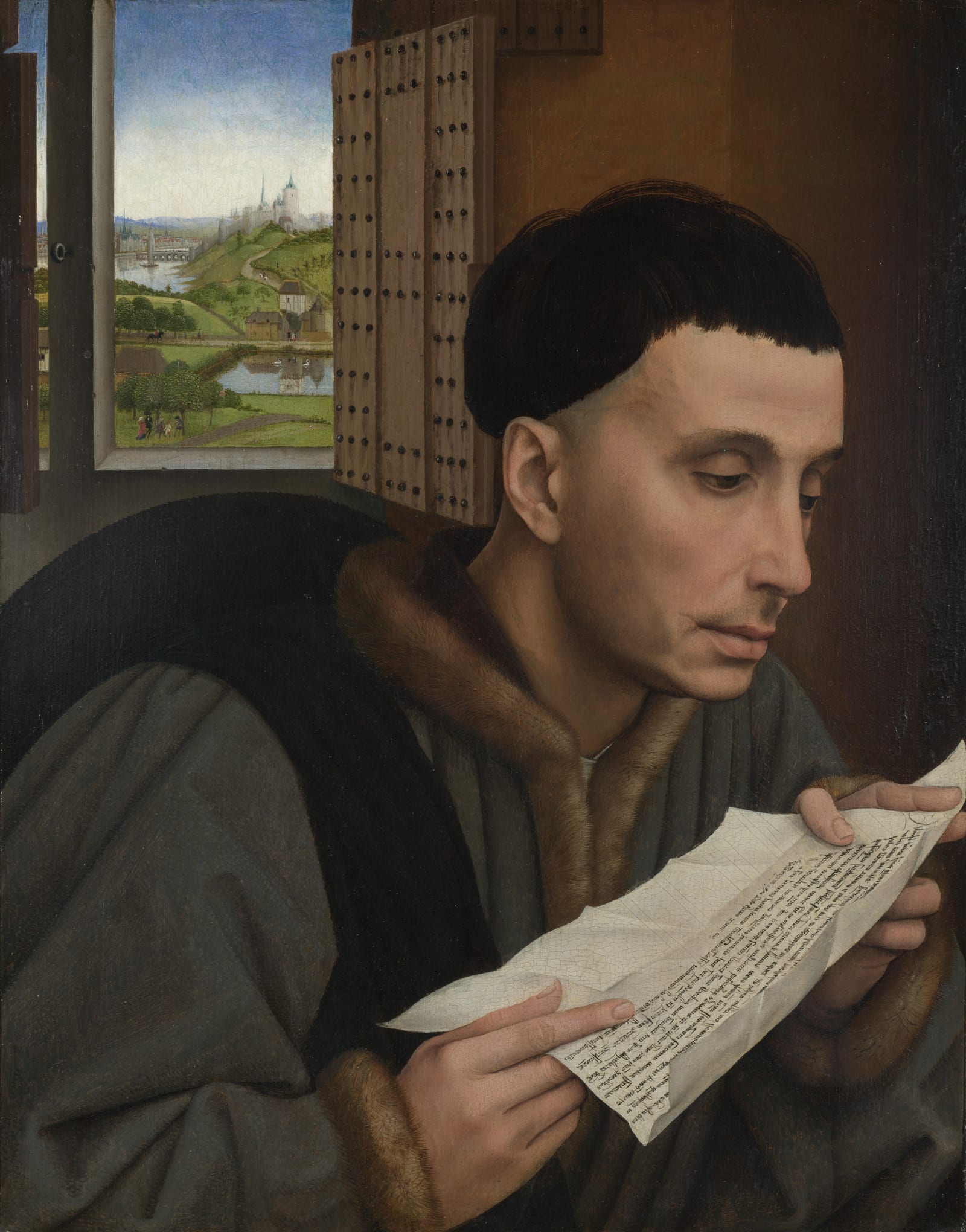
Yves Hélori was born to a Breton noble family at Kermartin near Tréguier. He was sent to study at Paris and Orléans — civil and canon law — and was rated by his contemporaries as one of the most brilliant young legal minds of his generation. Around 1280 he returned to Brittany and became official (canonical judge) of the diocese of Rennes, then of Tréguier, and was ordained priest in 1284.
His twenty-year ecclesiastical legal career was the foundation of his reputation. He refused all bribes, took no fees from the poor (paying out of his own pocket for their cases when needed), travelled the courts in the simplest of attire, and consistently judged in favour of justice over influence. The medieval Latin epigram — Advocatus erat et non latro, res miranda populo ('He was a lawyer and not a thief, a thing remarkable to the people') — captures his contemporary fame.
He was sent at fourteen to Paris, where he studied theology under Bl. Peter of Auvergne, a disciple of St. Thomas Aquinas, and then to Orléans for civil law. In 1280 he was made judge of the ecclesiastical court of Rennes, the principal judicial office in Brittany, and afterwards of Tréguier — the courts in which his reputation was made.
The Bretons put his character into a Latin jingle that became proverbial across medieval Europe, and which survives because it is a joke at the profession's expense: ‘Sanctus Ivo erat Brito, advocatus et non latro; res miranda populo’ — Saint Ivo was a Breton, an advocate and not a thief, a wonder to the people.
In 1287 he became also a parish priest at Trédrez and then Louannec, where he preached, slept on a straw mat on the floor, fed the poor at his rectory, and continued to serve as advocate for those who could pay nothing. He died at Louannec on May 19, 1303. Tréguier began an immediate campaign for his canonization which the Avignon papacy finally accepted in 1347 — 44 years after his death. He is the principal patron saint of legal professionals everywhere, and his Pardon (annual feast) at Tréguier on May 19 is the central religious-civic event of Breton Catholicism.