Somebody decided which books are the word of God. That is the uncomfortable way of putting it, and it is the question behind the one Catholics are asked most often: why does your Bible have seven more books than mine? This page answers both, with the texts quoted — every surviving canon list from a heretic in 144 to a funding resolution in 1826, what each one actually contained, and where the evidence cuts against the side telling the story.
Jerome is quoted here at length and not softened. He is the strongest witness against the canon his own Church settled on, and leaving him out would make this apologetics rather than history.
THE SHORT ANSWER
1The Church was preaching for twenty years before a word of the New Testament was written, and the books were gathered by use long before any council ratified them.
2The seven disputed books stood in the Greek Old Testament that the apostles' world read, and in the Christian Bibles of the fourth century. They were listed as Scripture at Carthage in 397 and by the Council of Florence in 1442.
3Jerome, translating the Vulgate, said they were not canonical. The Church followed Augustine instead. The doubt was real, it came from a saint, and it was never hidden.
4In 1546 Trent made the old list binding under anathema, because the Reformers had just removed the books. Trent did not add them; it closed the question.
01
The Church came before the book
For about twenty years after the Resurrection there was no New Testament at all.
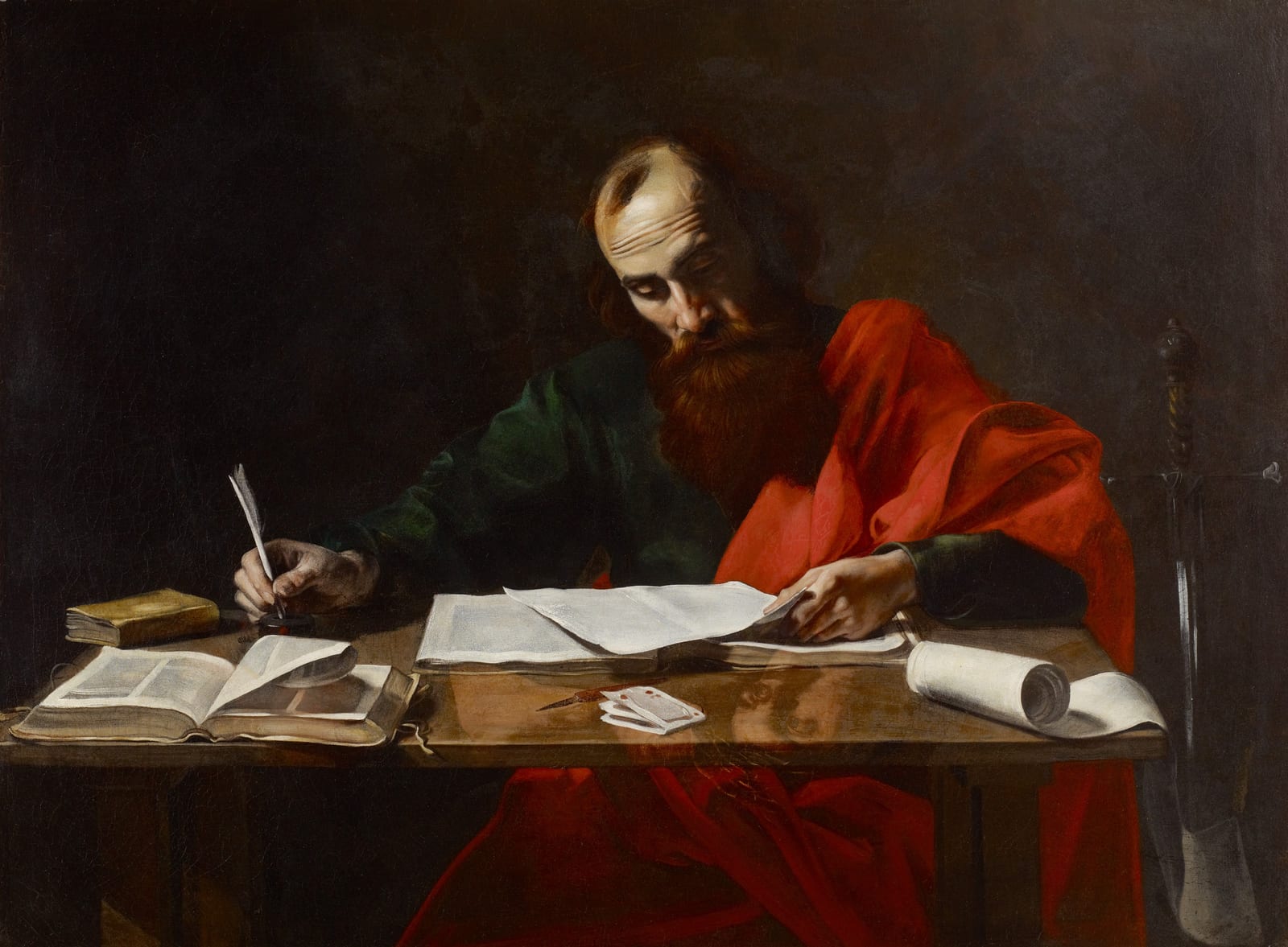
Valentin de Boulogne, Saint Paul Writing His Epistles, c. 1618–20 — Museum of Fine Arts, Houston
Nobody sat down to write a Bible. The Gospel was preached, argued over, suffered for and celebrated at the altar for a generation before a line of the New Testament existed. The earliest surviving Christian writing is probably Paul's first letter to the Thessalonians, around AD 50 or 51 — and it is a letter, written to one troubled congregation about one set of problems, not a chapter of a planned volume.
The four Gospels were written across roughly the second half of the first century; the datings are argued and this site gives the range rather than a false precision. Every one of them was written to be read in a particular church, and every one of them circulated on its own before anyone bound them together.
So when the New Testament writers say "the scriptures", they are never talking about themselves. They mean the Old Testament. Which means the real question is not how the Church got the Bible. It is how the Church came to recognise which of her own writings were Scripture — and that took three hundred years, several arguments, and a good deal of disagreement between saints.
02
The Bible Jesus read
In the first century there was no single, closed, agreed Jewish canon to inherit.
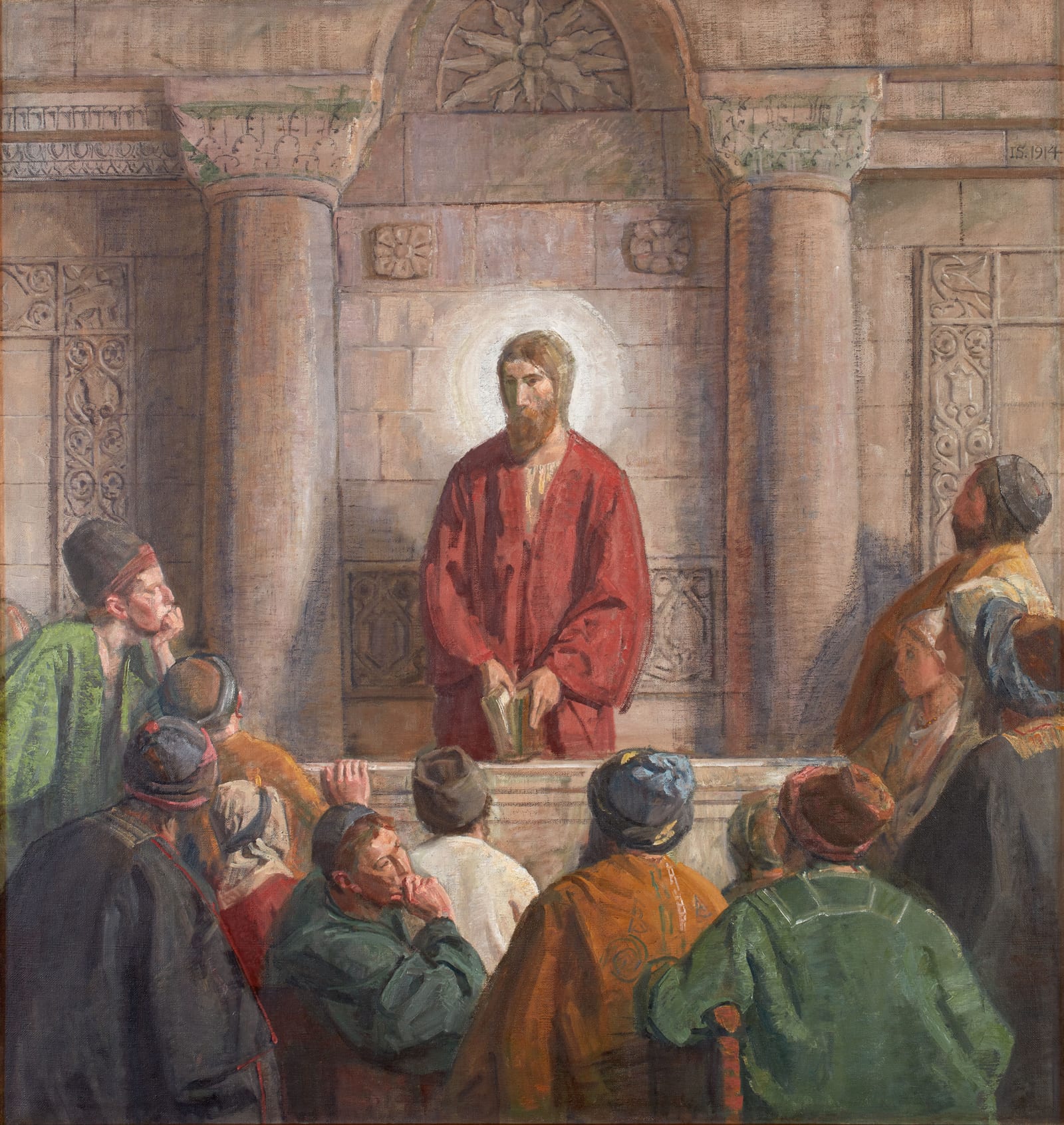
Joakim Skovgaard, Jesus in the Synagogue, 1914
Different Jewish communities held different collections. The Sadducees are reported to have accepted only the five books of Moses. The community at Qumran copied Isaiah and Genesis and also kept Jubilees and Enoch, which no one holds as Scripture today except the Ethiopian Church. There was a settled core — the Law, the Prophets — and a fringe that was not settled.
Greek-speaking Jews read the Septuagint, the translation begun in Alexandria in the third century BC. It was wider than the collection the rabbis later fixed, and it is the version the New Testament writers overwhelmingly quote — sometimes in wording that exists in the Greek and not in the Hebrew. Matthew 1:23 reads Isaiah 7:14 as "a virgin shall conceive", following the Greek parthenos; the Hebrew almah is broader.
The popular idea that a Jewish council at Jamnia closed the canon around AD 90, and that Christians ought therefore to follow its list, does not survive contact with the sources. There is no record of such a council deciding any such thing. The phrase was coined by Heinrich Graetz in 1871 and the hypothesis was dismantled by Jack P. Lewis in 1964; what the rabbinic sources actually show is a school at Yavneh discussing whether certain books "defile the hands", which is not the same question.
03
The provocation
The first person to publish a fixed Christian canon was a heretic, and the Church has been answering him ever since.
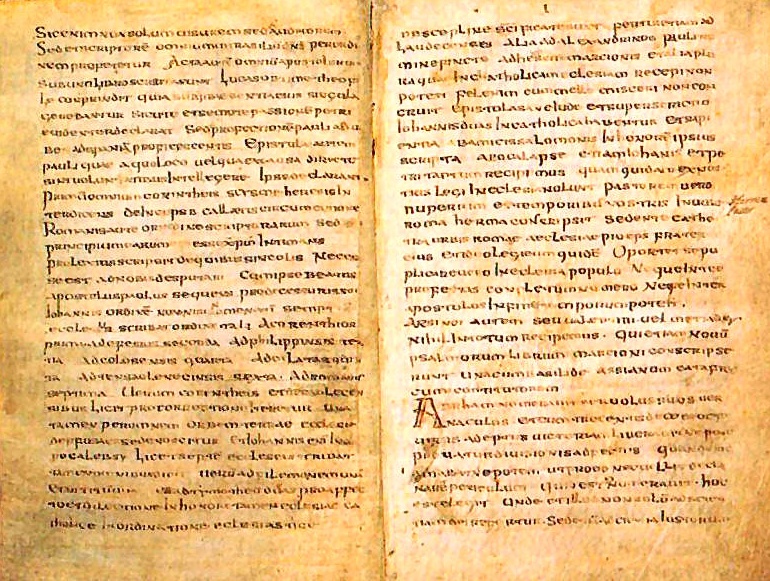
The Muratorian fragment — an eighth-century copy of a list written about 170–200; Biblioteca Ambrosiana, Milan
Around 144 Marcion of Sinope was expelled from the church at Rome. He taught that the God of the Old Testament was a lesser and crueller being than the Father of Jesus Christ, and he acted on it: he produced a Bible with no Old Testament whatsoever, consisting of a shortened Luke and ten letters of Paul, edited to remove what he took to be Jewish corruption.
This forced a question nobody had needed to answer in writing. The Church's reply was not, at first, a rival list. It was an appeal to what the churches everywhere actually read aloud when they gathered — which is why the oldest surviving orthodox canon list, the Muratorian fragment, is concerned less with abstract inspiration than with what may be read publicly in church.
That fragment, a Latin manuscript preserving what is generally taken to be a Greek original of the late second century, already names four Gospels, Acts, thirteen letters of Paul, Jude, letters of John and the Apocalypse. It also does something we should notice: it names forgeries and refuses them by name.
“There is current also [an epistle] to the Laodiceans, [and] another to the Alexandrians, [both] forged in Paul's name to [further] the heresy of Marcion.”
The Muratorian fragment, lines 63–65 · Muratorian fragment, c. 170–200, tr. Bruce Metzger · source
04
Acknowledged, disputed, spurious
Around 325 — the year of Nicaea — the Church's first historian sorted the books into three baskets, and freely admitted that the sorting was not finished.
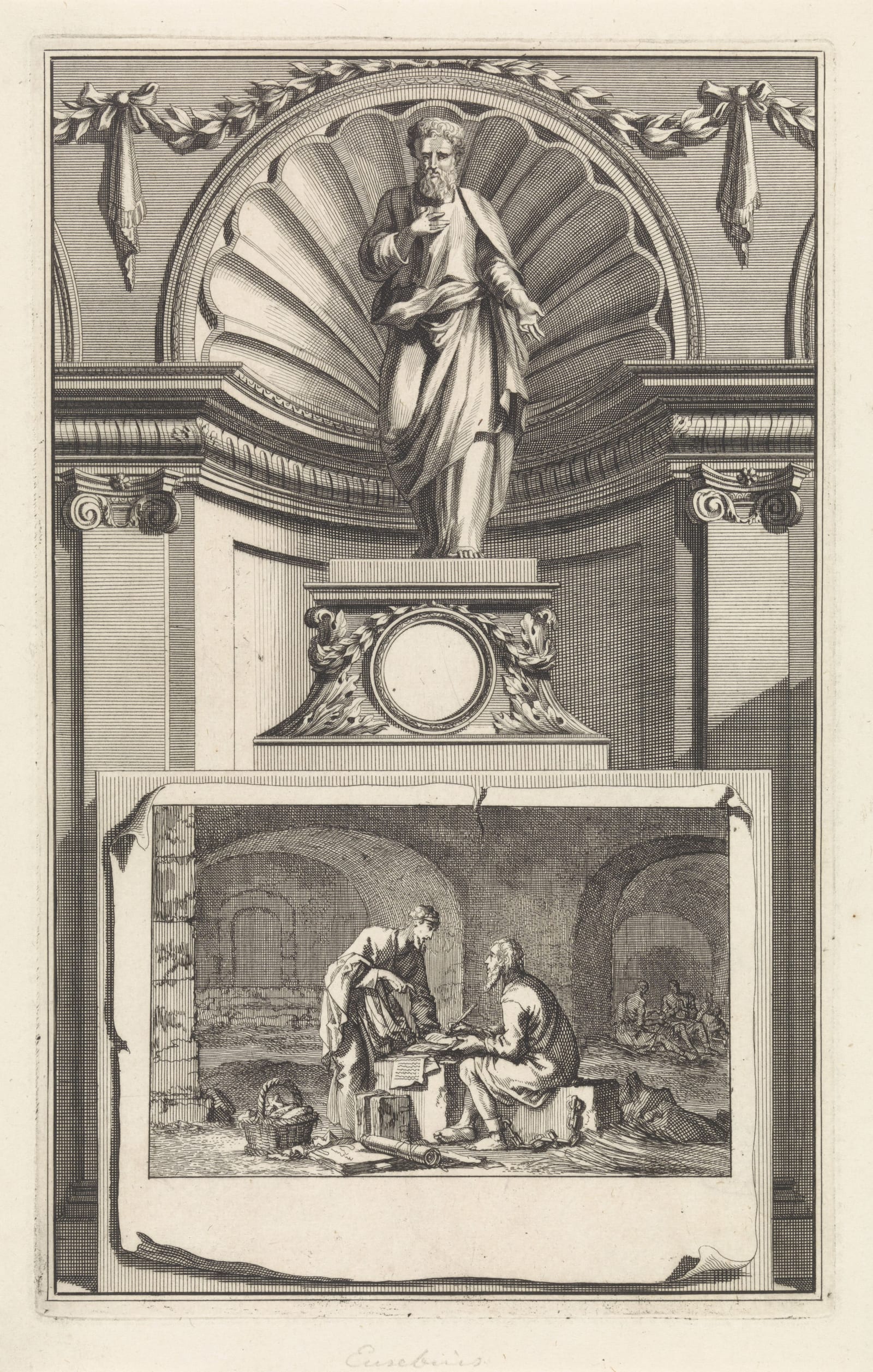
Eusebius of Caesarea — frontispiece to an edition of his works, engraving, 1698; Rijksmuseum, Amsterdam
Eusebius of Caesarea, writing his Church History, divided the Christian writings into the acknowledged, the disputed, and the spurious. In the first he put the four Gospels, Acts, the letters of Paul, 1 John and 1 Peter. In the second — disputed, though recognised by many — he put James, Jude, 2 Peter, and 2 and 3 John.
Those are, almost exactly, the books that would still be argued about twelve hundred years later. The Reformation did not invent doubts about James; it inherited them.
Eusebius could not place Revelation at all, and said so, listing it in one place among the accepted and in another among the rejected, "if it seem proper", according to whose opinion you followed. This matters for a reason that has nothing to do with Catholic or Protestant: Eusebius was present at the Council of Nicaea. If Nicaea had settled the canon, the man who was in the room would not have been writing this.
“Among the disputed writings, which are nevertheless recognized by many, are extant the so-called epistle of James and that of Jude, also the second epistle of Peter, and those that are called the second and third of John, whether they belong to the evangelist or to another person of the same name.”
Eusebius of Caesarea · Church History III.25, c. 325 · source
05
The lists close
Between 367 and 419 the argument, in the West at least, came to rest — and the list it came to rest on is the Catholic one.
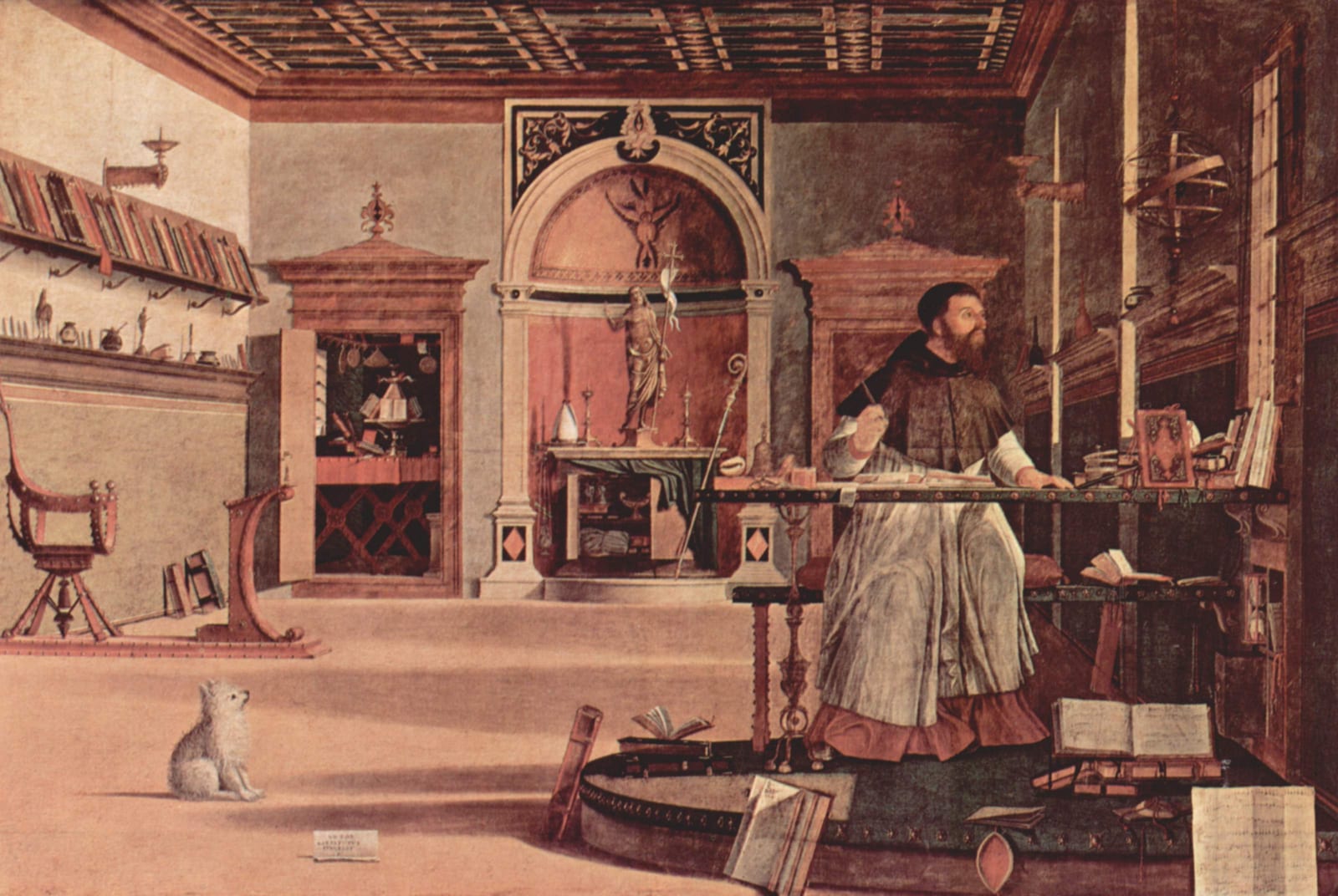
Vittore Carpaccio, The Vision of Saint Augustine, 1502 — Scuola di San Giorgio degli Schiavoni, Venice
In 367 Athanasius of Alexandria sent out his thirty-ninth Festal Letter, and in it appears the first surviving list of exactly the twenty-seven books of the New Testament, no more and no fewer, that every Christian communion on earth now holds. It ends: "Let no man add to these, neither let him take ought from these."
But Athanasius should not be enlisted too quickly by either side, and this page will not do it. His Old Testament list is neither the Catholic one nor the Protestant one. He leaves Esther out of the canon entirely, placing it among books "not indeed included in the Canon, but appointed by the Fathers to be read" — alongside Wisdom, Sirach, Judith and Tobit. Anyone who cites Athanasius against the seven books has also cited him against Esther.
Augustine gave the rule that actually decided the matter, and it was not a theory of inspiration but a rule of evidence: follow the churches. Prefer what all the catholic churches receive; where they differ, weigh the number of the churches and their authority. Applied to the fourth-century Latin West, that rule produced the list the African councils then wrote down.
The Council of Hippo in 393 and the Third Council of Carthage in 397 put it in a canon of church law, framed exactly as the practical question it was: what may be read aloud in church under the name of the divine Scriptures. Carthage was reaffirmed in 419. Its list of the Old Testament includes Tobit, Judith, and the two books of Maccabees, and its "five books of Solomon" takes in Wisdom and Ecclesiasticus.
A Council of Rome under Pope Damasus in 382 is often cited as the first to fix the list. This page treats that with caution. The list attributed to it survives in the Decretum Gelasianum, a document most scholars now judge to be a private compilation made in Italy or Gaul in the early sixth century rather than the act of Damasus. The African councils are the firm ground; Rome 382 is not.
“Now, in regard to the canonical Scriptures, he must follow the judgment of the greater number of catholic churches; and among these, of course, a high place must be given to such as have been thought worthy to be the seat of an apostle and to receive epistles.”
Augustine of Hippo · On Christian Doctrine II.8, c. 397 · source
06
Jerome's doubt
The greatest biblical scholar of the ancient Church did not agree, and said so in the prefaces of the Bible he was translating. This is the strongest argument against the Catholic canon, and it is a Catholic saint's.
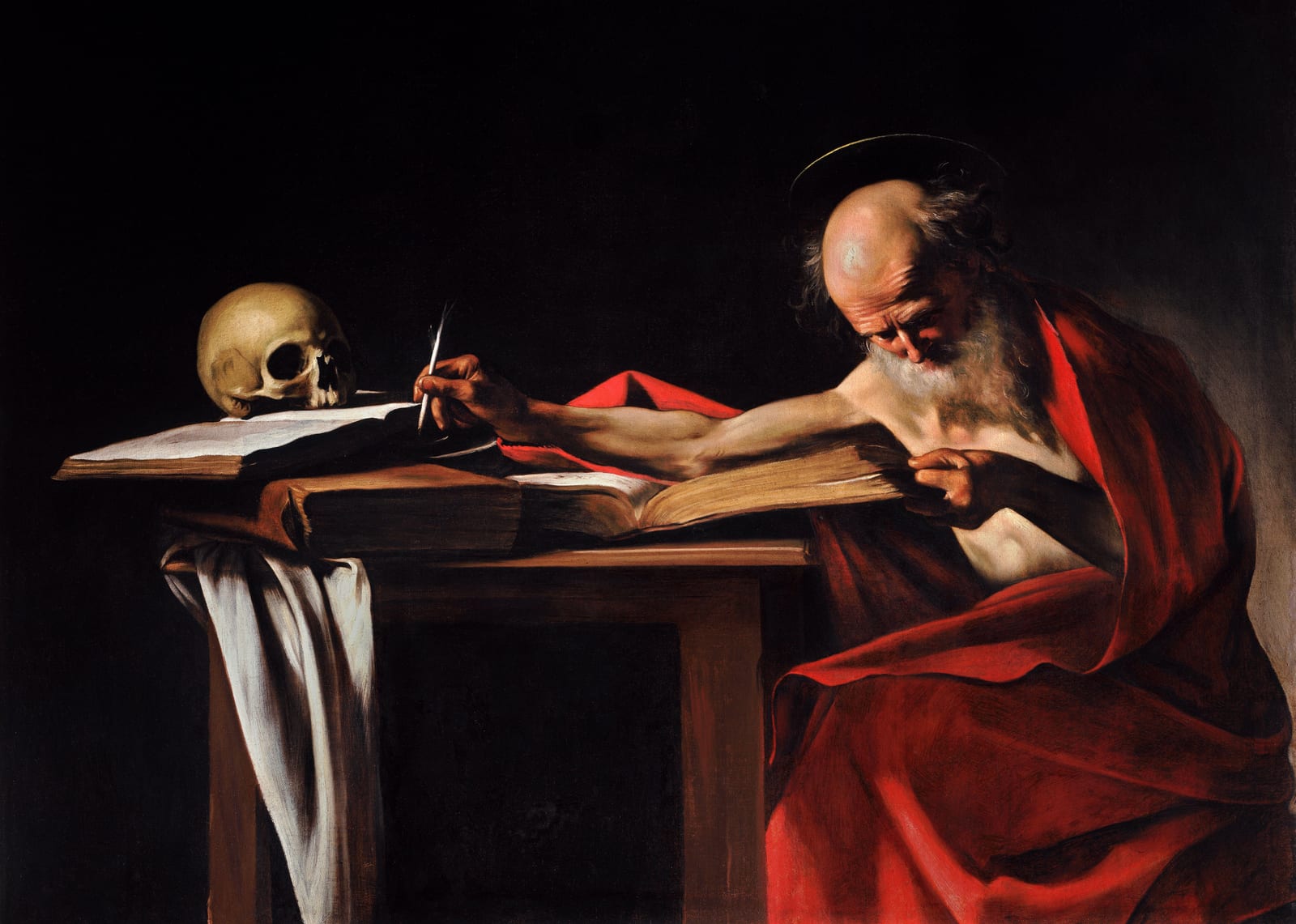
Caravaggio, Saint Jerome Writing, 1605–06 — Galleria Borghese, Rome
Jerome learned Hebrew, went to Bethlehem, and translated the Old Testament from the Hebrew rather than the Greek — the version that became the Vulgate and the Church's Bible for a thousand years. And in his prologues he stated, repeatedly and without hedging, that the books outside the Hebrew collection were not canonical. On Wisdom and Sirach he wrote the sentence that would be quoted against Rome for the next twelve centuries.
There is no honest way around it: on this question the Church did not follow her greatest scholar. She followed Augustine, and the councils followed Augustine, and Jerome lost.
The complication — and it is a real one, not a debating point — is that Jerome did not behave like a man who thought these books were rubbish. He translated Judith anyway, in a single night's work, and said in the preface that he did it because the Council of Nicaea was reckoned to have counted the book among the sacred Scriptures. That claim is itself doubtful, since no surviving canon of Nicaea says anything of the kind, and this page does not pretend otherwise. But it tells us what Jerome thought he was deferring to.
He defended the Greek portions of Daniel against Rufinus with the question of a man who knew the argument was not his to win alone: "What sin have I committed in following the judgment of the churches?"
And there is a last irony worth stating plainly, because it is the hinge of the whole story. When the Church of England settled the question in the opposite direction in 1563, it did not appeal to a Reformer. Article VI cites Jerome by name — "as Hierome saith" — and reproduces almost exactly the formula from his prologue to the books of Solomon. Both settlements are quoting the same man.
“Therefore, just as the Church also reads the books of Judith, Tobias, and the Maccabees, but does not receive them among the canonical Scriptures, so also one may read these two scrolls for the strengthening of the people, (but) not for confirming the authority of ecclesiastical dogmas.”
Jerome · Prologue to the Books of Solomon, c. 398 · tr. Kevin P. Edgecomb · source
07
A thousand years of practice
Between the African councils and the Reformation the list did not quietly drift. It was carried, copied, read, and once more written down.
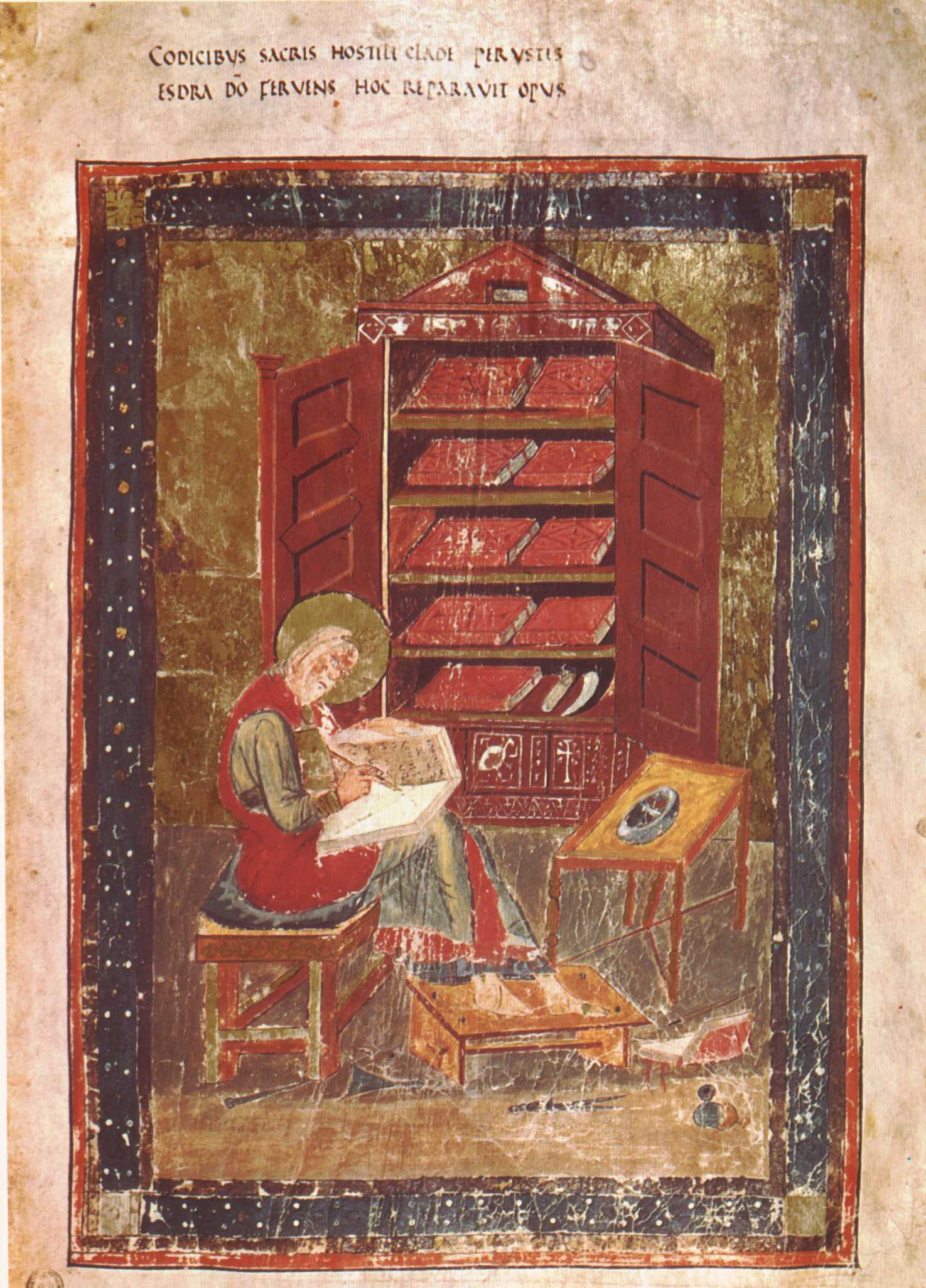
Ezra the scribe, from the Codex Amiatinus, made before 716 — Biblioteca Medicea Laurenziana, Florence
The medieval Latin Bible carried the disputed books as a matter of course. It also carried Jerome's prologues, which is worth noticing: the doubt was never suppressed. Any monk copying an Old Testament could read, in the front matter of his own Bible, the translator's opinion that some of what followed was not canonical. The argument was preserved inside the very manuscripts that transmitted the books.
In 1442, a hundred and four years before Trent and seventy-five before Luther posted his theses, the Council of Florence issued the bull Cantate Domino for the Copts. It professes that one and the same God is the author of both Testaments, and then does something plain and decisive: it lists the books. Tobit, Judith, Wisdom, Ecclesiasticus, Baruch and the two books of Maccabees are all there, by name, in a papal bull of a general council, before the Reformation existed to react to.
This is the fact that settles the most common accusation. Whatever Trent did in 1546, it did not invent the list.
“It professes that one and the same God is the author of the old and the new Testament — that is, the law and the prophets, and the gospel — since the saints of both testaments spoke under the inspiration of the same Spirit. It accepts and venerates their books, whose titles are as follows.”
The Council of Florence · Bull Cantate Domino, 4 February 1442 · source
08
The split
In the space of a hundred and twelve years the Western Church produced four different settlements of the same question, and we still live inside the result.
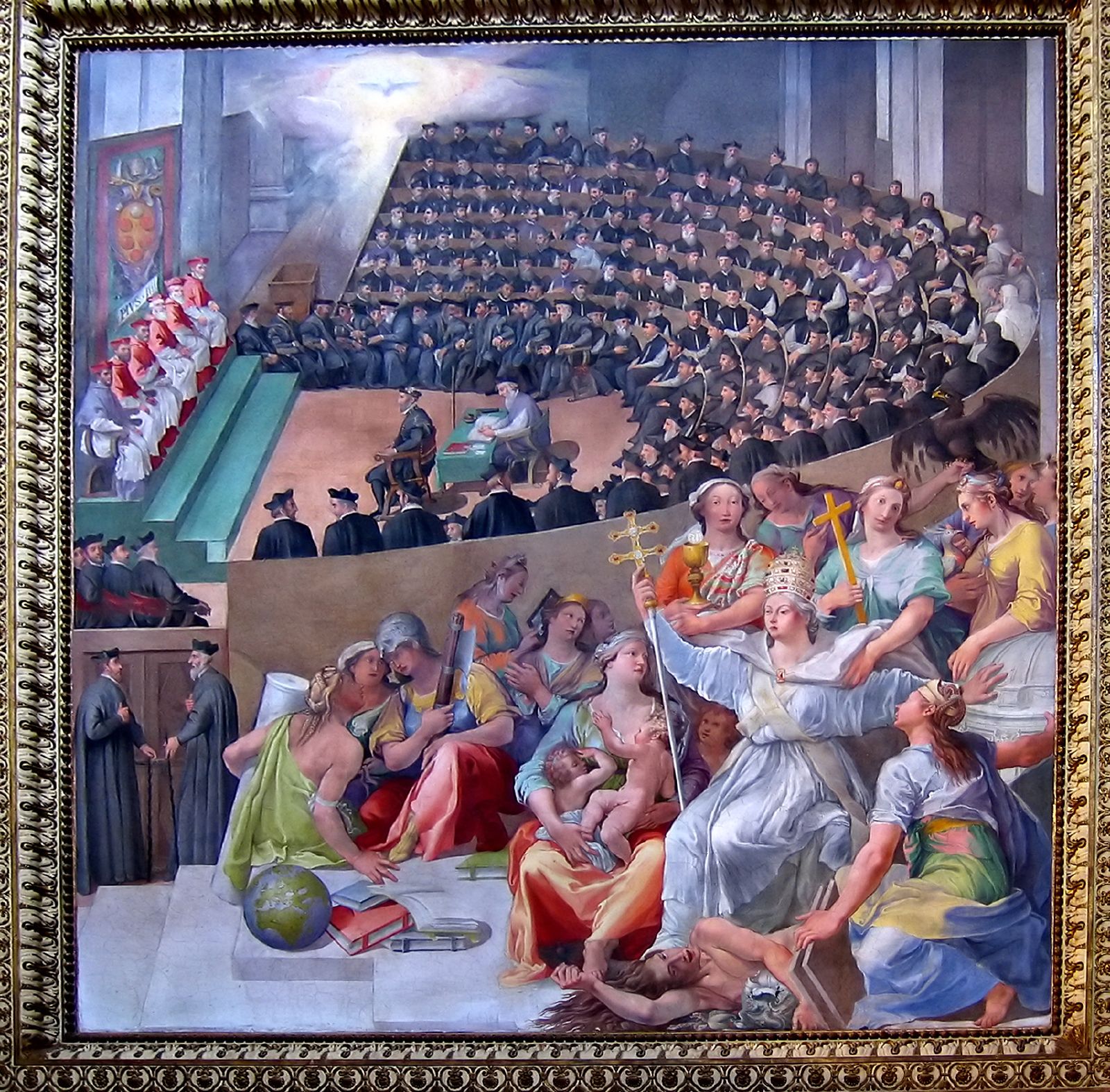
Pasquale Cati, The Council of Trent, 1588 — Santa Maria in Trastevere, Rome
Luther's German Bible of 1534 did not burn the seven books. It moved them. He gathered them out of the Old Testament into a separate section placed between the Testaments and headed Apocrypha, and went on printing them. He also rearranged the New Testament, shifting Hebrews, James, Jude and Revelation to the end — the four he doubted, and about which, as Eusebius shows, there had been ancient doubt. Of James he wrote in 1522 that it is "a perfect straw-epistle compared with them, for it has in it nothing of an evangelic kind".
Trent answered on 8 April 1546, in the fourth session. It listed the books, said it received them all "with an equal affection of piety, and reverence", and — this is what was genuinely new — attached an anathema to the list. The Catholic Church had held these books for centuries; what she had never done before was make holding them a test of communion. She did it in response to their removal.
Four centuries later the Second Vatican Council said the same thing without the anathema, and said where the list comes from. Dei Verbum, in 1965, does not argue for the seven books; it states the principle this whole page has been tracing, that the canon is a fact of the Church's living memory before it is a fact of any council: "Through the same tradition the Church's full canon of the sacred books is known, and the sacred writings themselves are more profoundly understood." That is Augustine's answer to Jerome, restated by the Church's last council.
The Church of England's Article VI in 1563 took the middle road and took it from Jerome: the canonical books are those "of whose authority was never any doubt in the Church", and the others the Church reads "for example of life and instruction of manners; but yet doth it not apply them to establish any doctrine". It then names them — Tobias, Judith, Wisdom, Sirach, Baruch, the Maccabees, Susanna, Bel and the Dragon and the rest — and keeps them in the book.
The Westminster Confession of 1646 refused the middle road. The apocryphal books are "no part of the canon of the Scripture, and therefore are of no authority in the Church of God, nor to be any otherwise approved, or made use of, than other human writings". That is the sharpest statement any side made, and it is the one most Protestants inherited in practice.
In practice, though, the printing lagged the theology by two centuries. Protestant Bibles generally continued to include the Apocrypha as a matter of course — the King James Bible of 1611 contained it. What removed the books from the Protestant Bible most English-speakers have held was not a council or a confession but a funding decision: after a two-year controversy the British and Foreign Bible Society resolved in 1826 to stop paying for any Bible that contained them.
“But if any one receive not, as sacred and canonical, the said books entire with all their parts, as they have been used to be read in the Catholic Church, and as they are contained in the old Latin vulgate edition; and knowingly and deliberately contemn the traditions aforesaid; let him be anathema.”
The Council of Trent · Session IV, Decree concerning the Canonical Scriptures, 8 April 1546 · source
The seven books
What they actually are, when they were written, in what language, and why each one was contested. Every passage links into this site’s Douay-Rheims reader.
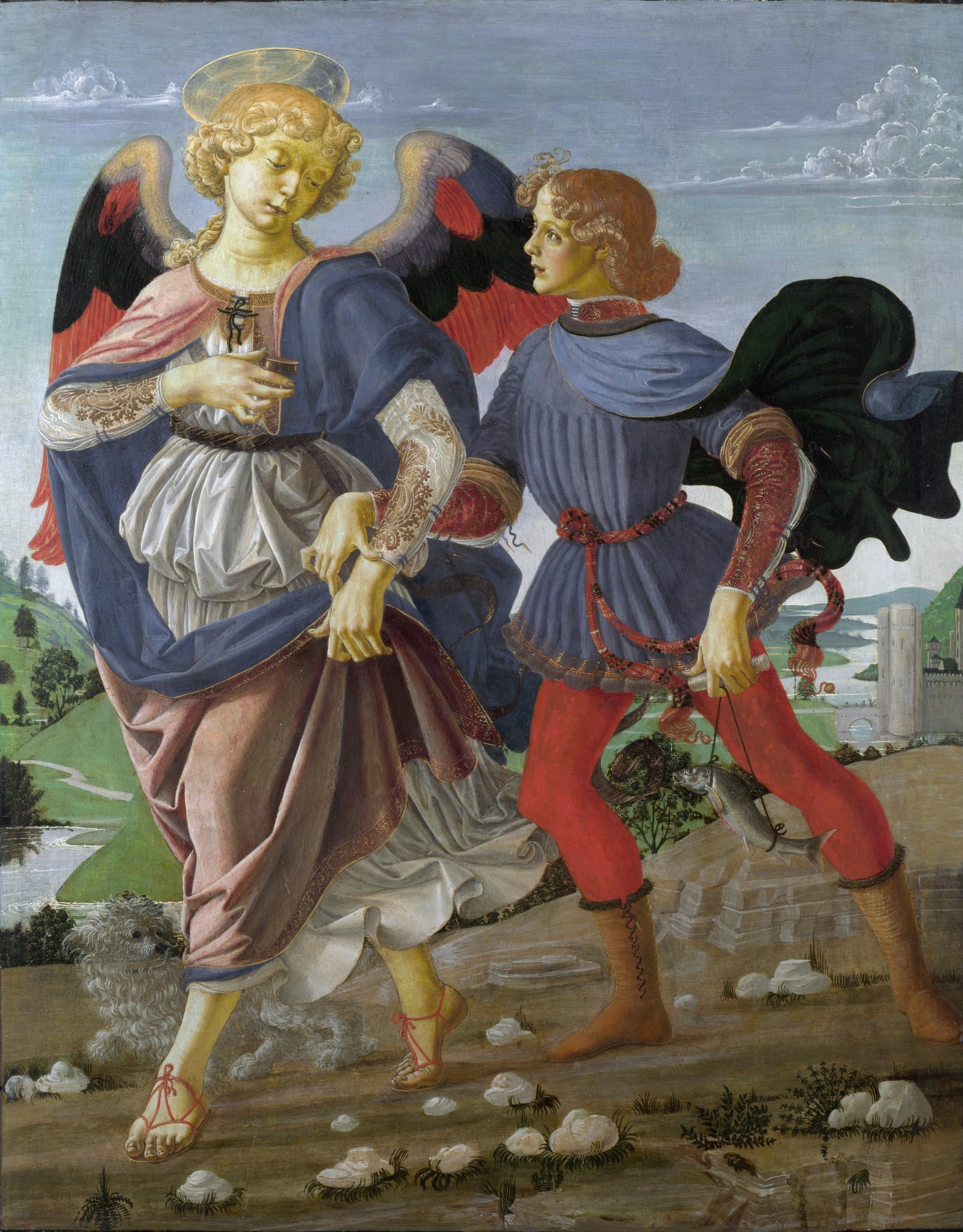
Workshop of Andrea del Verrocchio, Tobias and the Angel, c. 1470–75 — National Gallery, London
Tobit
c. 225–175 BC
Tobias
A blind old man in exile at Nineveh, a son sent on a journey, a young widow tormented by a demon, a fish, a dog, and an archangel travelling in disguise as a relative.
Language
Aramaic or Hebrew — Five copies were found at Qumran — four in Aramaic, one in Hebrew — which ends the old claim that the book was a late Greek composition.
Why it was disputed
Absent from the rabbinic Hebrew Bible, and Jerome named it among the books he would not call canonical — though he translated it anyway.
“For I am the angel Raphael, one of the seven, who stand before the Lord.”
One of only two places in the whole Bible where an archangel other than Michael or Gabriel gives his name, and the source of the Church's tradition of the seven who stand before the throne.
“And another angel came and stood before the altar, having a golden censer: and there was given to him much incense, that he should offer of the prayers of all saints, upon the golden altar which is before the throne of God.”
Raphael in Tobit does exactly this — he carries the prayers of Tobit and Sarah up before the Holy One.
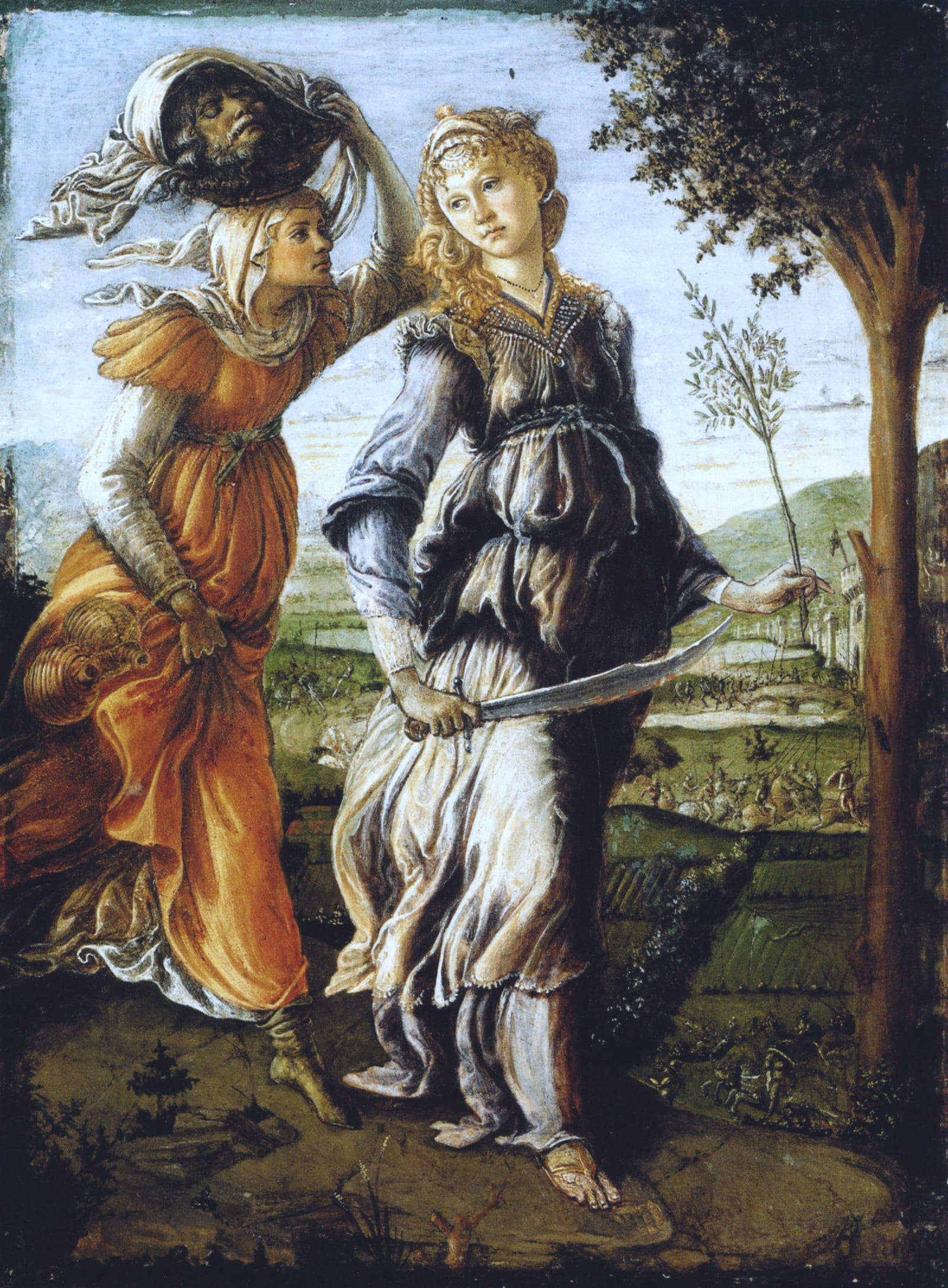
Sandro Botticelli, The Return of Judith to Bethulia, c. 1470–72 — Uffizi, Florence
Judith
c. 2nd century BC
A besieged town, a general who cannot be beaten in the field, and a widow who walks into his camp with a maid and a bag, and walks out with his head.
Language
Hebrew or Aramaic — Jerome translated it from what he called a "Chaldean" — that is, Aramaic — text, which has not survived.
Why it was disputed
Historical difficulties on the surface of the text — it calls Nebuchadnezzar king of the Assyrians reigning at Nineveh — which many readers ancient and modern take as the signal of a deliberately stylised story rather than a chronicle.
“And she struck twice upon his neck, and cut off his head, and took off his canopy from the pillars, and rolled away his headless body.”
The scene that made Judith one of the most painted women in Western art, from Donatello to Caravaggio to Artemisia Gentileschi.
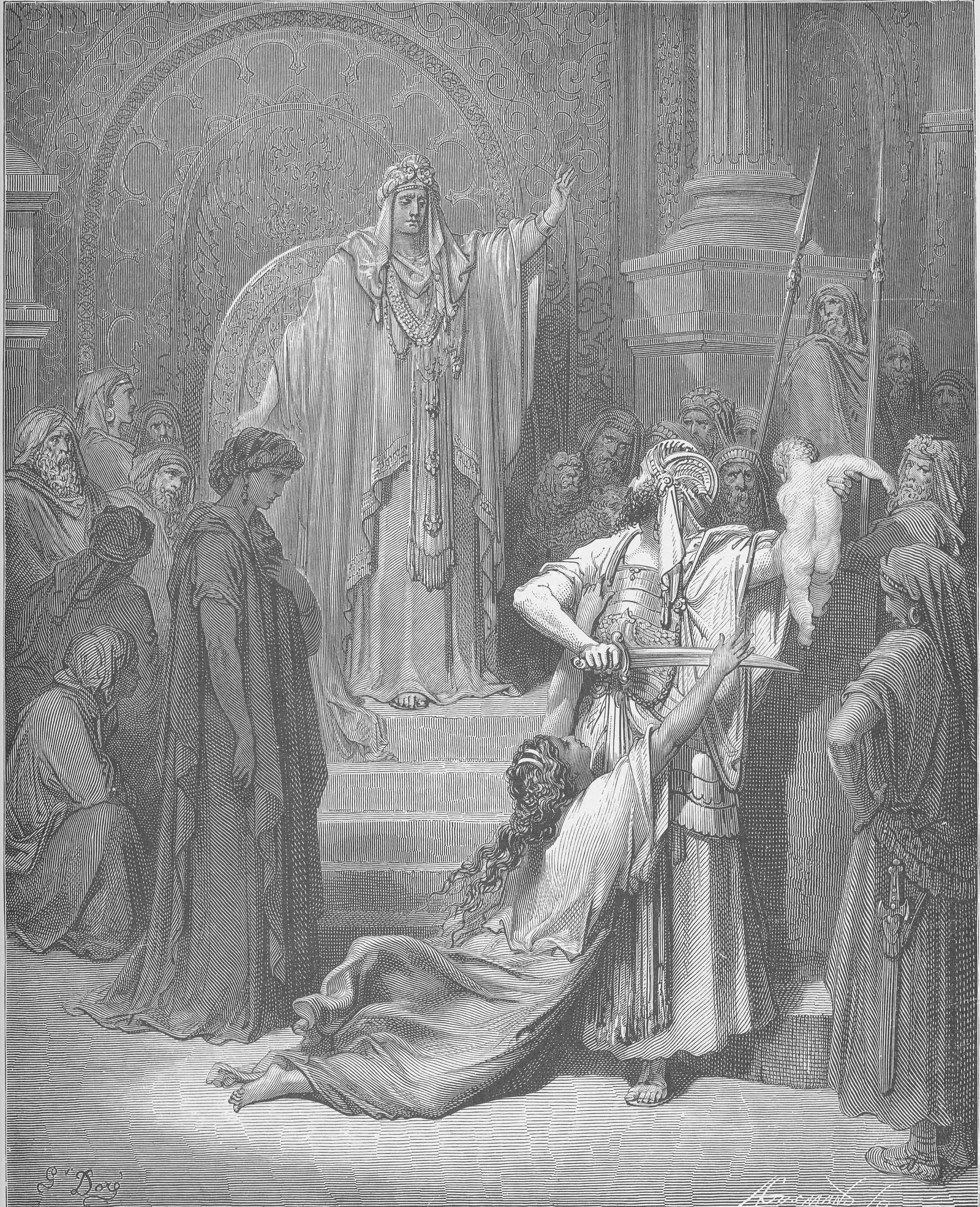
Gustave Doré, The Judgment of Solomon, 1866
Wisdom
c. 100–50 BC
The Wisdom of Solomon
A meditation on wisdom, immortality and the folly of idols, containing the most startling anticipation of the Passion anywhere outside the prophets.
Language
Greek — Composed in Greek in Alexandria and not attributed to Solomon by anyone who read it carefully — Jerome said its style "reeks of Greek eloquence".
Why it was disputed
Certainly Greek, certainly not by Solomon, and outside the Hebrew collection — the clearest case for the Protestant objection.
“Let us, therefore, lie in wait for the just, because he is not for our turn, and he is contrary to our doings, and upbraideth us with transgressions of the law, and divulgeth against us the sins of our way of life.”
The passage runs on: "He boasteth that he hath the knowledge of God, and calleth himself the son of God… Let us condemn him to a most shameful death."
“He trusted in God: let him now deliver him if he will have him. For he said: I am the Son of God.”
Spoken at the foot of the Cross. The verbal correspondence with Wisdom 2 is close enough that many readers have taken Matthew to be pointing at it.
Sirach
c. 180 BC; Greek translation c. 132 BC
Ecclesiasticus, or the Wisdom of Ben Sira
The longest wisdom book in the Bible: a Jerusalem teacher's collected instruction on friendship, money, speech, parents, humility and death, closing with a hymn in praise of the ancestors.
Language
Hebrew — Substantial portions of the Hebrew original survive — a scroll from Masada, fragments from Qumran, and the great cache found in the Cairo Geniza. Jerome reports having seen it in Hebrew himself.
Why it was disputed
Not in the rabbinic canon, and named by Jerome among the books to be read for edification but not for doctrine — despite his knowing it existed in Hebrew.
A book in the name of Jeremiah's secretary: a confession of national sin, a poem on wisdom, and a consolation for the exiles, with the Letter of Jeremiah against idols appended as chapter 6.
Language
Hebrew and Greek
Why it was disputed
Treated in the Hebrew tradition as no part of Jeremiah, and dropped by the Reformers with the rest — though Article VI still lists it by name as a book the Church reads.
“Afterwards he was seen upon earth, and conversed with men.”
Read by the Fathers as a prophecy of the Incarnation, and one of the reasons the book kept its place in Christian liturgy.
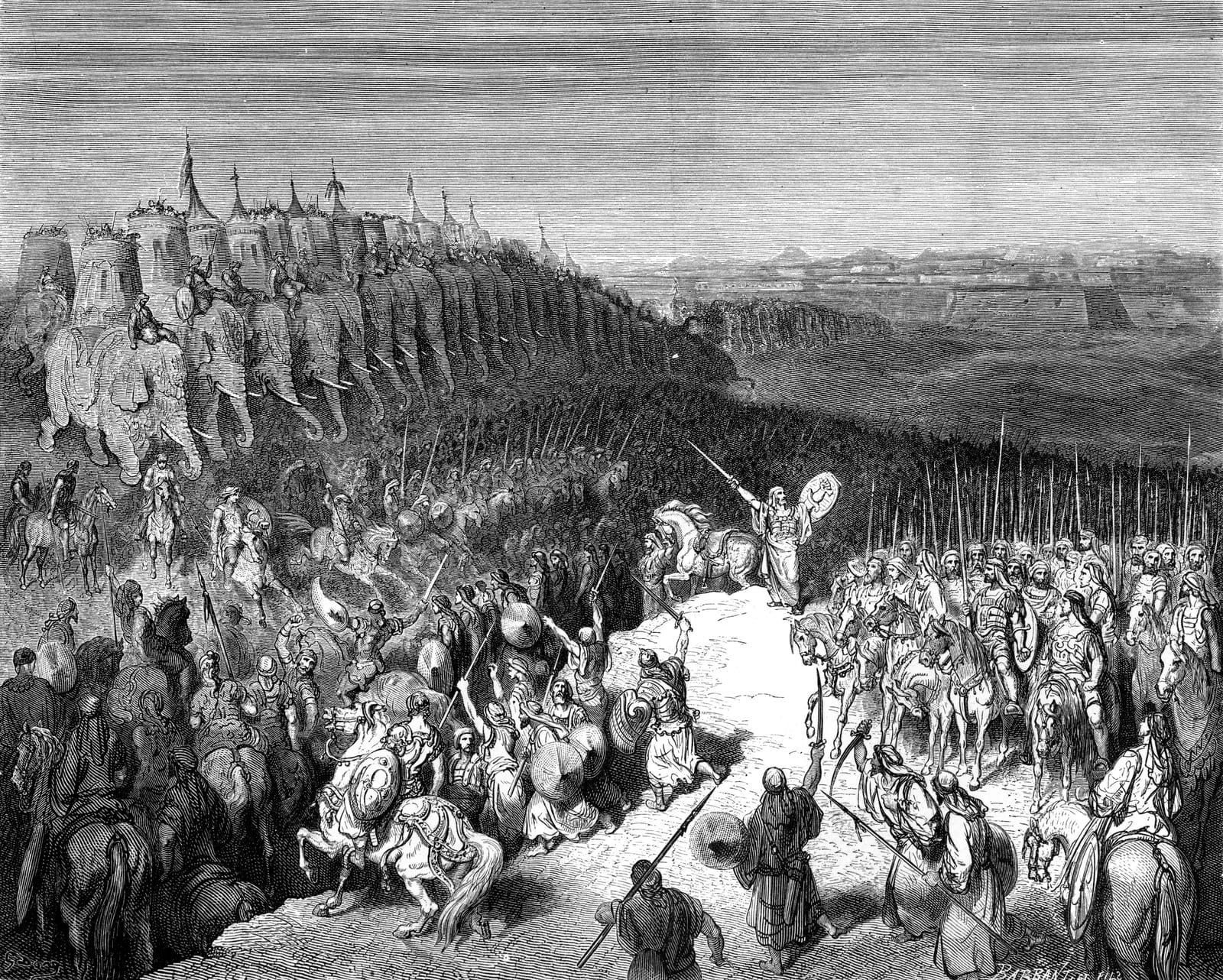
Gustave Doré, Judas Maccabeus before the Army of Nicanor (1 Maccabees 7), 1866
1 Maccabees
c. 100 BC
Sober, close-grained history: the revolt of Judas Maccabeus and his brothers against the Seleucid persecution, the cleansing of the defiled Temple, and the rededication of the altar.
Language
Hebrew — Written in Hebrew; the Hebrew has not survived and the book comes to us in Greek.
Why it was disputed
Excluded from the rabbinic canon despite being the founding narrative of Hanukkah, and dropped by the Reformers.
“And Judas, and his brethren, and all the church of Israel decreed, that the day of the dedication of the altar should be kept in its season from year to year for eight days, from the five and twentieth day of the month of Casleu, with joy and gladness.”
The institution of the feast of the Dedication — Hanukkah.
“And it was the feast of the dedication at Jerusalem: and it was winter.”
Jesus keeps a feast whose origin is recorded in no book of the Hebrew canon, and in the Gospel he walks in the Temple during it.
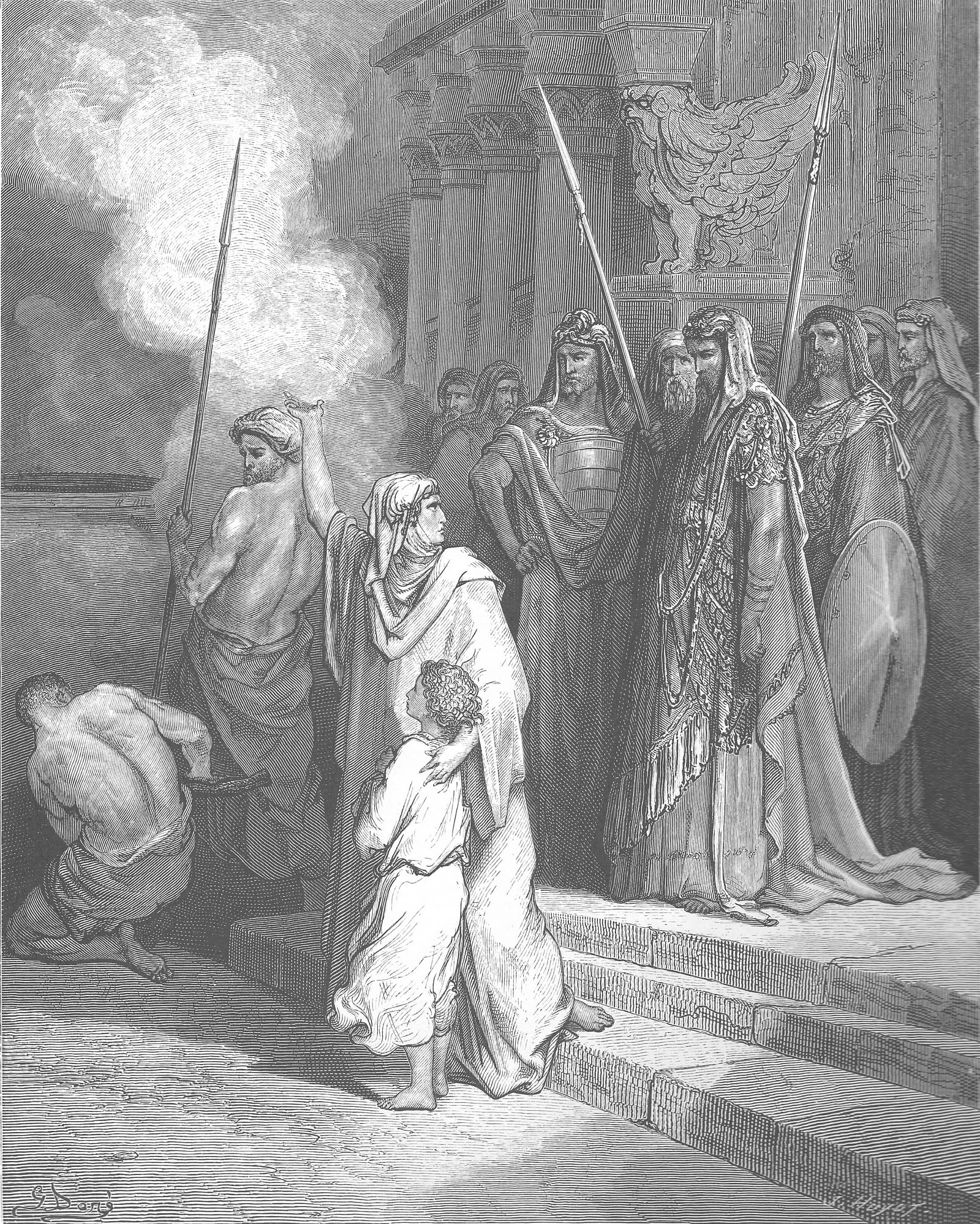
Gustave Doré, The Courage of a Mother — the mother of the seven sons, 1866
2 Maccabees
c. 124 BC
Not a sequel but a rival account, condensed from a lost five-volume history — more theological, more terrible, and containing the martyrdom of the mother and her seven sons.
Language
Greek
Why it was disputed
This is the book where the argument stops being about manuscripts. Two of its verses are the classic scriptural support for prayer for the dead, and therefore for purgatory and the indulgences that set off the Reformation. Any reader should know that the dispute over this book was never purely a question of Hebrew originals.
“Women received their dead raised to life again. But others were racked, not accepting deliverance, that they might find a better resurrection.”
The second half of the verse describes no martyrdom in the Hebrew canon. It describes the mother and her seven sons in 2 Maccabees 7.
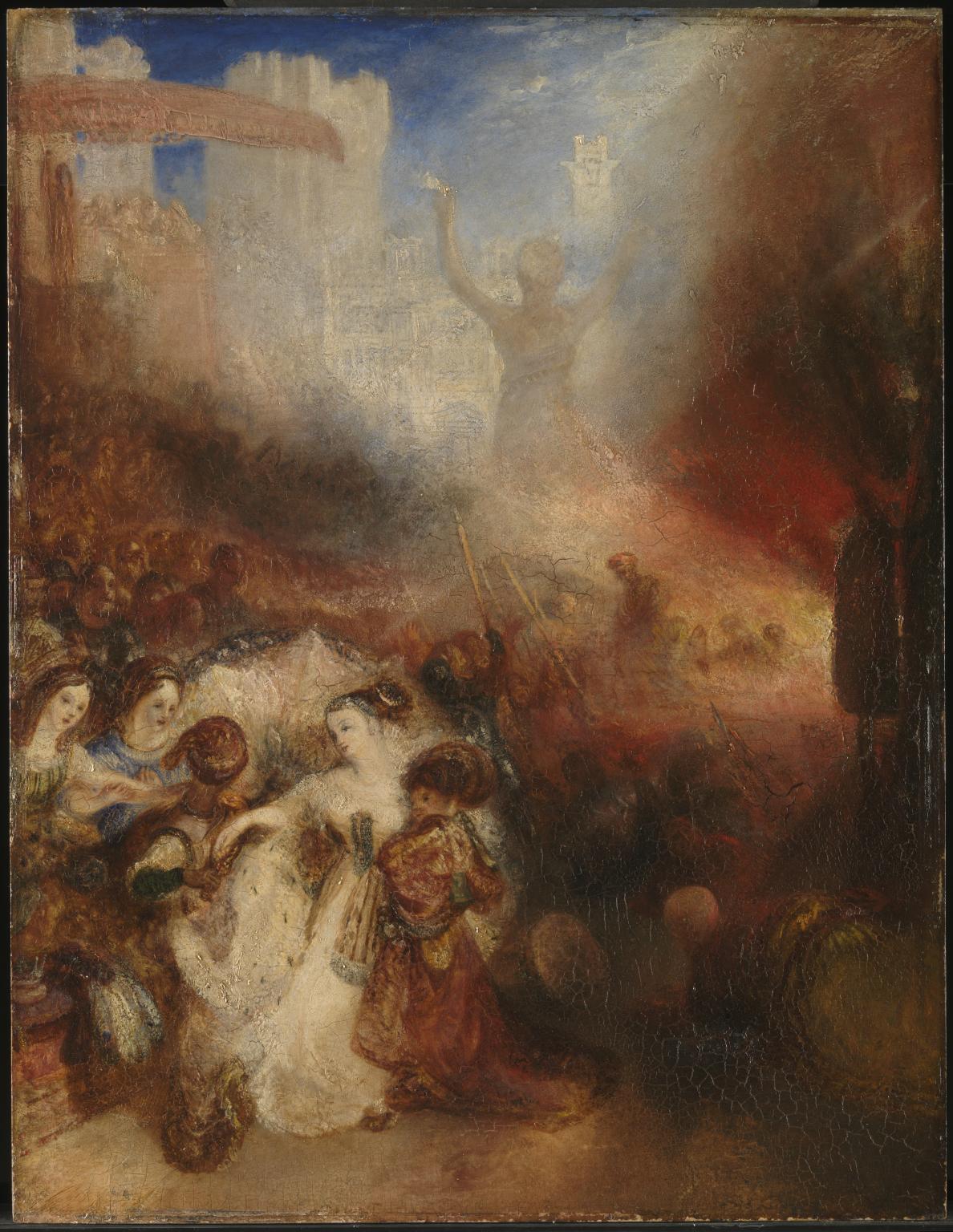
J. M. W. Turner, Shadrach, Meshach and Abednego, 1832 — Tate, London
The additions
c. 2nd–1st century BC
to Esther and Daniel
Not separate books but longer editions: the Greek Esther, which adds the prayers and puts God's name into a book that otherwise never mentions it; and the Greek Daniel, which adds the Prayer of Azariah and the Song of the Three Children, the trial of Susanna, and Bel and the Dragon.
Language
Greek, and probably Hebrew or Aramaic behind parts of Daniel
Why it was disputed
They are the reason Trent said "the said books entire with all their parts". The dispute here is not whether Daniel is Scripture but how much of Daniel is.
“The chapter of Susanna — the falsely accused wife, the two elders, and the young Daniel who cross-examines them separately and catches them in contradictory testimony.”
Sometimes called the first detective story. It is chapter 13 in Catholic Bibles and absent from Protestant ones.
The New Testament books that were argued over
Catholics and Protestants hold an identical New Testament — but it was not identical from the beginning. Six books were doubted for centuries, and the doubts Luther raised were the ones Eusebius had recorded twelve hundred years earlier.
Accepted early in the West and long resisted in the East, where it is still never read aloud in the Byzantine liturgy.
In
Could not place it
In
In
Moved to the end
And the books that nearly made it
Read as Scripture in real churches, bound into real Bibles, and in the end not received.
The Shepherd of Hermas
A Roman book of visions and moral instruction, hugely popular and widely read aloud in church.
Bound into Codex Sinaiticus after Revelation. The Muratorian fragment praises it but rules that it cannot be read publicly among the Prophets or the Apostles.
The Epistle of Barnabas
An early allegorical reading of the Old Testament against a Judaising interpretation.
Bound into Codex Sinaiticus, immediately after Revelation.
1 and 2 Clement
A letter from the church at Rome to the church at Corinth, and a homily later attached to it.
Bound into Codex Alexandrinus after Revelation.
The Didache
The Teaching of the Apostles — a manual of church order, baptism and the Eucharist.
Listed by Athanasius among books appointed to be read, and by Eusebius among the rejected.
The Apocalypse of Peter
A vision of heaven and hell that shaped later Christian imagination of both.
The Muratorian fragment receives it, while noting that "some of us are not willing that [it] be read in church".
The register
Every surviving witness to the canon, in order, with what it says about the seven disputed books — and with the complications printed rather than buried.
Received as canonicalRead, but not canonicalRejectedMixedDoes not say
c. 144
Marcion's canon
Canon listRejected
Marcion of Sinope
The first fixed Christian canon on record, and a heretical one: a shortened Luke and ten letters of Paul, with no Old Testament at all.
— Marcion rejected the entire Old Testament, not merely the disputed books. He is the reason the Church had to start writing lists.
c. 170–200
The Muratorian fragment
Canon listDoes not say
Unknown, at Rome
The oldest surviving orthodox canon list: four Gospels, Acts, thirteen letters of Paul, Jude, letters of John, and the Apocalypse.
“We receive only the apocalypses of John and Peter, though some of us are not willing that the latter be read in church.”
— It survives in a single damaged eighth-century Latin manuscript and is mutilated at both ends, so its silences cannot be pressed hard.
— It concerns the New Testament; it is not a witness either way on the Old.
c. 325
Eusebius, Church History III.25
Canon listDoes not say
Eusebius of Caesarea
Sorts the Christian writings into the acknowledged, the disputed, and the spurious — and cannot place Revelation.
“Among the rejected writings must be reckoned also the Acts of Paul, and the so-called Shepherd, and the Apocalypse of Peter, and in addition to these the extant epistle of Barnabas, and the so-called Teachings of the Apostles.”
— Eusebius attended the Council of Nicaea. That he was still sorting disputed books afterwards is the plainest evidence that Nicaea did not settle the canon.
4th century
Codex Vaticanus
ManuscriptMixed
An unknown scriptorium, probably Egypt
One of the two oldest substantially complete Greek Bibles in existence, carrying the Old and New Testaments together.
— It carries Tobit, Judith, Wisdom and Sirach — and it lacks the books of Maccabees entirely. The oldest complete Greek Bible we possess does not contain the Catholic canon exactly either.
4th century
Codex Sinaiticus
ManuscriptReceived as canonical
An unknown scriptorium
The other great fourth-century Greek Bible, and the only ancient manuscript with a complete New Testament.
— After Revelation it carries the Epistle of Barnabas and the Shepherd of Hermas — books in nobody's Bible today. A fourth-century Bible was not yet exactly our Bible.
367
The 39th Festal Letter
Canon listRead, but not canonical
Athanasius of Alexandria
The first surviving list of exactly the twenty-seven books of the New Testament held by every Christian communion today.
“But for greater exactness I add this also, writing of necessity; that there are other books besides these not indeed included in the Canon, but appointed by the Fathers to be read by those who newly join us, and who wish for instruction in the word of godliness. The Wisdom of Solomon, and the Wisdom of Sirach, and Esther, and Judith, and Tobit, and that which is called the Teaching of the Apostles, and the Shepherd.”
— Athanasius places Esther in this second group. His Old Testament canon is therefore neither the Catholic list nor the Protestant one, and he cannot be cited cleanly for either.
382
The Council of Rome
CouncilReceived as canonical
Pope Damasus I
Frequently cited as the first Roman list of the canon — but the citation rests on contested ground.
— The list attributed to it survives in the Decretum Gelasianum, which most scholarship since von Dobschütz judges a private compilation of the early sixth century made in Italy or Gaul, not an act of Damasus.
— This site does not treat Rome 382 as firm evidence. The African councils are the solid ground.
393
The Council of Hippo
CouncilReceived as canonical
The bishops of Roman Africa
Canon 36 settles what may be read in church as divine Scripture, and lists the books. Augustine was present as a priest.
— The acts of Hippo survive mainly through their incorporation at Carthage four years later; the list is substantially the same.
c. 397
On Christian Doctrine II.8
Canon listReceived as canonical
Augustine of Hippo
Gives the rule that actually decided the Western question — a rule of evidence, not of theory — and then lists the books, deuterocanon mixed in without distinction.
“…to prefer those that are received by all the catholic churches to those which some do not receive. Among those, again, which are not received by all, he will prefer such as have the sanction of the greater number and those of greater authority, to such as are held by the smaller number and those of less authority.”
The list that became the Catholic canon, written into church law and framed as the practical question of what may be read aloud in church.
“The Canonical Scriptures are these: Genesis, Exodus, Leviticus, Numbers, Deuteronomy, Joshua the son of Nun, Judges, Ruth, four books of Kings, two books of Paraleipomena, Job, the Psalter, five books of Solomon, the books of the twelve prophets, Isaiah, Jeremiah, Ezechiel, Daniel, Tobit, Judith, Esther, two books of Esdras, two books of the Maccabees.”
— "Five books of Solomon" takes in Wisdom and Ecclesiasticus alongside Proverbs, Ecclesiastes and the Song of Songs.
— What its "two books of Esdras" denotes is genuinely disputed — Ezra and Nehemiah, or a pairing that includes the Greek 1 Esdras. Trent later made its own reading explicit: "the first book of Esdras, and the second which is entitled Nehemias".
c. 390–407
The Vulgate prologues
TranslationRead, but not canonical
Jerome
The translator of the Church's Bible states in its own front matter that some of the books he is translating are not canonical.
“Among the Jews, the book of Judith is considered among the apocrypha; its warrant for affirming those which have come into dispute is deemed less than sufficient… But since the Nicene Council is considered to have counted this book among the number of sacred Scriptures, I have acquiesced to your request.”
Sed quia hunc librum Synodus Nicaena in numero sanctarum Scripturarum legitur computasse, acquievi postulationi vestrae
Preface on the Book of Judith · tr. Andrew S. Jacobs · source
— No surviving canon of Nicaea says anything about Judith. Jerome's appeal cannot be verified and this page does not treat it as established.
— The prologues travelled inside the medieval Bibles themselves, so Jerome's dissent was never hidden from the copyists who transmitted the books.
419
The Council of Carthage
CouncilReceived as canonical
The bishops of Roman Africa
Reaffirms the canon of 397 in the collected code of the African Church, which then passed into Western canon law.
5th century
Codex Alexandrinus
ManuscriptReceived as canonical
An unknown scriptorium
A nearly complete Greek Bible, carrying the Septuagint including the deuterocanon.
— It also carries 1 and 2 Clement after Revelation, and 3 and 4 Maccabees — more books than any church now holds.
4 February 1442
Cantate Domino
CouncilReceived as canonical
The Council of Florence, under Eugene IV
A general council lists the canon in full, by name, a century before Trent and seventy-five years before Luther.
— Tobit, Judith, Wisdom, Ecclesiasticus, Baruch and the two books of Maccabees are all named. Whatever Trent did, it did not invent this list.
Gathers the disputed Old Testament books into a separate section between the Testaments headed Apocrypha, and moves Hebrews, James, Jude and Revelation to the end of the New.
— He did not delete them. He kept printing them, and so did Protestant Bibles for the next three centuries.
8 April 1546
The Council of Trent, Session IV
CouncilReceived as canonical
The Council of Trent, under Paul III
Lists the books, receives them all with equal reverence, and — for the first time — attaches an anathema to the list.
“…receives and venerates with an equal affection of piety, and reverence, all the books both of the Old and of the New Testament — seeing that one God is the author of both — as also the said traditions…”
— The novelty at Trent is not the list, which is Carthage's and Florence's. It is the anathema. The Church made holding these books a test of communion in answer to their removal.
— The same session declared the Vulgate "authentic" for public use — a ruling about which Latin edition to use, not a claim that the Latin outranks the Greek and Hebrew.
Defines Scripture as the books "of whose authority was never any doubt in the Church", and assigns the rest to reading but not to doctrine — on Jerome's authority, by name.
“And the other Books (as Hierome saith) the Church doth read for example of life and instruction of manners; but yet doth it not apply them to establish any doctrine.”
— It names the books it excludes — Tobias, Judith, Wisdom, Sirach, Baruch, Susanna, Bel and the Dragon, the Maccabees and the rest — and keeps them bound in the Bible.
— Its own criterion sits awkwardly with its New Testament: Eusebius records real and ancient doubt about James, Jude, 2 Peter, 2 and 3 John and Revelation, all of which Article VI receives without qualification. This is the standard Catholic reply, and it is a fair one.
1646
The Westminster Confession, chapter I
ConfessionRejected
The Westminster Assembly
Refuses the middle road and denies the disputed books any standing whatever.
“The books commonly called Apocrypha, not being of divine inspiration, are no part of the canon of the Scripture, and therefore are of no authority in the Church of God, nor to be any otherwise approved, or made use of, than other human writings.”
After a two-year dispute, the Society resolved to fund no Bible containing the Apocrypha — the decision that actually removed the books from the Bible most English-speaking Protestants have held.
— The King James Bible of 1611 contained the Apocrypha. What emptied the Protestant Bible was not a council or a confession but a printing and funding decision two centuries later.
What actually survives
Not arguments but objects. Note how often the oldest Bibles contain more, or less, than any church now holds — the physical evidence embarrasses every side a little.
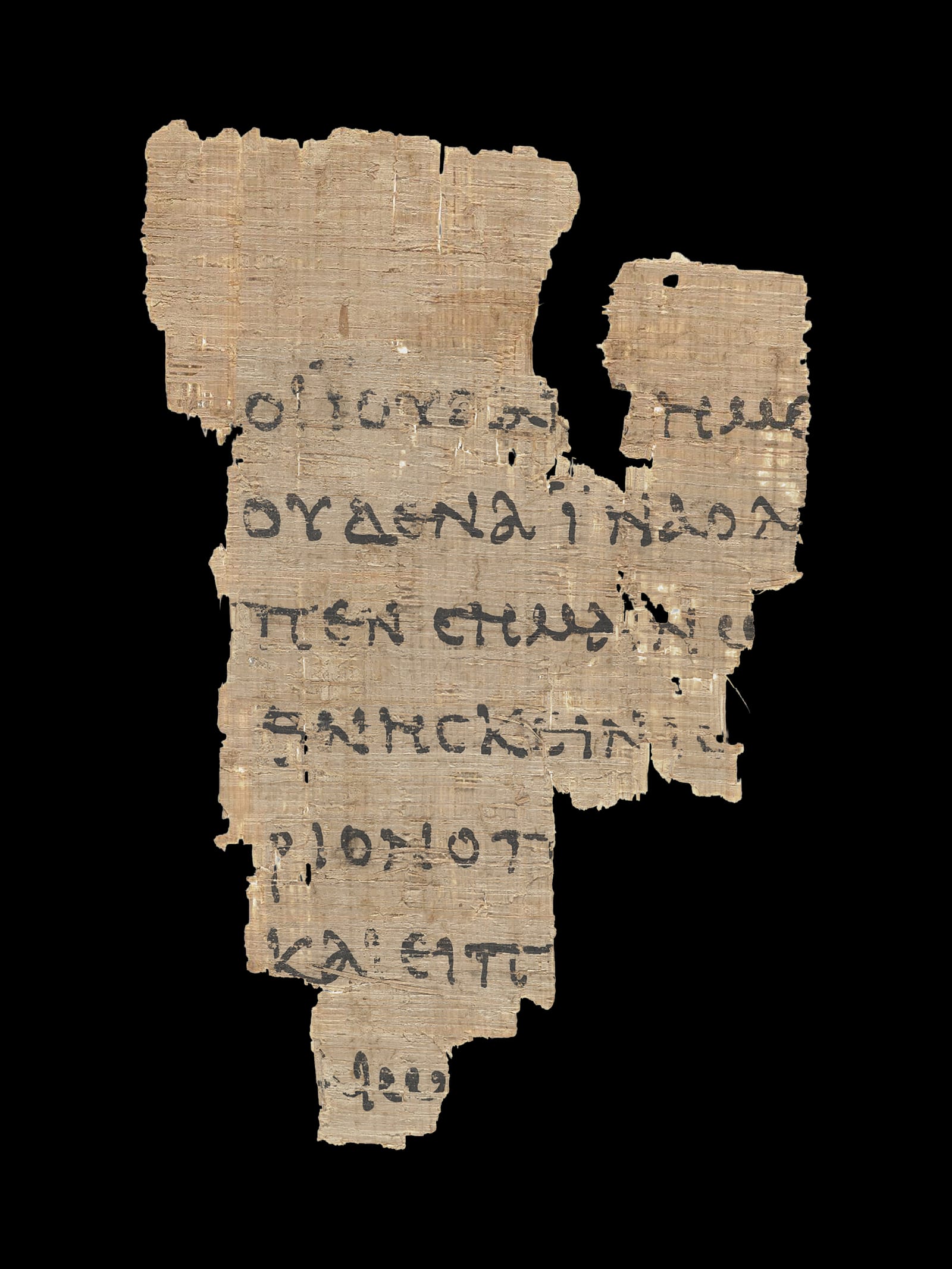
Papyrus 52, recto: John 18:31–33 — John Rylands Library, Manchester
Papyrus 52
2nd century
A credit-card-sized scrap of John 18, with Pilate's questioning on one side and the words about the kingdom not of this world on the other. Generally the oldest identified fragment of any New Testament book.
John Rylands Library, Manchester
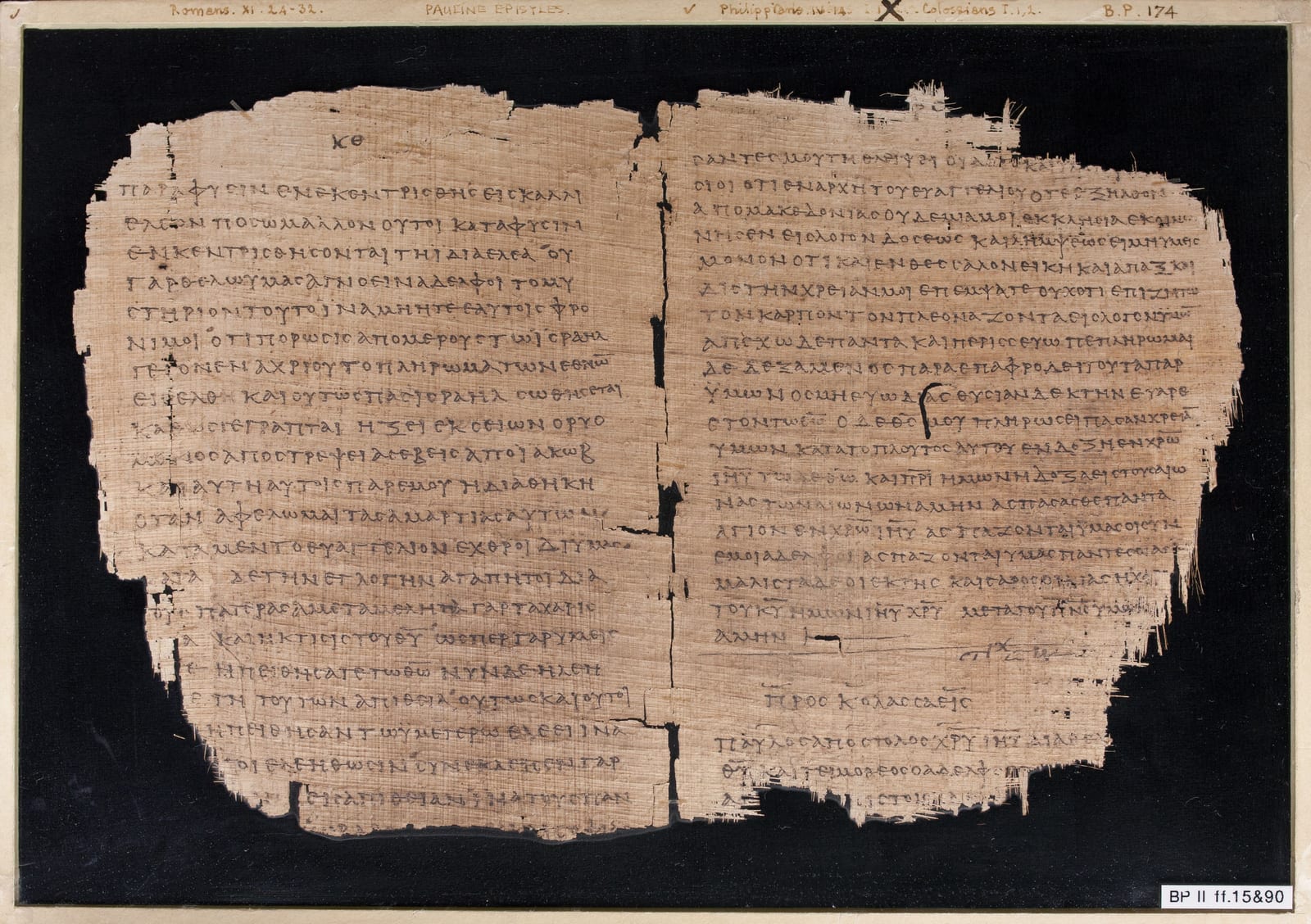
Papyrus 46, c. 200 — a bifolio carrying Romans on one leaf and the end of Philippians and the start of Colossians on the other; Chester Beatty, Dublin
Papyrus 46
c. 200
Eighty-six surviving leaves of a codex of Paul's letters — the earliest substantial copy of the Pauline collection, showing the letters already gathered and circulating as a set.
Also carries: It places Hebrews among Paul's letters, immediately after Romans.
Chester Beatty Library, Dublin, and the University of Michigan
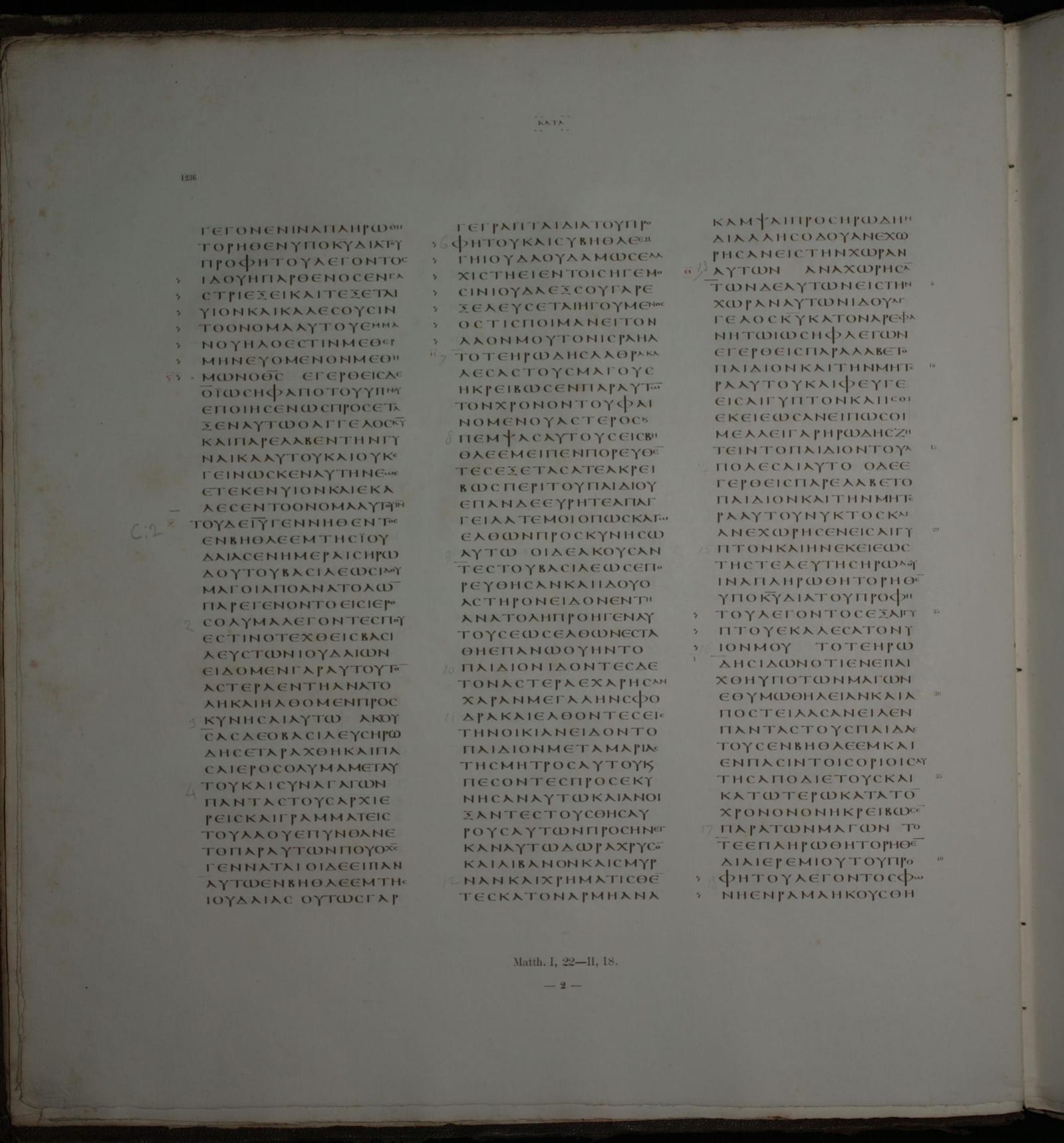
Codex Vaticanus, Matthew 1:22–2:18 — Vatican Library
Codex Vaticanus
4th century
One of the two oldest substantially complete Greek Bibles, Old and New Testament in one volume.
Lacks: The books of Maccabees, and the Prayer of Manasseh.
The Vatican Library
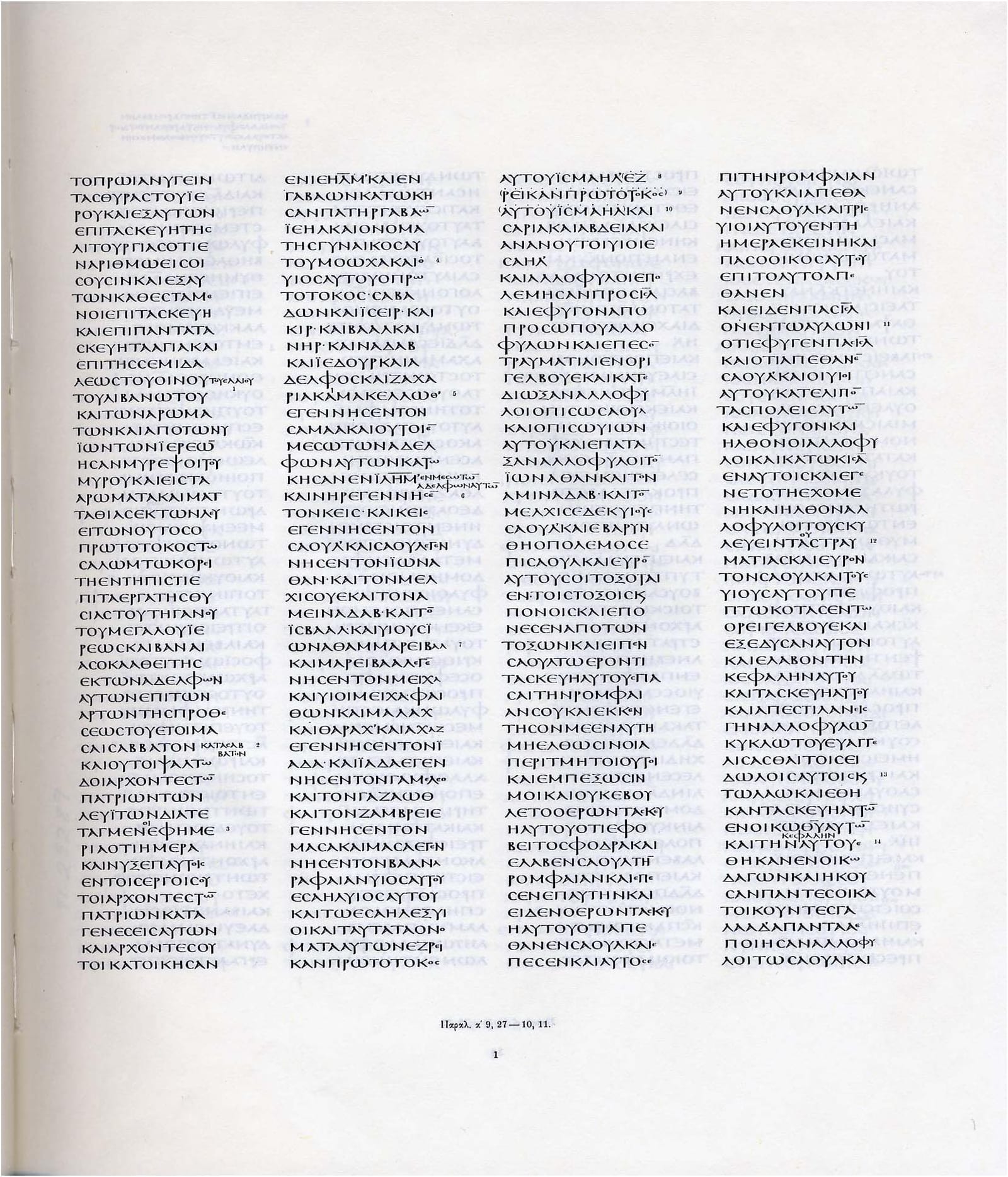
Codex Sinaiticus, 2 Chronicles 9:27–10:11 — from Tischendorf's facsimile edition of 1862
Codex Sinaiticus
4th century
The only ancient manuscript containing a complete New Testament, found at the monastery of Saint Catherine on Sinai.
Also carries: The Epistle of Barnabas and the Shepherd of Hermas, bound in after Revelation.
Split between London, Leipzig, Sinai and St Petersburg
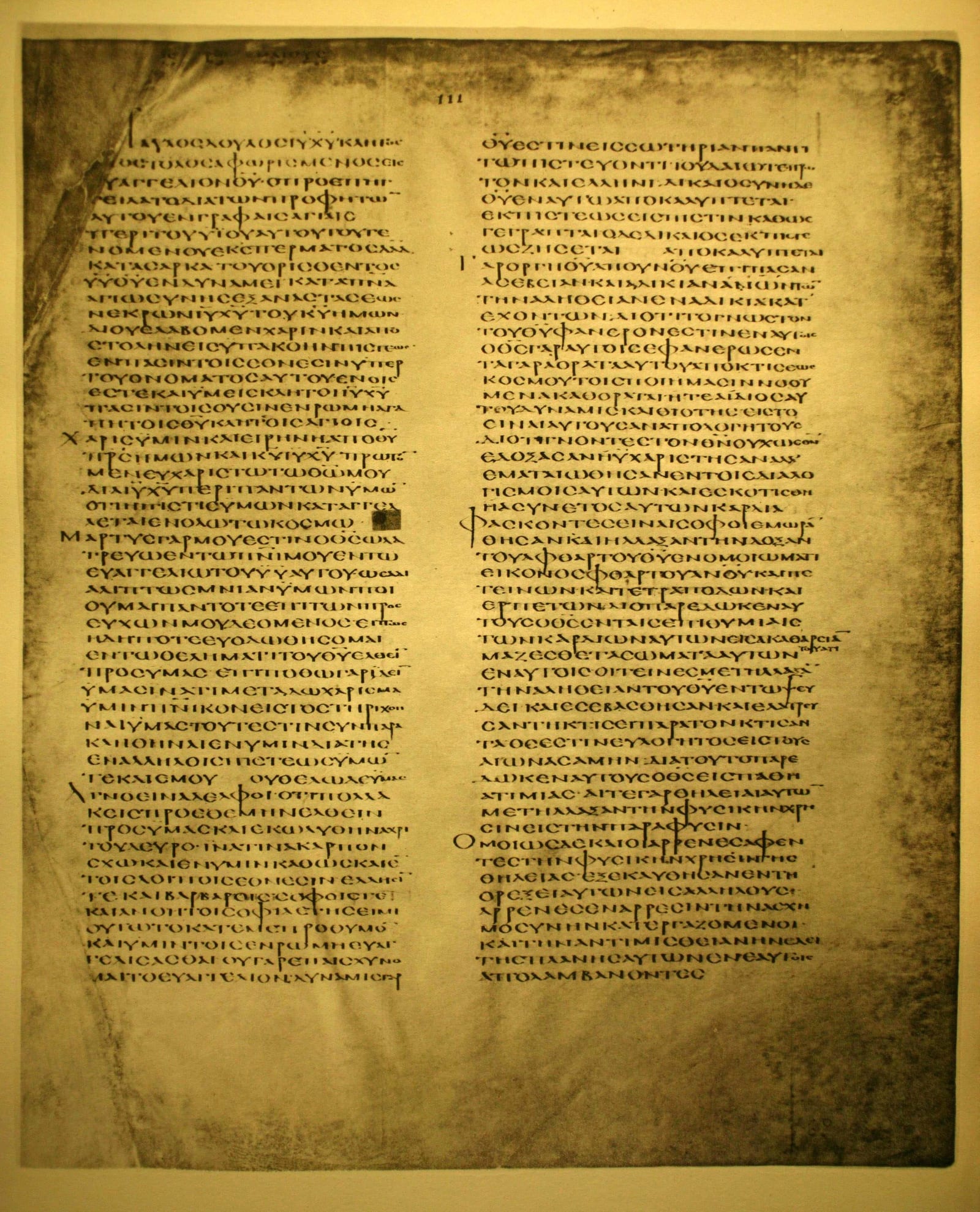
Codex Alexandrinus, the opening of Romans — British Library
Codex Alexandrinus
5th century
A nearly complete Greek Bible carrying the Septuagint with the deuterocanonical books.
Also carries: 1 and 2 Clement after Revelation, and 3 and 4 Maccabees.
The British Library
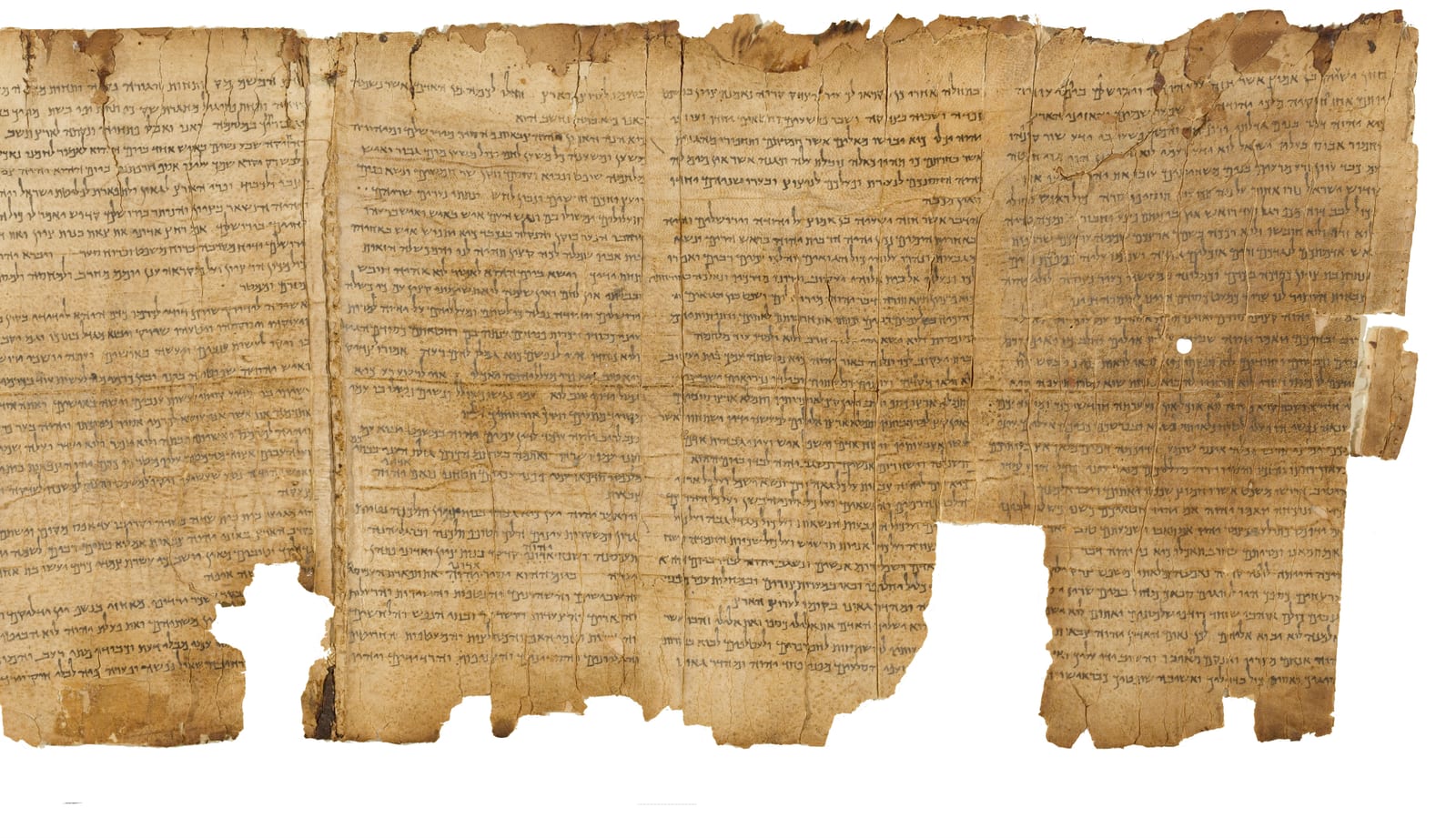
The Great Isaiah Scroll (1QIsaᵃ), from Qumran — Shrine of the Book, Jerusalem
The Dead Sea Scrolls
3rd century BC – 1st century AD
Around nine hundred manuscripts from the caves at Qumran: the oldest Hebrew biblical texts by a thousand years, alongside books nobody now holds canonical.
Also carries: Tobit in four Aramaic copies and one Hebrew, and Sirach in Hebrew — which ends the claim that the disputed books were Greek compositions.
The Shrine of the Book, Jerusalem, and elsewhere
Where it stands today
There is no single Christian canon, and there never has been. There is a very large shared core and a contested edge.
Tradition
Old Testament
New Testament
What that means
Catholic
46 books
27 books
The list of Carthage, Florence and Trent: the Hebrew books plus Tobit, Judith, Wisdom, Sirach, Baruch and 1–2 Maccabees, with the longer Esther and Daniel.
Eastern Orthodox
49 or more
27 books
Everything the Catholic canon holds and more — 1 Esdras, 3 Maccabees, Psalm 151 and the Prayer of Manasseh, with 4 Maccabees usually in an appendix. Confirmed at the Synod of Jerusalem in 1672.
Protestant
39 books
27 books
The rabbinic Hebrew collection, counted differently. The New Testament is identical to the Catholic one — the split concerns only the Old.
Ethiopian Orthodox Tewahedo
46 books
35 books
The broadest canon in Christianity, 81 books in all, and the only one that holds Enoch and Jubilees as Scripture.
Jewish
24 books
—
The Tanakh: the same material as the Protestant Old Testament, counted as 24 rather than 39, in a different order ending with Chronicles.
What people think happened
Each stated as strongly as its believers state it. One of them is a Catholic argument, and it does not survive either.
“Constantine chose the books of the Bible at the Council of Nicaea in 325, and burned the ones he did not like.”
No canon of Nicaea concerns the biblical canon; the council's business was the divinity of Christ, the date of Easter and twenty disciplinary canons. The decisive evidence is Eusebius, who was in the room at Nicaea and who was still sorting books into acknowledged, disputed and spurious afterwards. If Nicaea had settled it, he would have had nothing to sort.
“The Catholic Church added seven books to the Bible at Trent in 1546.”
The same books are listed by the Council of Carthage in 397, by Augustine in the same decade, and by the Council of Florence in 1442 — a century before Trent and before Luther was born. They stand in the fourth- and fifth-century Greek Bibles. What Trent added was not the books but the anathema.
He moved them, and kept printing them. The 1534 Bible gathers them into a section between the Testaments headed Apocrypha. The King James Bible of 1611 contained them too. What finally emptied them out of the English Protestant Bible was the British and Foreign Bible Society's resolution of 1826 to stop funding any edition that included them.
“The disputed books were written in Greek, so they were never Jewish Scripture and cannot be canonical.”
Tobit turned up at Qumran in four Aramaic copies and one Hebrew. Sirach was found in Hebrew at Masada, at Qumran, and in the Cairo Geniza; Jerome says he saw it in Hebrew himself. 1 Maccabees was composed in Hebrew. Wisdom and 2 Maccabees genuinely were written in Greek — but so was every book of the New Testament.
“A Jewish council at Jamnia closed the Old Testament canon in AD 90.”
There is no record of such a council closing anything. The phrase was coined by Heinrich Graetz in 1871 and the hypothesis was taken apart by Jack P. Lewis in 1964; it survives in popular writing long after the scholarship abandoned it. The rabbinic texts show a school at Yavneh debating whether certain books "defile the hands", which is a question about ritual status, not a canon list.
“Jesus and the apostles never quote the seven books, which proves they are not Scripture.”
The argument proves too much. Nothing in the New Testament quotes Esther, Ecclesiastes, Ezra, Nehemiah, Obadiah, Nahum or Zephaniah either, and no one proposes dropping them. Meanwhile Jude 14–15 quotes 1 Enoch by name, and Catholics do not hold Enoch canonical. Being quoted is not the test, and this site will not pretend it is — even when it is a Catholic making the argument.
“The lost gospels — Thomas, Judas, Mary — were suppressed to hide the real Jesus.”
They were not hidden; they were named and answered in the open. The Muratorian fragment identifies forgeries by title around the year 180 and refuses them in writing. The surviving texts are second-century or later, carry no serious claim to apostolic origin, and mostly belong to Gnostic movements whose Jesus denies that the world and the flesh are good. The Church argued with them in public for centuries.
“The Bible fell from heaven complete, or was assembled by a single decree.”
Neither. It was written across roughly a thousand years, gathered by use before it was ratified by decree, argued over by saints who disagreed with each other, and fixed in the West only after three centuries of practice had made the answer obvious. The Church did not vote the books into existence; she recognised what she had been reading at the altar all along.