A cross-reference is a verse that answers another: a prophecy and the day it was kept, a psalm and the Gospel that quotes it, a law and the letter that explains it. Christians have kept them since at least the fourth century, when Eusebius drew up his tables of the Gospels, and have written them in the margins of their Bibles ever since. In 2007 Chris Harrison and Christoph Römhild drew nearly sixty-four thousand of them as arcs over the chapters of the Bible and the picture went everywhere — but their Bible had sixty-six books. This one has seventy-three.
411,812 links, from eleven witnesses: the readings the Church sets together at Mass, the Treasury of Scripture Knowledge, the references printed in the Douay-Rheims Bible itself, Haydock's Catholic Bible of 1883 and the passages its notes cite, the Abbé Vigouroux's notes to Glaire's French Vulgate, Mons. Straubinger's notes to the Biblia Platense, the Crampon Bible of 1923, the Swedish Bible of 1917 and its Apocrypha, the Nestle-Aland index of the New Testament's allusions, the New American Bible's notes, and the margins of the King James Bible of 1611. Every one of them opens in the reader, beside the text, with a mark by each verse that other passages answer to.
Each bar is a chapter, Genesis 1 at the left, the Apocalypse at the right, taller where it has more verses; the seven books are in blue. Each arc joins two chapters that refer to each other: the farther apart they stand in the Bible, the wider and higher the arc, and its colour runs from red for neighbours to violet for the two ends. The more links two chapters share, the brighter their arc. Colour by the prophecies of Christ, and the arcs that join a prophecy to its fulfilment light up in gold, blue and rose over the rest. Touch a bar.
In the reader
Open any book in the Bible reader. Every verse that other passages answer to has a small link mark after it; tap the mark and a panel opens beside the text — under it on a phone.
The panel lists what the verse points to, then what points to it, each with its words and the Bibles that print the link — and, where the Church reads the two together at Mass, the day she does. Tap one and the reader goes there, the panel following; Back brings you home.
The pill beside the version pills turns the marks off; the reader remembers your choice.
Open the reader →On this picture
Every bar is a chapter, in the order of the Catholic canon; the seven books are blue. Hover a bar and its arcs light, with how many links leave it and reach it, and the chapters it reaches most are listed; click to hold it, and Release to let go.
Catholic only draws just the links Catholic editors and commentators printed — the Douay-Rheims' own references, Haydock's notes, the Abbé Vigouroux's, Mons. Straubinger's and the Crampon Bible's — and the readings the Church sets together at Mass; The seven books, only the links that touch Tobit, Judith, Wisdom, Sirach, Baruch and the Maccabees; Old to New, only the links between the Testaments, promise and fulfilment.
Below, a page for each book lists every chapter with what it reaches, as plain links.
The seventy-three ↓Find a passage
Type a book, a chapter or a verse in the box above the picture — Sirach, Ecclus 24, 1 Macc 4:59, Matthew 7:12 — in any spelling the reader knows.
A verse shows its own cross-references right here; a chapter is held on the picture; a book opens its page.
Psalms are read by their usual numbering; write (Vulgate) after one to use the Douay's.
Find a passage ↑Where the New Testament reaches into them
The Treasury of Scripture Knowledge — the source of nearly every cross-reference set on the web — never reached Tobit, Judith, Wisdom, Sirach, Baruch or the Maccabees. The links into them here come from the Church's own Bibles, from the Swedish Bible of 1917 and its Apocrypha, from the margins of the 1611 King James Bible, and from the scholars' index: the twenty-seventh Nestle-Aland Greek New Testament proposes some three hundred and thirty places where the New Testament may echo these books and the Greek parts of Daniel. The strongest of them:
the mockery at the cross — "He trusted in God: let him now deliver him" — answers the plot against the just man in Wisdom 2
"others were racked, not accepting deliverance, that they might find a better resurrection": the seven brothers and their mother
God known from his creatures, and the slide into idolatry, follows the argument of Wisdom 13–15 closely
"seven angels standing in the presence of God" — and Raphael's words to Tobias and his father: "one of the seven, who stand before the Lord"
Gabriel, "who stand before God"
"Come to me, all you that labour" — Wisdom's own invitation in Sirach 24, and the sage's "Draw near to me, ye unlearned" in Sirach 51
the feast of the Dedication Jesus kept in Jerusalem was instituted here
the potter and his clay
"the brightness of his glory" — one of the eleven New Testament margins of the 1611 King James Bible that point into the Apocrypha
"Blessed art thou, O daughter … above all women upon the earth": Ozias' words to Judith, before Elizabeth's "Blessed art thou among women" to Mary
The King James Bible of 1611 printed these books between the Testaments, with others it called the Apocrypha, and sent its readers into that Apocrypha from the margin a hundred and thirteen times, eleven of them from the New Testament. Most later printings dropped the books, and the margins with them. How We Got the Bible tells how the seven came to stand where they stand.
The seventy-three
- Genesis50 chapters · 14,654 out · 23,180 in
- Exodus40 chapters · 11,355 out · 23,870 in
- Leviticus27 chapters · 7,527 out · 14,724 in
- Numbers36 chapters · 8,879 out · 20,756 in
- Deuteronomy34 chapters · 10,515 out · 23,765 in
- Joshua24 chapters · 5,302 out · 9,702 in
- Judges21 chapters · 4,761 out · 7,131 in
- Ruth4 chapters · 643 out · 635 in
- 1 Samuel31 chapters · 6,970 out · 12,051 in
- 2 Samuel24 chapters · 6,088 out · 10,293 in
- 1 Kings22 chapters · 8,062 out · 12,711 in
- 2 Kings25 chapters · 7,390 out · 11,447 in
- 1 Chronicles29 chapters · 6,141 out · 11,049 in
- 2 Chronicles36 chapters · 7,984 out · 12,333 in
- Ezra10 chapters · 2,212 out · 3,586 in
- Nehemiah13 chapters · 3,315 out · 5,786 in
- Tobit14 chapters · 465 out · 418 in
- Judith16 chapters · 413 out · 261 in
- Esther16 chapters · 1,435 out · 1,898 in
- Job42 chapters · 10,544 out · 15,954 in
- Psalms150 chapters · 43,992 out · 61,910 in
- Proverbs31 chapters · 11,159 out · 14,779 in
- Ecclesiastes12 chapters · 3,121 out · 3,272 in
- Song of Songs8 chapters · 2,081 out · 1,629 in
- Wisdom19 chapters · 1,960 out · 2,896 in
- Sirach51 chapters · 3,781 out · 2,454 in
- Isaiah66 chapters · 23,257 out · 46,445 in
- Jeremiah52 chapters · 20,856 out · 33,428 in
- Lamentations5 chapters · 2,231 out · 2,918 in
- Baruch6 chapters · 446 out · 340 in
- Ezekiel48 chapters · 16,520 out · 28,209 in
- Daniel14 chapters · 5,719 out · 11,156 in
- Hosea14 chapters · 3,863 out · 4,772 in
- Joel3 chapters · 1,283 out · 2,302 in
- Amos9 chapters · 2,409 out · 3,679 in
- Obadiah1 chapter · 354 out · 546 in
- Jonah4 chapters · 622 out · 1,045 in
- Micah7 chapters · 2,317 out · 3,499 in
- Nahum3 chapters · 682 out · 864 in
- Habakkuk3 chapters · 1,040 out · 1,577 in
- Zephaniah3 chapters · 1,182 out · 1,631 in
- Haggai2 chapters · 621 out · 848 in
- Zechariah14 chapters · 4,552 out · 5,550 in
- Malachi4 chapters · 1,470 out · 2,164 in
- 1 Maccabees16 chapters · 1,117 out · 1,190 in
- 2 Maccabees15 chapters · 960 out · 1,679 in
- Matthew28 chapters · 15,348 out · 44,415 in
- Mark16 chapters · 7,252 out · 13,592 in
- Luke24 chapters · 13,940 out · 36,881 in
- John21 chapters · 13,113 out · 36,923 in
- Acts28 chapters · 15,169 out · 27,975 in
- Romans16 chapters · 8,526 out · 18,784 in
- 1 Corinthians16 chapters · 6,655 out · 13,490 in
- 2 Corinthians13 chapters · 4,701 out · 9,099 in
- Galatians6 chapters · 2,847 out · 5,000 in
- Ephesians6 chapters · 3,931 out · 8,851 in
- Philippians4 chapters · 2,480 out · 4,260 in
- Colossians4 chapters · 2,323 out · 3,453 in
- 1 Thessalonians5 chapters · 2,062 out · 3,312 in
- 2 Thessalonians3 chapters · 1,010 out · 2,282 in
- 1 Timothy6 chapters · 2,633 out · 3,485 in
- 2 Timothy4 chapters · 1,994 out · 3,459 in
- Titus3 chapters · 1,065 out · 2,063 in
- Philemon1 chapter · 247 out · 324 in
- Hebrews13 chapters · 6,313 out · 13,026 in
- James5 chapters · 2,497 out · 5,076 in
- 1 Peter5 chapters · 2,884 out · 6,129 in
- 2 Peter3 chapters · 1,367 out · 3,370 in
- 1 John5 chapters · 2,368 out · 5,752 in
- 2 John1 chapter · 179 out · 279 in
- 3 John1 chapter · 166 out · 261 in
- Jude1 chapter · 612 out · 965 in
- Revelation22 chapters · 7,880 out · 18,949 in
Not one link taken on trust
Of the 411,812 links here, 343,352 come from one Protestant book, the Treasury of Scripture Knowledge. So every link was read with the Church, the Catholic Bibles' own as well, and 206 were taken out: misprints, and links that would set Scripture against her teaching, like Our Lady beside King Asa's mother, deposed for her idol. On the verses most often turned against the Catholic faith, the reader opens with a short note of what the Church holds. There are 159 notes:
- Our Lady · 18
- Peter and the keys · 13
- The Eucharist · 10
- Faith, works and justification · 24
- Purgatory and prayer for the dead · 11
- The seven books · 4
- Confession and the anointing of the sick · 4
- The priesthood · 3
- Celibacy, virginity and marriage · 6
- The intercession of the saints and the angels · 3
- The honour paid to the saints, the angels and relics · 3
- Sacred images · 4
- The Passion · 2
- Baptism and Confirmation · 8
- Tradition, Scripture and the Church · 9
- The Jewish people · 11
- The Antichrist and Babylon · 3
- Predestination, grace and free will · 20
- Feasts, fasts and holy days · 3
- TreasuryTreasury of Scripture Knowledge, as OpenBible.info publishes it
- Douay-RheimsThe references printed in the Douay-Rheims Bible (Challoner)
- HaydockHaydock's Catholic Family Bible, 1883
- Swedish 1917The Swedish Bible of 1917 and its Apocrypha of 1921
- Nestle-AlandThe Nestle-Aland index of New Testament allusions (27th edition)
- NABREThe New American Bible, Revised Edition (its references, cited for study)
- KJV 1611The margins of the King James Bible of 1611
- GlaireGlaire's French Vulgate with the Abbé Vigouroux's notes
- CramponThe Crampon Bible of 1923, its notes
- Mass readingsThe Lectionary for Mass: passages the Church reads together
- PlatenseThe Biblia Platense, with Mons. Straubinger's notes (1948)
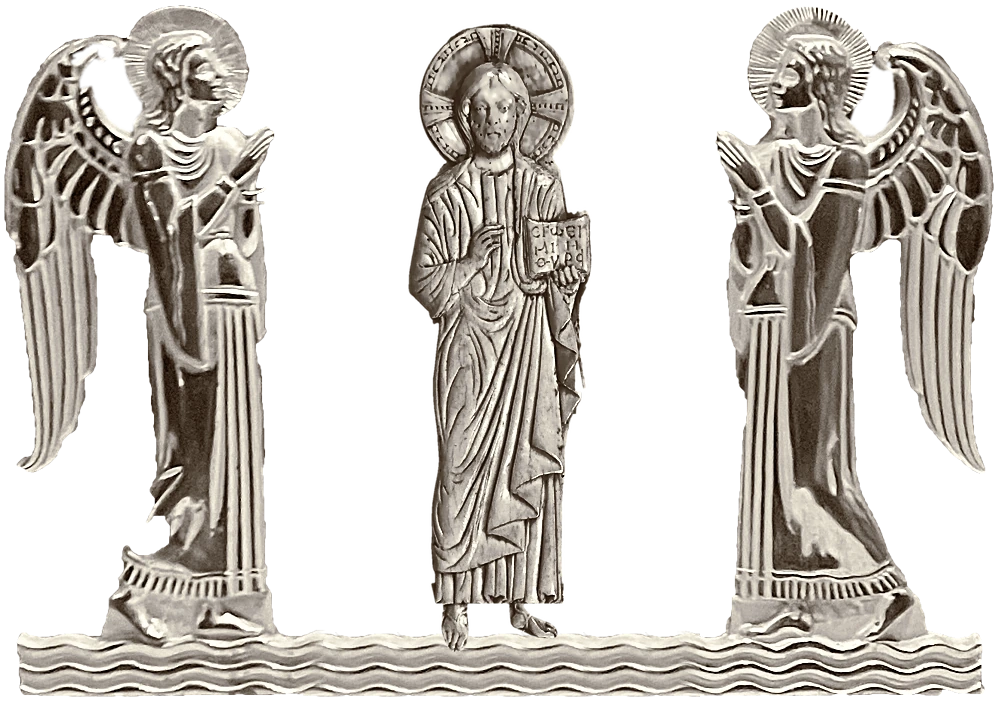
The two angels at the head of the page stand either side of the doors of a bronze tabernacle, under its frieze Sanctus, Sanctus, Sanctus — the song of Isaias 6:3 taken up in the Apocalypse 4:8, the Old Testament's words in the New, which is what a cross-reference is. The photographs are the author's own.
The Treasury's list is published by OpenBible.info under a Creative Commons Attribution licence and is placed on the Douay's numbering by the site's own tables; the Douay-Rheims references were typed from a printed Bible by John Herro; Haydock's and the Swedish Bible's are public domain; the Nestle-Aland index is read from a published transcription; a few hundred of the New American Bible's references are cited for study, and its apparatus is not reproduced. The reader shows which witnesses print each link. Details are on the attributions page.