
The exhibition panel tells the story as the 1584 pilgrimage booklet of Johannes Engerd preserved it. Where the village of Bettbrunn now stands there was once only a farm and a cattle-well called Viehbrunn, an hour and a half from the parish church of Tholling. The herdsman who lived there, devoted to the Blessed Sacrament but seldom able to reach Mass, secretly kept back a consecrated host and hid it in a hollow he cut into the head of his staff. Each day, while the cattle rested, he planted the staff in the ground and knelt before it for hours. After some months, one day — the diocesan account says in a thunderstorm — he flung the staff without thinking at beasts that had strayed, and the host fell to the ground.
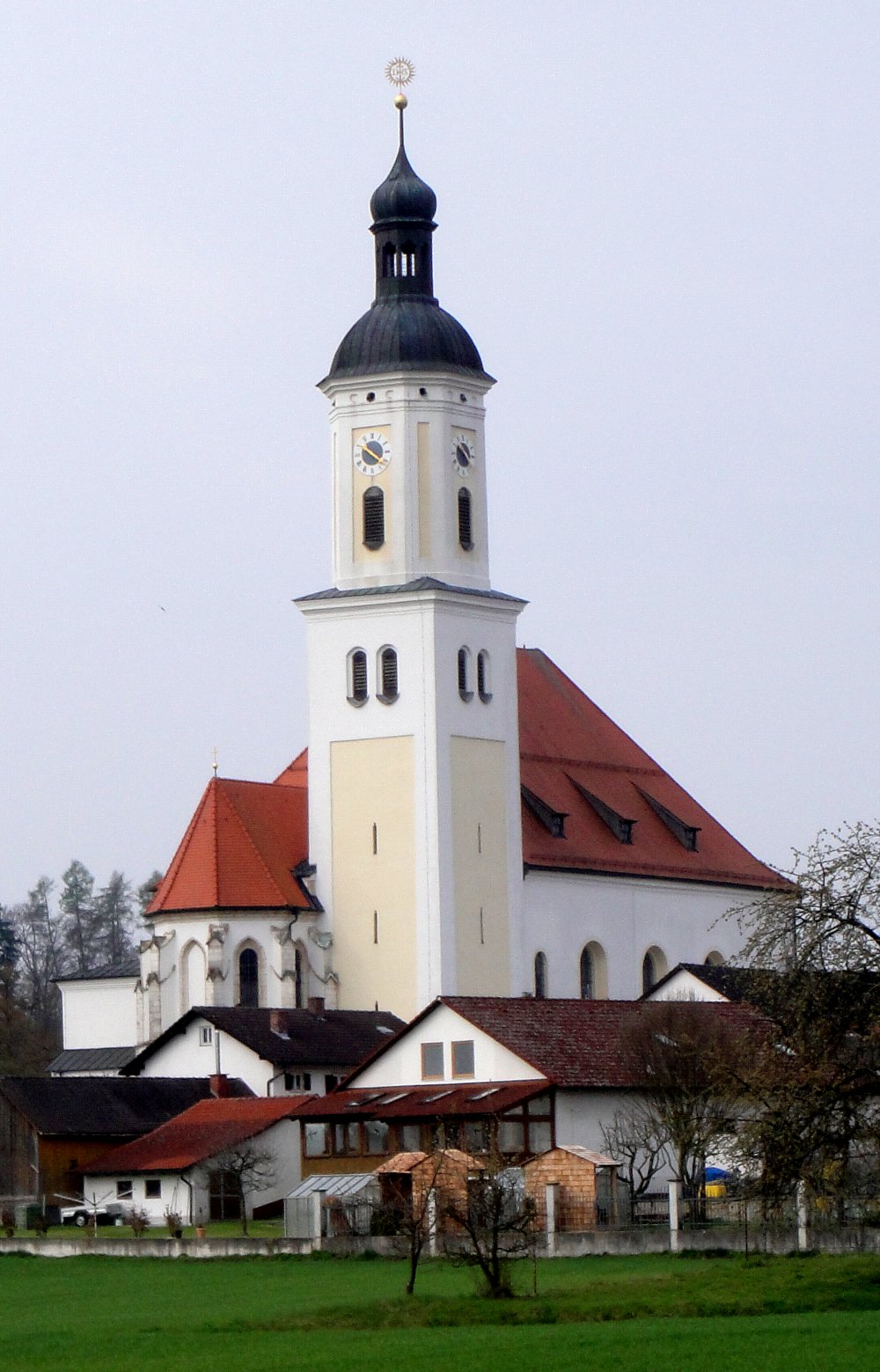
Stricken, he bent to pick it up and could not; the parish priest of Tholling, hastily summoned, could not either. At last they sent for Hartwig, Bishop of Regensburg, who came with his clergy, and only when he promised to build a chapel on that spot was the host raised. A wooden chapel was completed in 1125, the bishop gave it a small carved figure of Christ as King, and the host was kept there on the high altar until a fire in 1329–1330 destroyed chapel and relic together. The Salvator figure, 34 centimetres high and now fitted with silver heart, sceptre and orb from 1728, survived and became the object of devotion; the Gothic church that rose on the site (choir c. 1330, reworked c. 1460 by the cathedral master Konrad Roritzer) was replaced in 1774 by the present baroque church of Veit Haltmayr, under a 70-metre tower of 1681–1684.
Bettbrunn is documented as the oldest Eucharistic pilgrimage in Bavaria. Historians note that the 1125 date rests on the sixteenth-century booklet and that the event more probably belongs to the thirteenth or fourteenth century; but the pilgrimage itself is old beyond doubt — the church keeps what is called the oldest votive candle in Europe, given by pilgrims from Ingolstadt in 1378. Elector Maximilian I made the pilgrimage at seventy-nine in 1651; in 1754 groups came from nine cities, twenty-one market towns and 114 village parishes, and three years later 37,000 pilgrim communions were counted. Today more than sixty parishes still come each year, above all on Whit Monday, Trinity Sunday and the men's pilgrimage on the second Sunday of October, to the "Holy Saviour of Bettbrunn."