
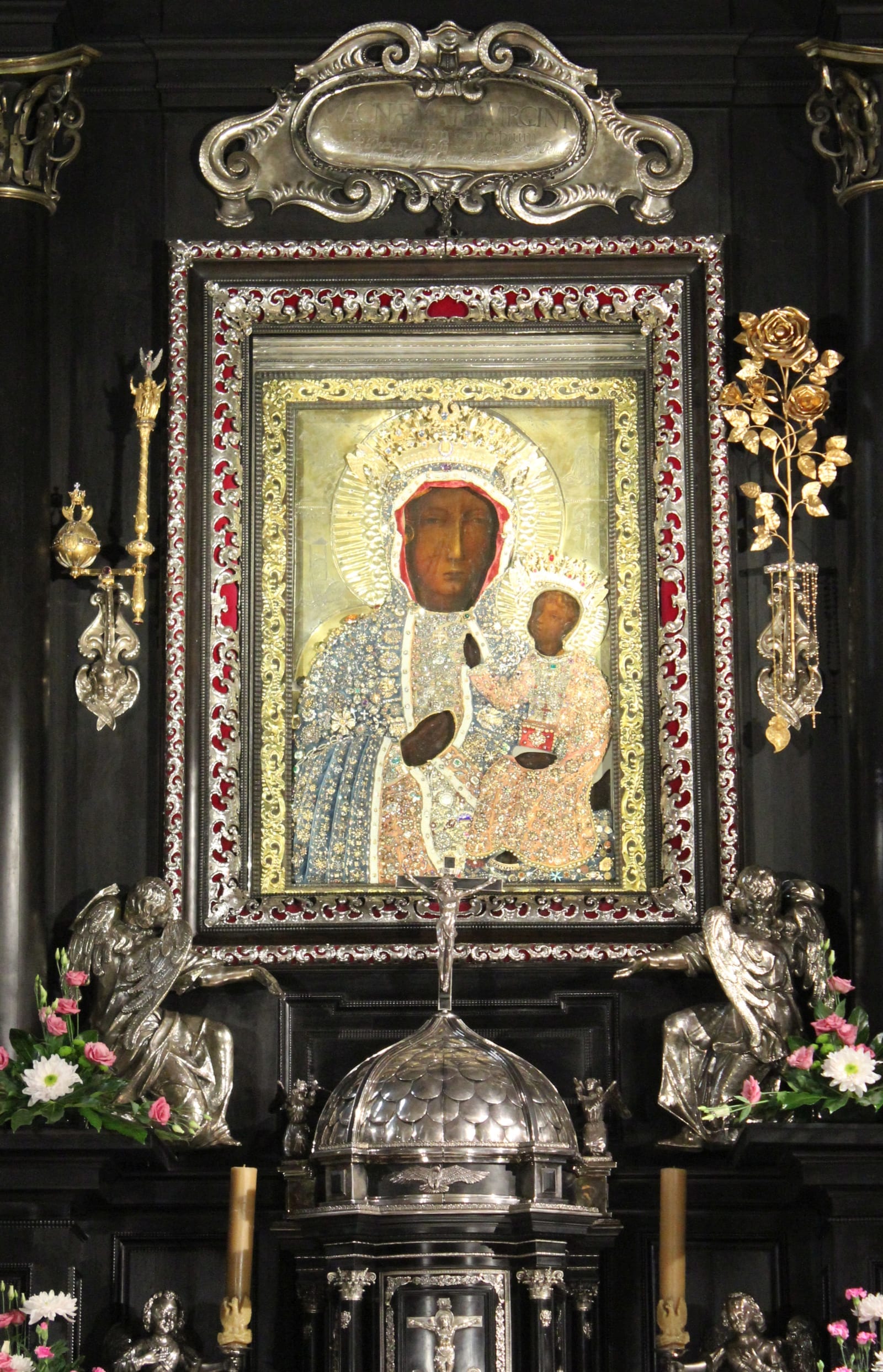
The Black Madonna is a panel icon of the Virgin Hodegetria type (Mary pointing to her Son as 'the Way'), in dark olive tones from age and centuries of candle smoke. Tradition holds it was painted by St. Luke the Evangelist on a cypress table from the Holy Family's house. Documentary history begins around 1382 when Prince Ladislaus of Opole entrusted it to the new Pauline monastery on Jasna Góra ('Bright Hill') outside Częstochowa.
In 1430 Hussite raiders sacked the monastery and slashed the icon's right cheek twice with a sabre — wounds that have refused, despite multiple restorations, to be permanently overpainted. In 1655 the monastery, defended by 70 monks and 250 soldiers, withstood the siege of a Swedish Lutheran army of 4,000 — a stand credited with turning the tide of the entire Swedish invasion of Poland. King Jan Casimir formally proclaimed the Black Madonna 'Queen of Poland' in 1656. She is the foremost national religious icon of the country; the 1979 visit of John Paul II to Jasna Góra drew the largest single religious gathering in the history of Poland to that time.