
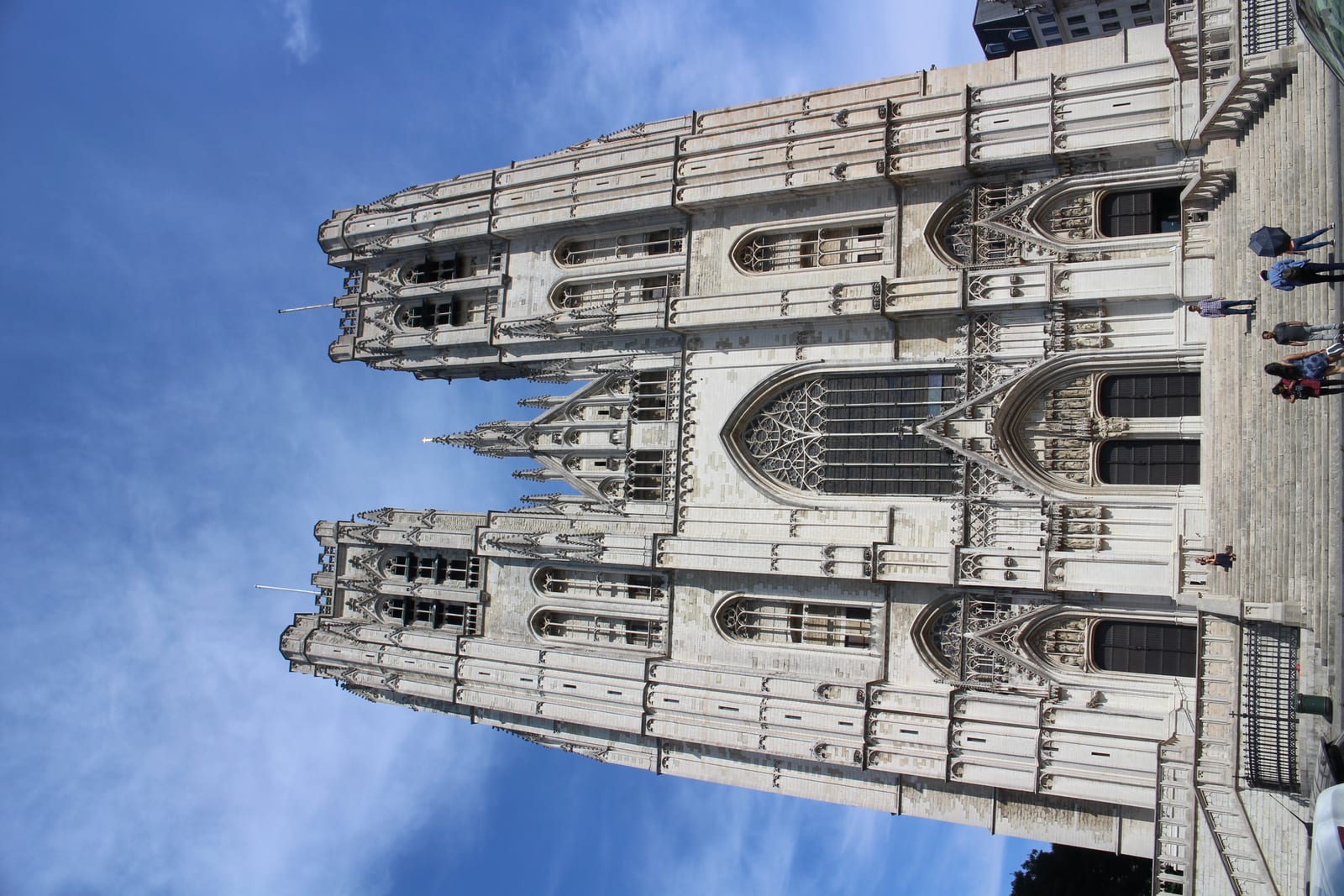
The story, as the Brussels exhibition panel and the cathedral's own windows tell it, runs thus: in 1369 a wealthy man of Enghien, Jonathas, had consecrated hosts stolen from the chapel of St. Catherine in Molenbeek with the help of a convert from Leuven; after his murder, the hosts passed to the Jewish community of Brussels, and on Good Friday 1370 they were said to have been pierced with knives and to have bled. A woman then reported the matter to the curate of Notre-Dame-de-la-Chapelle. On 22 May 1370, the eve of the Ascension, six accused were paraded through the city, tortured and burned alive at the Wollendries tower; the remaining Jews were banished and their goods confiscated. Chronicles count the dead at six, some at around twenty.
The hosts were carried to the collegiate church of St. Gudula and became the "Sacrament of Miracle," one of the great devotions of the Low Countries. Margaret of Austria instituted an annual procession in 1530; a Flamboyant Gothic chapel was built beside the choir in 1534–1539; Emperor Charles V and the Habsburgs gave seven windows by Jan Hack after Bernard van Orley and Michiel Coxcie, four of which survive, and further windows were added between 1436 and 1870. The 500th jubilee of 1870 was so contested between liberals and Catholics that the Church cancelled the celebrations. Reliquaries and eighteenth-century tapestries of the legend are still kept in the cathedral treasury.
It must be said plainly that the cult rested on a charge of host desecration of the kind levelled against Jewish communities across medieval Europe, and that the men and women burned in 1370 were innocent victims of it. In the wake of the Second Vatican Council's Nostra Aetate, the Archdiocese of Mechelen-Brussels formally withdrew its recognition of the cult in 1968, and Cardinal Suenens had a plaque placed in the cathedral in 1977 acknowledging the "tendentious character" of the accusations and the legendary nature of the "miracle." The reliquary no longer holds hosts. On 27 April 2026 Archbishop Luc Terlinden and Chief Rabbi Albert Guigui unveiled four plaques, in Dutch, French, English and Hebrew, asking forgiveness of the Jewish people. The exhibition retains Brussels as a witness to what was once venerated; this catalogue records it so that the victims are remembered with the dignity the cult denied them.