
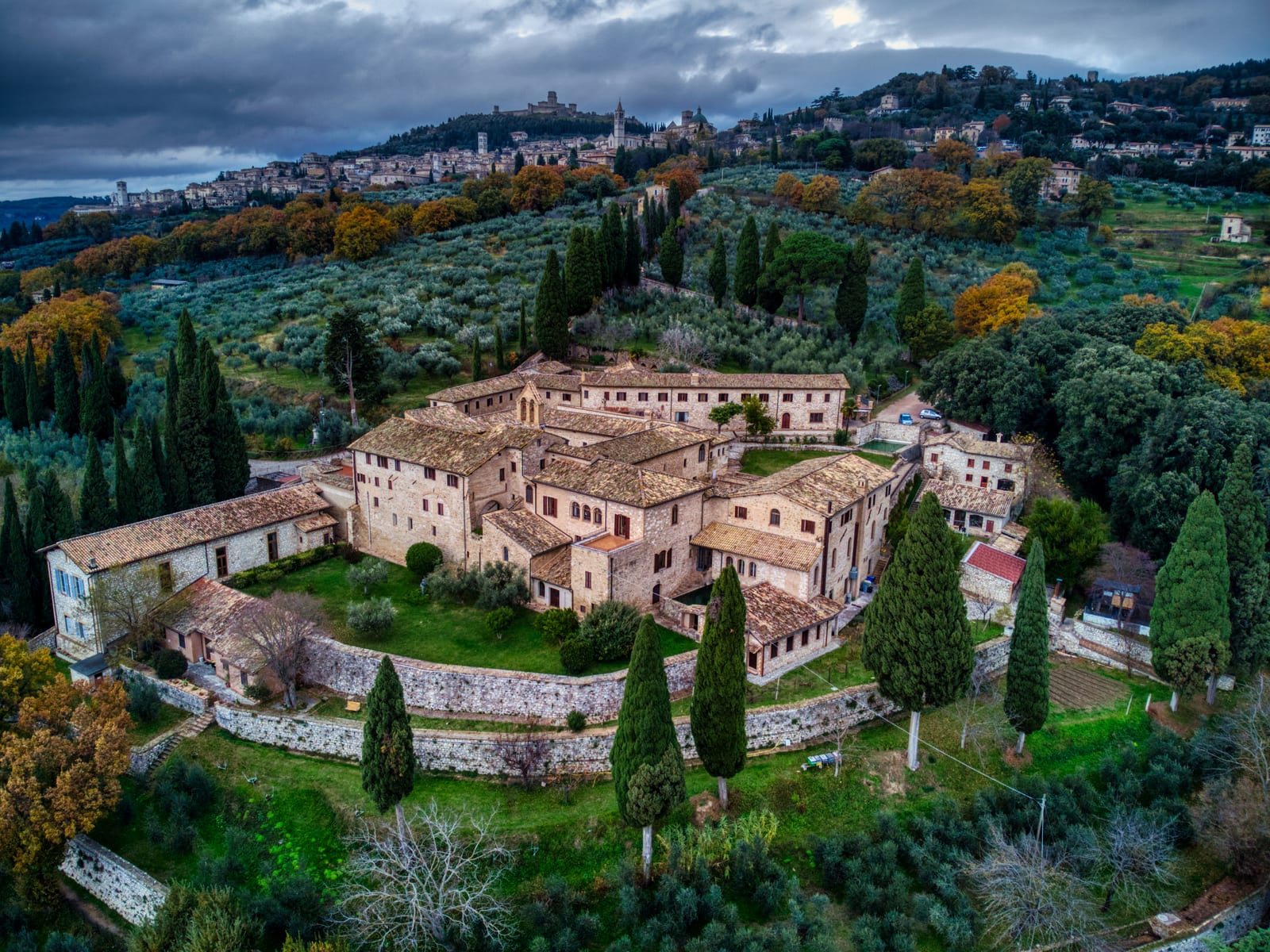
In September 1240 the Emperor Frederick II, at war with the papacy, had Muslim troops from his Apulian settlement of Lucera ranging through the Spoleto valley. On a Friday a company of these Saracen archers scaled the wall of San Damiano, the small monastery below Assisi where Clare and her Poor Ladies had lived since 1212, and pushed into the cloister itself. The sisters ran in terror to their mother, who was lying ill. The Legend of Saint Clare, written about 1255 and traditionally attributed to Thomas of Celano, says that Clare had herself led to the door and ordered the silver-and-ivory case holding the Body of Christ to be carried before her. Prostrate on the ground, she asked the Lord aloud whether he meant to hand his defenseless handmaids over to pagans.
According to the Legend, a voice like a child's answered from the tabernacle: 'I will always protect you.' Clare asked that the city too be protected, and heard: 'It will have to undergo trials, but it will be defended by my protection.' Turning to the sisters she told them they would suffer no harm if they had faith in Christ. The Saracens, the text says, took fright at the sisters' boldness and fled back over the walls they had climbed. Clare then ordered those who had heard the voice to tell no one of it while she lived. Sister Francesca repeated the story under oath in the canonization process of 1253, which makes this one of the best-attested episodes of Clare's life.
A second deliverance followed in June 1241, when the imperial captain Vitale d'Aversa laid siege to Assisi itself; Clare and her sisters prayed with ashes on their heads, and a violent storm scattered the besiegers. Assisi long kept both days as civic feasts. Later art, from the Cesari canvas in the Hermitage to the icons in the Basilica of Saint Clare, shows her holding a monstrance; the early sources speak only of a pyx or ciborium, and the monstrance is an anachronism of devotion rather than of history. San Damiano, today a Franciscan friary, still shows the refectory and dormitory where Clare lived and died in 1253; her body rests in the crypt of the basilica in the upper town.