
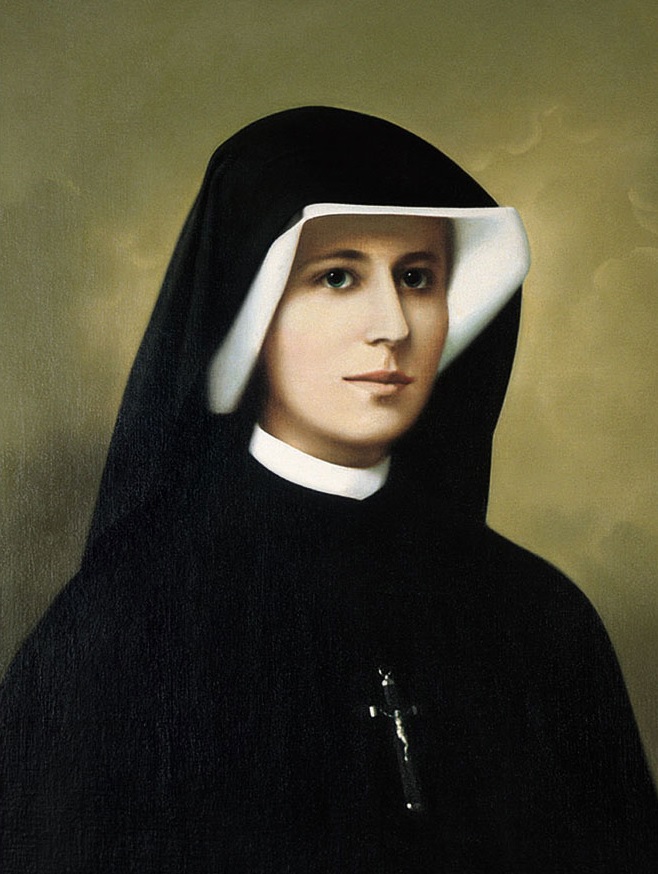
On the evening of February 22, 1931, Sister Maria Faustina Kowalska — a young Polish nun of the Sisters of Our Lady of Mercy, working as cook and gardener at the convent at Płock — saw a luminous figure in her cell. He was robed in white, His right hand raised in blessing, His left touching His garment near the breast, and from beneath the garment streamed two great rays: one red (blood), one pale (water). He said: 'Paint an image according to the pattern you see, with the signature: Jesus, I trust in You.'
In subsequent apparitions over the next seven years Christ added detailed requests: a Feast of the Divine Mercy on the Sunday after Easter, a Chaplet of the Divine Mercy (a prayer using rosary beads), the keeping of the 'Hour of Mercy' at 3:00 p.m. (the hour of His death), and the dissemination of the message of mercy. Faustina recorded the apparitions and the messages in a 600-page Diary kept under obedience. The Image was first painted in Vilnius by Eugene Kazimierowski in 1934; a second version was painted by Adolf Hyła in Kraków in 1944. After a 1959 temporary ban (lifted in 1978), Faustina was canonised by John Paul II in 2000 and the Feast of Divine Mercy instituted for the universal Church.