
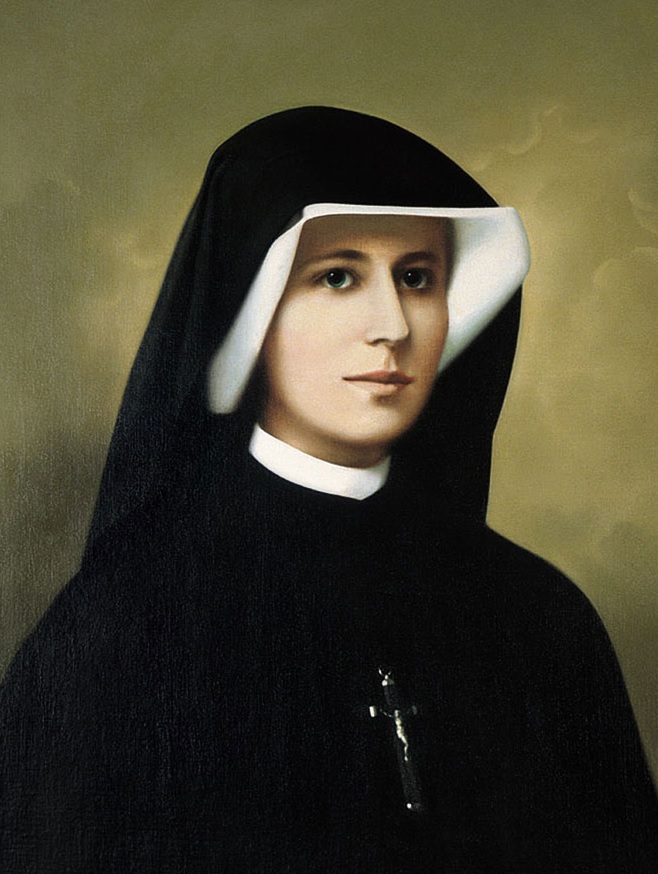
Helena Kowalska was the third of ten children of a poor Polish peasant family. At seven she felt an interior call to religious life; at sixteen she went into domestic service; at twenty she entered the Congregation of the Sisters of Our Lady of Mercy in Warsaw, taking the name Sister Maria Faustina of the Blessed Sacrament.
Her life as a religious was hidden: she worked as a cook, a gardener, a porter. But on February 22, 1931, in the convent at Płock, she received the first of a long series of visions of Christ — robed in white, with two great rays, one red and one pale, streaming from his pierced side. He said: 'I desire that this image be venerated, first in your chapel, and throughout the world.'
Under obedience she recorded six hundred pages of these visions in her Diary: Divine Mercy in My Soul, kept secret during her life. Christ revealed to her the Image of Divine Mercy (painted first in Vilnius in 1934 by Eugene Kazimierowski under her direction), the Chaplet of Divine Mercy, the Hour of Mercy (3:00 p.m.), and the Feast of Divine Mercy, to be celebrated on the Sunday after Easter.
She died of tuberculosis at thirty-three. Devotion to Divine Mercy spread quickly, but in 1959 the Holy Office placed her writings on a temporary ban — partly because of poor translations into Italian. The ban was lifted in 1978 with the personal intervention of Cardinal Karol Wojtyła. As Pope John Paul II he beatified her in 1993 and canonised her in 2000 — the first canonisation of the new millennium — and instituted Divine Mercy Sunday for the universal Church.