
In the summer of 1572, during the Dutch Revolt, the Watergeuzen or Sea Beggars in the service of the Prince of Orange seized Gorkum (Gorinchem) in Holland, the same town where nineteen Catholic priests and religious were martyred that July. The exhibition panel, following the Spanish tradition, calls the soldiers followers of Zwingli. They sacked the town's church, broke open the tabernacle with iron bars and seized the monstrance containing the Blessed Sacrament. The Host was thrown to the floor and one of the soldiers trampled it with a spiked boot, which pierced it in three places. From the three punctures, the account says, living Blood began to flow, and the marks set as three small round wounds that can still be seen on the Host today.
One of the profaners, struck with remorse at what he saw, warned the canon Jean (Jan) van der Delft, who managed to recover the Host and hide it; tradition adds that the penitent soldier later became a Franciscan. After various dangers and detours the relic passed into the hands of the Habsburgs, and in 1594 it was given to King Philip II of Spain, who entrusted it to the Hieronymite monks of his new monastery of San Lorenzo de El Escorial. Marble reliefs beside the present altar show the four stages of this story: the profanation, the profaner's conversion, Emperor Rudolf II holding the Host, and Philip II kneeling to receive it. Some Spanish accounts give 1592 for the gift; the panel and Dutch sources give 1594.
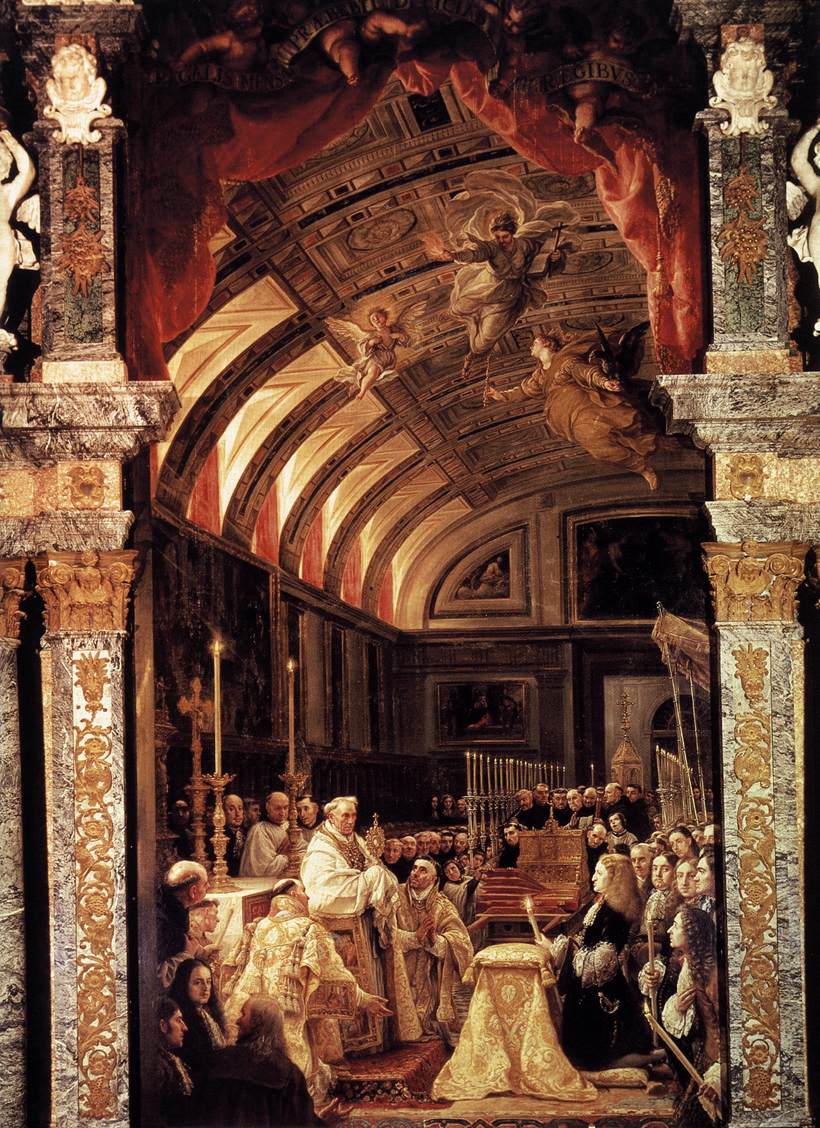
On 19 October 1684 King Charles II had the Host solemnly translated from the basilica to a new altar in the monastery's sacristy, in an act of reparation after the sanctuary had been violated by noblemen seeking refuge there. The king then commissioned Filippo Filippini's four bas-reliefs in marble and bronze and, from his court painter Claudio Coello, the great canvas La Sagrada Forma (1685–90), which portrays the 1684 ceremony with Charles II kneeling, the prior Francisco de los Santos holding the Host, and the court looking on. The painting is itself the door of the shrine: it slides on rails to uncover the nineteenth-century Gothic tabernacle by Vicente López in which the Host is exposed.
El Escorial historically kept two feasts of the Sagrada Forma, on 29 September and 28 October, with Mass and procession; today the Host is exposed on the last Sunday of September and on 28 October. The miracle has never been the object of a Holy See decree, but it has been venerated by the Spanish crown and the monastery's successive communities, Hieronymite and Augustinian, for more than four centuries, and the Host itself remains intact.