
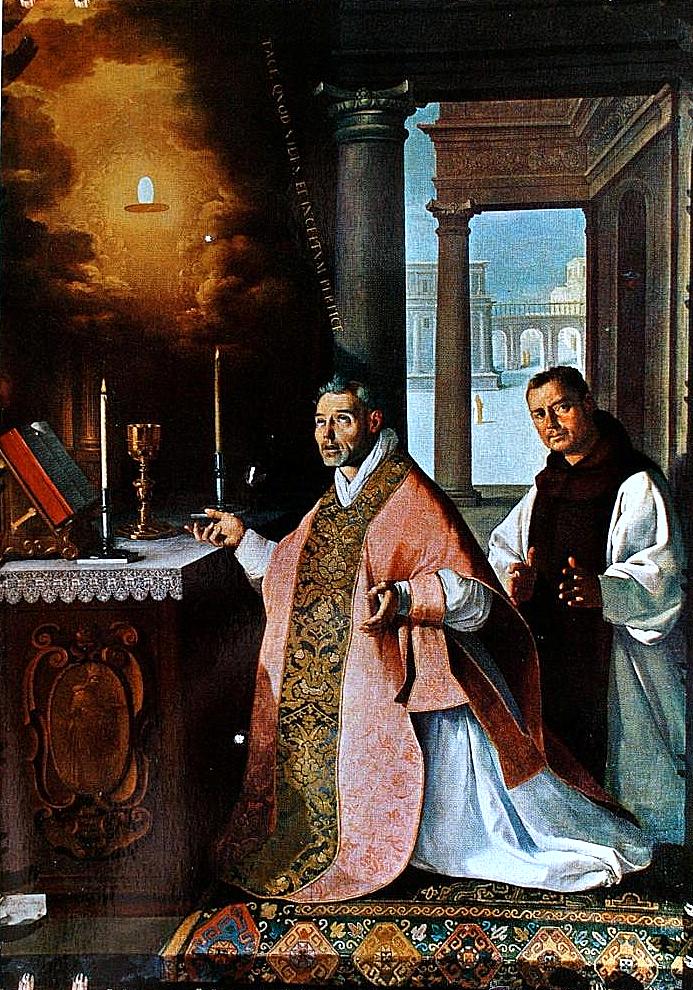
Fray Pedro de Cabañuelas, also called Pedro de Valladolid, entered the Hieronymite community of Guadalupe around 1389 and became known for long hours of adoration before the Blessed Sacrament by night and by day. Yet, as the monastery's own chronicles record, he was harshly tempted to doubt transubstantiation, and the doubt bit hardest at the altar. The Vatican exhibition panel places the resolution in 1420: celebrating his daily Mass, at the consecration he saw a dense cloud descend and settle over the altar so that he could no longer see the Host or the chalice. Weeping, he begged the Lord to take his doubts away. The cloud slowly thinned and showed him the Host suspended above the chalice, from which large drops of Blood fell, filling the cup until it spilled over onto the corporal and the pall.
A voice then told him to finish the Mass and, for the moment, to tell no one what he had seen. According to the catechetical account published by the Spanish bishops' conference, Cabañuelas himself later wrote the event down, and his brethren spread the news through Castile. In 1434 King Juan II, Queen María of Aragon and the young prince Enrique visited Guadalupe and were received by Cabañuelas, by then prior; the queen made him her confessor and in her testament asked to be buried beside him. She died in 1445 and lies in the basilica, where her son Enrique IV was later buried near her (the king himself rests at Miraflores). Cabañuelas died on 20 March 1441 with a reputation for holiness, and tradition honours him as 'Venerable', though no formal cause has been concluded.
The bloodstained corporal and pall (the starched linen that covers the chalice) are shown in the monastery's reliquary; in the seventeenth century they were examined before an apostolic notary and declared authentic, and in 1926 they were exposed for veneration at the National Eucharistic Congress in Toledo. In 1638 Francisco de Zurbarán painted 'The Mass of Fray Pedro de Cabañuelas' for the monastery sacristy, showing the kneeling friar transfixed while his server notices nothing. The account rests on the Hieronymite chronicles and the monastery archive rather than on any later episcopal inquiry, so the site presents it as a venerable local tradition supported by a well-documented relic.