
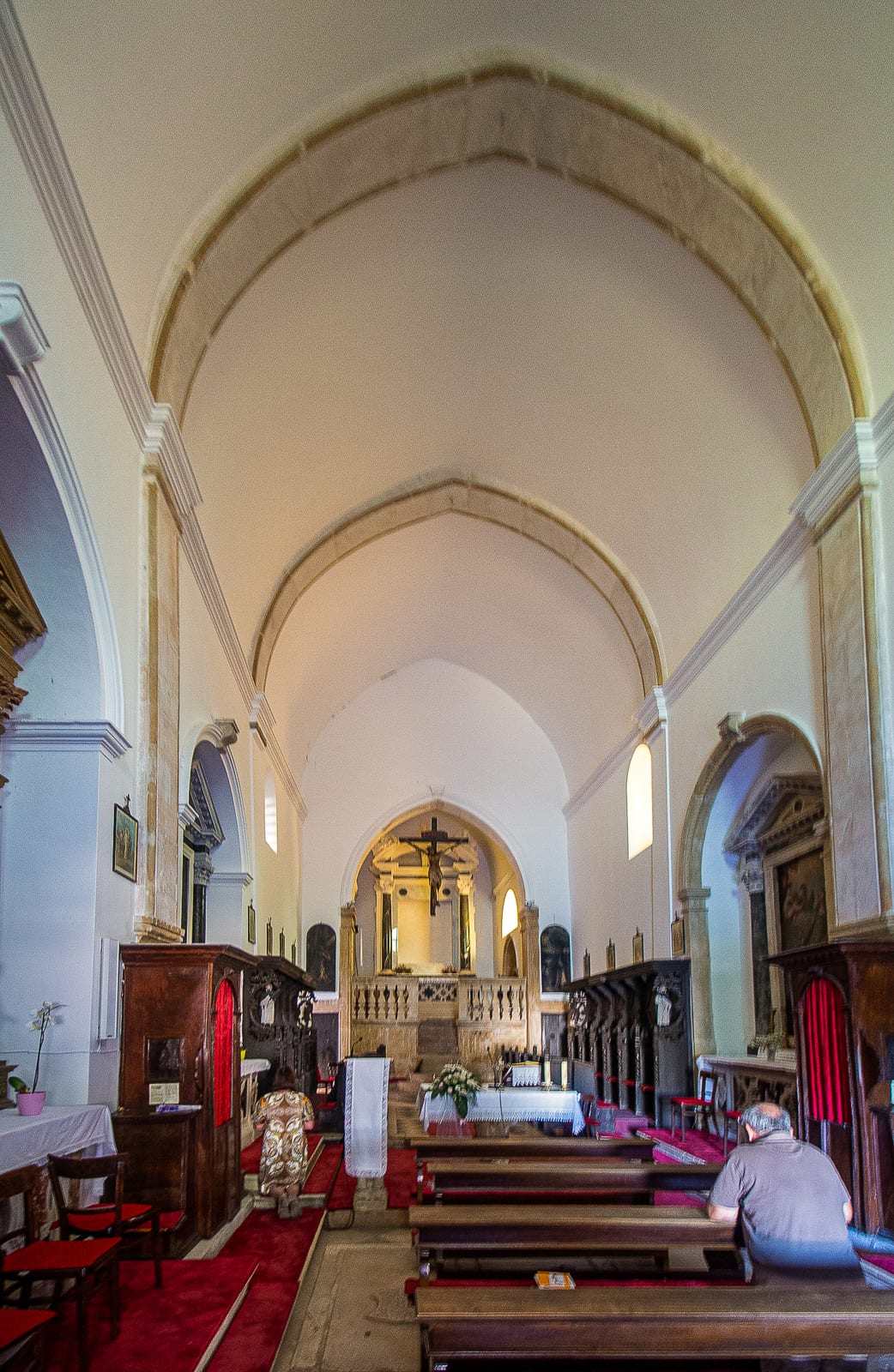
The Dominican convent of the Holy Cross stands on the north shore of the island of Čiovo, facing Trogir across the channel. It was founded in 1432 on the initiative of a Dominican of Trogir, Nikola Milinović, with the citizens of the town, under a bull of Pope Eugene IV and with the leave of the Venetian Doge Francesco Foscari; an inscription dates the church to 1499. The friars brought Albanian families to work the convent's land, and the village took its name, Arbanija, from them. The crucifix hangs beneath the triumphal arch of the church. Experts attribute it to the Split canon Juraj Petrović; a local legend has a hermit carve it from olive wood and carry it over the hills.
The Dominicans and the Croatian Catholic press tell of the miracle in the same few words: on Holy Saturday, 1 April 1600 — Easter fell on 2 April that year — blood dripped from the wounds of Christ on the crucifix, twice, first before a friar and then before the gathered faithful. Devotional retellings add more: that a lay brother tidying the church saw it and ran for the prior, that the bishop of Trogir would not believe the friars, and that Orthodox Christians from Trogir crossed by boat and watched under the cross through the night, when the blood flowed again and the head of the figure turned. Those details come without a cited record and are given here as the tradition gives them.
The bleeding is kept on Suhi petak, 'Dry Friday' — the first Friday after Ascension, prepared by a novena. The prior of the Dominican convent of Trogir blesses water and cotton and wipes, or 'dries', the wounds of the crucifix; the cotton and the water are given to the people to take home. The Dominicans call it a feast kept nowhere but on Čiovo. Pilgrims once came here above all on Good Friday and on Ascension Day, and a parish of Split still walks some thirty kilometres to the shrine in Lent. Silver ex-votos hang near the crucifix — praying figures, limbs, farm animals, even bees.
The friars left in 1852; Dominican sisters later ran a children's home here, and since 1957 the church has served the parish of Žedno-Arbanija. Fire burned two wings of the convent in 1928, and on the evening of 20 November 2024 fire destroyed the old wing; firefighters saved the church and the crucifix, and the Dominicans are rebuilding.
What is not claimed here: no notarial record, episcopal inquiry or judgement of the Church on the bleeding has been found; the full history of the convent (Stjepan Krasić, 1991) could not be consulted. Some Croatian sources say the church was declared a shrine 'by Pope Pius IX in 1939' — impossible, as Pius IX died in 1878 — and a seven-year indulgence of Eugene IV, who died in 1447, is sometimes linked to it; neither is repeated as fact.