
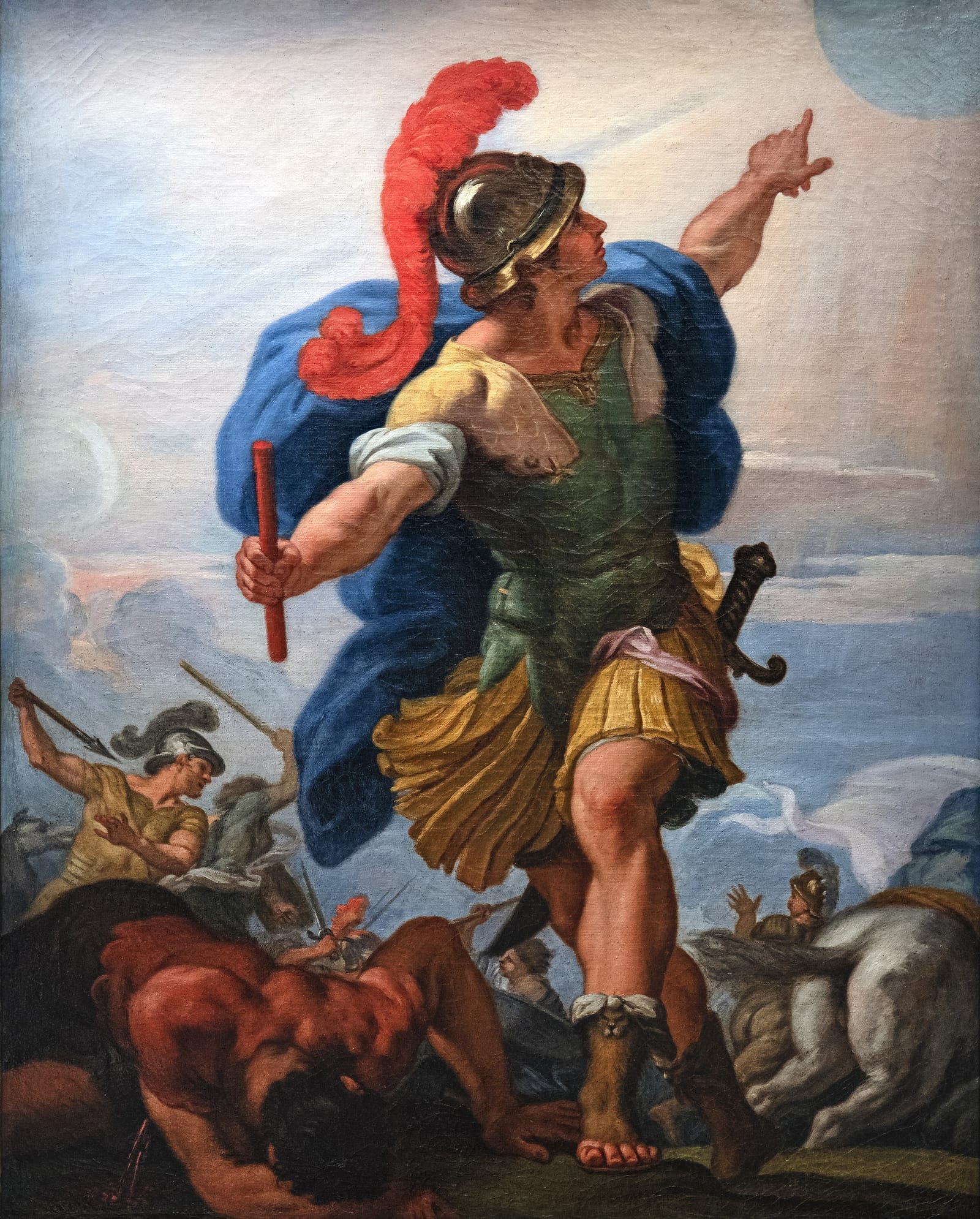
Five Amorite kings allied against the city of Gibeon, which had made peace with Israel. Joshua marched all night from Gilgal and fell upon them at dawn. The Lord 'threw them into a panic before Israel' (Joshua 10:10) and sent great hailstones from heaven that killed more of the enemy than the sword.
Then, with the day waning and the rout incomplete, Joshua spoke 'in the sight of Israel': 'Sun, stand still at Gibeon, and Moon, in the valley of Aijalon.' And the sun stood still, and the moon stopped, until the nation took vengeance on their enemies. 'There has been no day like it before or since, when the LORD heeded a human voice' (Joshua 10:12–14).
The site of Gibeon is identified with el-Jib, six miles north of Jerusalem, where a 1956 excavation by James B. Pritchard of the University of Pennsylvania uncovered a great pool-shaft and jar handles inscribed with the Hebrew GBʿN — confirming the identification. The Valley of Aijalon lies to the west, a corridor between the central highlands and the coastal plain.